What Is Filler Migration? Why Does Lip Filler Shift?
Filler migration is the shifting or spreading of an injected hyaluronic acid filler away from its original injection site into neighbouring tissues over time; it is most often noticed in lip filler as a “duck lips” or “sausage lips” appearance, with swelling and puffiness above the upper lip extending beyond the vermilion border. The same phenomenon can, less commonly, also be seen in other filler areas such as the nasolabial folds, chin and cheeks. So what exactly is filler migration, why does it occur, how is it distinguished from normal swelling and natural tissue spread, what symptoms indicate it and what are the treatment options? In this comprehensive guide, we address all these questions in detail.
What Is Filler Migration?
Filler migration is the condition in which hyaluronic acid injected under the skin gradually moves away from the injection point and spreads into neighbouring anatomical areas. This spread usually becomes noticeable within months, and sometimes over a longer period of one to two years. Migration is not the complete dissolution of the filler; it is a change in the position of the product. As a result, an asymmetric, unnatural or unexpected fullness appears on the face. Migration does not occur at the same speed or with the same severity in every patient or with every product; regional anatomy, tissue mobility and injection technique directly affect the course of this process.
Why Does Migration Occur?
Migration does not have a single cause; usually several factors come together. Injection at the wrong depth or in the wrong anatomical plane, the choice of a highly fluid or low-cohesivity product, excessive volume applied in a single session or in repeated sessions, constantly repeated facial movements and pressure, mechanical pressure applied to the area after the application, and the use of non-original or low-quality products are among the main causes of migration. Most of these factors can be significantly reduced through correct planning and the choice of the right practitioner; however, no application can offer a guarantee of zero risk.
Wrong Injection Depth and Planning
In the lip and facial area, tissue layers have different density and movement; the layer, depth and technique (bolus, linear, or cross-hatching) with which the filler is delivered directly affects the risk of migration. An overly superficial injection creates a ground on which the product can easily shift together with skin movement. In injections made too close to or crossing the vermilion border, it is more likely that the product will bulge onto the upper lip. For this reason, anatomical assessment and an injection plan made before the application are decisive for the safety of the outcome.
How Does Product Choice Affect Migration?
Hyaluronic acid fillers have different levels of fluidity (viscosity) and cohesivity (the tendency of molecules to stay together). Very fluid, low-cohesivity products can spread easily in the tissue; while this feature gives the desired soft result in some areas, it can increase the risk of migration in mobile, thin-tissued areas such as the lip. Correct product choice should be made according to the anatomy of the area to be treated and the desired result. Products specifically formulated for the lips, with balanced cohesivity, can help reduce this risk, but do not constitute a guarantee on their own.
Excessive Volume and Repeated Applications
When the volume injected in a single session exceeds the tissue’s carrying capacity, the filler can be pushed under pressure into neighbouring areas. Having filler repeated in the same area at short intervals can cause the new product to accumulate together with what remains from the previous application, leading to an uncontrolled increase in total volume. Over time this accumulation puts strain on the natural boundaries of the tissue, creating a ground for migration. For this reason, gradually increasing volume and leaving sufficient waiting time between sessions are among the basic principles of a safe application.
Facial Movement and Pressure Effects
The lip is one of the most mobile areas of the face; it contracts continuously during speaking, smiling, kissing and chewing. This repeated mechanical movement can contribute over time to the injected product shifting from its original position. Similarly, sleeping position, the habit of sleeping face-down, or frequent external pressure on the area (for example mask use, hard contact) are also considered among the factors that may accelerate the migration process. These effects alone do not necessarily cause migration, but when combined with an unsuitable technique or product, they can increase the risk.
Risk of Non-Original / Low-Quality Products
The content and purity of hyaluronic acid products that are not approved by health authorities, not original, or uncertified cannot be reliably verified. Particle size, degree of cross-linking and cohesivity in such products may be substandard; this increases the risk not only of migration but also of other complications such as inflammation, granuloma or allergic reaction. Filler applications being performed only by an experienced physician, with registered and approved products, is the basic safety measure that significantly reduces this risk.
What Is the Difference Between Migration and Swelling/Oedema?
The swelling seen in the first days after a filler application is a natural tissue response to the injection and usually reduces markedly within a few days. Migration, on the other hand, is a persistent and gradually increasing displacement that appears weeks or months later; it should not be confused with early-stage swelling. Swelling is symmetric and temporary, whereas migration usually begins asymmetrically and does not regress on its own. Timing and course are the most important clues for distinguishing the two conditions. We discuss the normal swelling and bruising process after filler in detail in this article.
What Is the Difference Between Migration and Natural Tissue Spread (Hydration)?
Hyaluronic acid has the property of binding water; within the first week after the application the product can absorb water and slightly plump up, giving a soft feeling of spreading into neighbouring tissue. This is different from migration, a temporary and expected process that stabilises within a few weeks. In migration, however, the spread increases over time, its boundaries become pronounced and it progresses in a way that disrupts the natural contour of the tissue. Because it can be difficult for patients to distinguish these two conditions on their own, an assessment in doubtful cases must always be made by a physician.
Migration in Lip Filler: Duck Lips / Sausage Lips Appearance
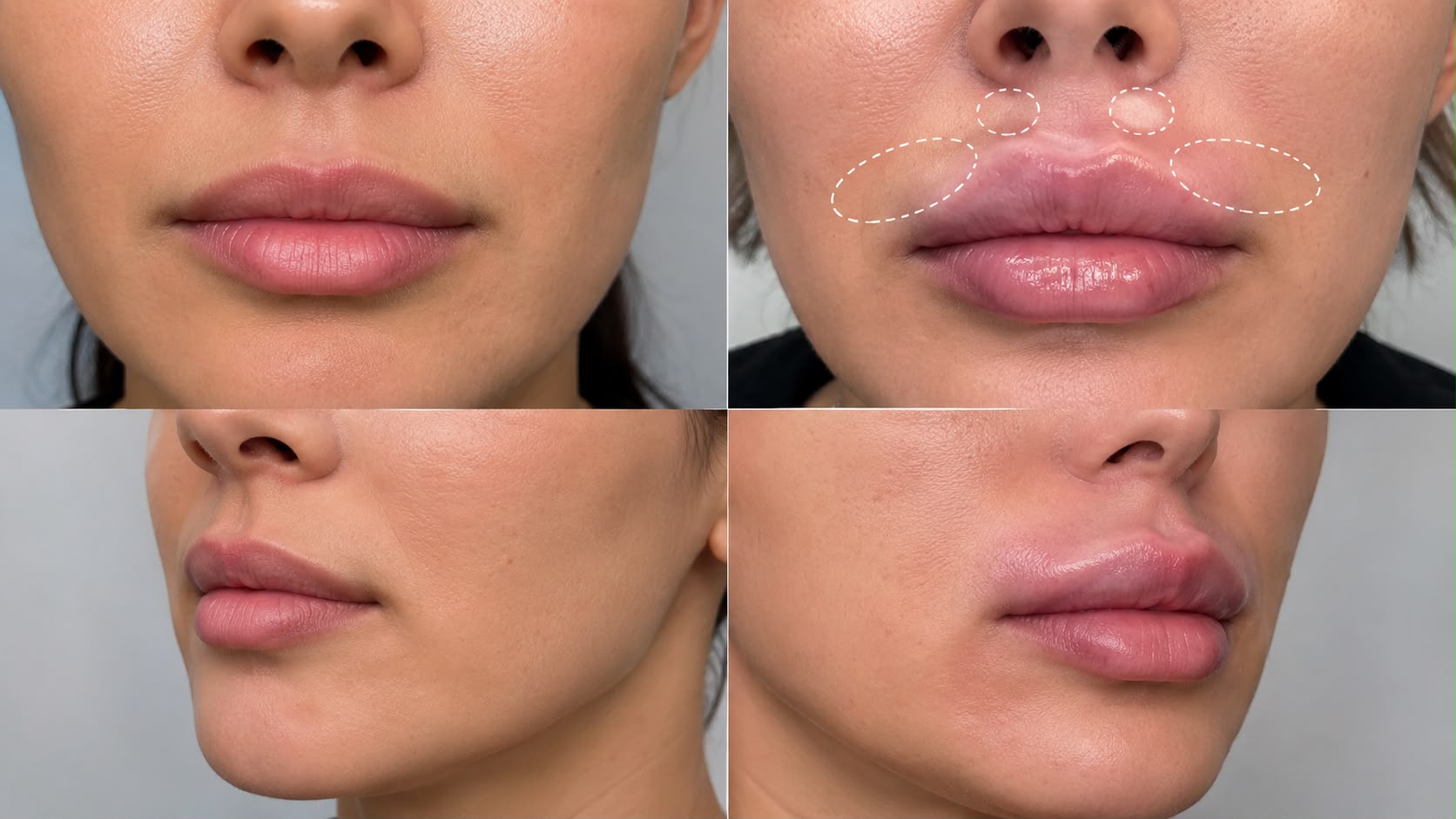
The most common clinical picture of migration in lip filler is the product spreading beyond the vermilion border of the upper lip towards the area below the nose; this appearance is popularly called “duck lips” or “sausage lips”. The natural Cupid’s bow contour of the lip disappears, and the upper lip looks disproportionately swollen and flattened. This picture is usually associated with excessive volume, incorrect depth or the use of a low-cohesivity product. One of the approaches that reduces this risk in lip filler applications is techniques that stay faithful to the natural anatomical boundaries of the lip and increase volume gradually.
Why Does Swelling Occur Above the Upper Lip?
Swelling above the upper lip usually occurs when the product shifts towards the philtrum area above the Cupid’s bow or towards the base of the nose. The tissue in this area is thin and mobile; in injections that are poorly planned or made too superficially, the product tends to be pushed in this direction. As a result, an irregular fullness forms on the upper edge of the lip that becomes even more noticeable with smiling. This appearance can create both aesthetic and functional discomfort (a feeling of tightness while speaking or smiling) and usually requires physician assessment.
What Are the Symptoms of Migration?
The main symptoms suggesting filler migration are: firmness or fullness felt outside the injection site, in a neighbouring area; asymmetry that increases over time and does not regress on its own; blurring of the natural boundaries of the lip contour; irregular bumps or nodules felt under the skin by hand; and fullness that becomes more noticeable with facial movement and does not disappear at rest either. If one or more of these symptoms are noticed, it is recommended to consult a physician rather than waiting on the assumption that it will resolve on its own.

Filler Migration in the Nasolabial Area
Migration in nasolabial fold filler can present as the product shifting towards the side of the nose or the lower cheek area; this situation is noticed as unexpected fullness or a contour irregularity on the face. The nasolabial area is a region where facial muscles work intensively; for this reason injection depth and technique are also of great importance here. Layer-appropriate injection performed by an experienced physician in nasolabial filler applications is one of the fundamental approaches that reduces the risk of migration.
Migration Risk in the Chin and Cheek Area
Although the chin and cheek area is less mobile than the lip, migration can be seen in injections at the wrong depth made too close to the bone structure or too close to the muscle layer. The product shifting towards the lower lip at the chin tip, or towards the under-eye area at the cheek, are among the pictures that have been reported, albeit rarely. In applications planned close to the bone, such as chin filler, a controlled injection technique close to the periosteal level helps to limit this risk.
Which Areas Carry the Highest Migration Risk?
Migration risk increases in direct proportion to the mobility and anatomical thinness of the tissue. For this reason, thin and mobile-tissued areas such as the lip and under-eye area, and areas where facial muscles work intensively, such as the nasolabial fold, carry a relatively higher risk. In more fixed, bone-adjacent areas such as the chin tip, cheekbone and temple, the risk is relatively lower, although it is not zero. Sharing area-specific risks openly with the patient before the application is an important part of building realistic expectations.
When Should You Consult a Doctor?
A physician should be consulted without delay when a new fullness is noticed outside the injection site, when this fullness grows over time, when firmness or a nodule is felt in the tissue, when marked asymmetry develops on the face, or when there is serious dissatisfaction with the aesthetic result. If signs of infection such as pain, redness or increased warmth accompany these findings, consultation is even more urgent. Early assessment facilitates both making a correct diagnosis and applying treatment options through less invasive means.
How Is Filler Migration Diagnosed?
Diagnosis begins first with a detailed patient history (which product, when, how many times, where it was applied) and a clinical examination. The physician assesses the boundaries, firmness, symmetry of the fullness and its relationship with facial movement. In cases deemed necessary, ultrasound imaging clearly reveals the exact location, depth and relationship of the filler with neighbouring tissues; this allows the treatment plan to be built correctly. Ultrasound is also an important tool for distinguishing migration from other possible causes (granuloma, cyst, oedema).
Dissolving Treatment With Hyaluronidase
When migration is detected, the most commonly used treatment method is injecting the hyaluronidase enzyme, which breaks down hyaluronic acid, into the relevant area. This procedure aims to partially or completely dissolve the shifted filler; afterwards, if necessary, filler can be reapplied in a controlled manner with the correct technique. Hyaluronidase application is also a procedure that requires experience; the dose and injection site are determined by the physician according to the extent of the migration. We explain in detail what hyaluronidase is and in which situations it is used in this article.
Waiting and Observation Approach
If the severity of the migration is mild and it does not create a serious aesthetic or functional discomfort for the patient, the physician may in some cases first recommend an observation approach. Hyaluronic acid fillers are naturally broken down by the body over time; in mild migration cases this natural process can resolve the problem on its own as the product is completely eliminated. However, this approach is not suitable for every patient, and the decision should be made based on the physician’s clinical assessment; self-diagnosing and waiting is not recommended.
Correcting Migration With a Technical Adjustment
In some cases, instead of dissolving the filler completely, contour correction can be made with additional, balancing injections placed around the remaining product. This approach may be preferred especially in cases where migration is limited and mild. The goal is to restore the natural symmetry and contour of the tissue. Which method (dissolving, observation or technical correction) will be applied is determined by taking into account together the extent of the migration, the patient’s expectation and the physician’s clinical assessment.
Choosing the Right Practitioner to Prevent Migration
One of the most important steps in reducing the risk of migration is having the application performed by an experienced and certified physician who has a good command of facial anatomy. The right practitioner creates a personalised injection plan based on the patient’s tissue structure, facial proportions and facial movement habits; avoids excessive volume and, when necessary, acts on the principle that “less is more”. Adherence to clinical hygiene standards and the use of approved products are also inseparable parts of this process.
How Should the Right Product and Technique Be Chosen?
Choosing a product with viscosity and cohesivity suitable for the area is one of the basic factors that reduces migration risk; more cohesive products are preferred in mobile areas such as the lip, while softer products are preferred in thin areas such as under the eyes. Injection technique is equally important: techniques such as micro-bolus, linear retrograde or cross-hatching are chosen according to the area, and excessive pressure is avoided. Those who want to obtain general information about filler applications can review the variety of products and techniques on this page.
Common Misconceptions About Migration
The idea that “migration only happens in bad clinics” is not entirely correct; even with the correct technique, migration can rarely occur, and what matters is minimising the risk. The belief that “migration is always permanent” is also incorrect; many cases can improve with hyaluronidase or natural breakdown. Another misconception is the idea that “every fullness is migration”, whereas most swelling is temporary and normal. Because these misconceptions can lead to either unnecessary anxiety or, conversely, neglect, an assessment based on clear information is always the most reliable path.
Recovery Process After Migration Correction
After a hyaluronidase application, mild swelling and redness lasting a few days may be seen in the area; this is a natural response to the procedure and usually subsides within a short time. If a technical correction has been performed, the healing process progresses in a manner similar to a standard filler application. In the period after treatment, protecting the skin from the sun, avoiding heavy exercise and following the physician’s care instructions support the stabilisation of the result. Follow-up appointments are important for assessing whether the correction has been successful.
What Should Realistic Expectations Be?
Filler migration is a possibility whose risk can be significantly reduced with the right practitioner and the right technique, but which cannot be reduced entirely to zero. For this reason, absolute promises such as “migration will never happen” should be avoided; the patient should be informed realistically about the process. A well-planned application, regular follow-up and early intervention allow the result to be managed effectively even if migration occurs. Expectation management is a decisive element for both patient satisfaction and a safe treatment process.
How Is Migration Distinguished From Vascular Occlusion?
Migration is a slow-progressing, painless cosmetic change usually noticed within days to weeks, whereas vascular occlusion is an emergency caused by the filler blocking or compressing a blood vessel, presenting as sudden, severe pain, paleness, a purple-white colour change and coldness in the tissue. If vascular occlusion is suspected, intervention is needed within hours; therefore, if unexpected severe pain or colour change is noticed after a procedure, the clinic should be contacted without delay. Migration, on the other hand, carries no such urgency, and a planned assessment is sufficient. This distinction matters both so the patient can take the right step without panicking and so that genuine emergencies are managed without delay.
Can Filler Be Reapplied After Migration Is Corrected?
Once migration has been dissolved with hyaluronidase and the tissue has returned to normal, patients who wish to can have filler reapplied after waiting a few weeks. This time, the injection plan is adjusted based on the cause of the previous migration: depth is corrected, a more cohesive product is preferred, and volume is given in smaller increments spread across multiple sessions. Follow-up frequency is also increased for patients with a history of migration; check-up examinations are planned in the first months to catch any recurrence early. In some patients, migration risk may remain permanently elevated due to tissue structure and facial-movement habits; in such cases, a smaller-volume approach refreshed at more frequent intervals may be preferred.
Are There Ways to Notice Migration Early at Home?
Patients can notice early changes by regularly observing the symmetry, border clarity and texture on touch of the lip or treated area in front of a mirror. Findings worth noting include a persistent swelling above the upper lip’s vermilion border that is visible even without facial movement, one side of the area looking noticeably different from the other, or a firm, irregular bulge felt on touch. Photo comparison is also useful; comparing photos taken a few weeks and a few months after the procedure can reveal slow changes that are not visible to the eye. When a suspicious finding is noticed, a check-up examination should be scheduled rather than self-diagnosing.
How Long Does It Take for Migration Treatment to Show Results?
After a hyaluronidase injection, dissolution of the filler usually begins within hours, and the true result becomes clear within a few days as the swelling settles; in some patients, full tissue recovery may take one to two weeks. When the waiting-and-observation approach is chosen, the process can take weeks, since the aim is for the filler to reduce at its own natural breakdown rate. When a technical correction (balancing symmetry with a small amount of additional filler in the area) is chosen, results are usually seen immediately after the procedure, though the final appearance requires the swelling to subside. Whichever method is chosen, at least two to three weeks are needed to properly evaluate the result.
What Should Be Watched in the First 48 Hours After the Procedure?
The most critical period for reducing migration risk is the first 48 hours, before the filler has fully settled into the tissue. During this time, it is recommended not to apply unnecessary pressure to the area, not to sleep face-down, and not to wear masks, glasses or other accessories that press firmly and continuously on the area. Hot environments (saunas, steam rooms) and intense exercise are also postponed, as they can increase tissue swelling and raise the likelihood of the product shifting. The area should not be massaged without the doctor’s approval, as this could move the product in an unwanted direction. These simple precautions alone do not fully prevent migration, but combined with the correct technique they noticeably reduce the risk.
The Approach to Filler Migration at Zen Polyclinic
At Zen Polyclinic, filler applications are carried out with a personalised plan that assesses the patient’s facial anatomy, tissue structure and expectations; approved products, controlled volume and a technique suitable for the area are preferred in order to reduce migration risk. For patients presenting with suspected migration, a detailed examination, ultrasound assessment when necessary, and patient-specific treatment options (hyaluronidase, observation or technical correction) are offered. The same careful approach applies in our clinic in Istanbul Ataşehir. You can reach us for an assessment through our appointment page.
Conclusion
Filler migration is the condition in which injected hyaluronic acid shifts over time from its original application site into neighbouring tissues, most often noticed in lip filler as a duck lips or sausage lips appearance; it can also be seen in other areas such as the nasolabial folds, chin and cheeks. Incorrect injection depth, an unsuitable product choice, excessive volume and the use of low-quality products are the main risk factors. Migration that is noticed early can be effectively managed with methods such as dissolving with hyaluronidase or technical correction. The most reliable way to minimise the risk is through an application performed by an experienced physician, with the right product and technique, and with realistic expectations.
Frequently Asked Questions (FAQ)
What is filler migration?
Filler migration is the shifting or spreading of an injected hyaluronic acid filler from its original site into neighbouring tissues over time. It is not complete dissolution of the product but a change in its position, and it usually becomes noticeable within months.
Why does filler migration occur?
Incorrect injection depth or planning, choosing a highly fluid or low-cohesivity product, excessive volume, repeated applications, facial movement and pressure, and the use of non-original or low-quality products are among the main causes.
Is a 'sausage lips' appearance after lip filler migration or normal swelling?
Swelling seen in the first days is temporary and usually subsides within a few days. Migration, on the other hand, appears weeks or months later, does not regress on its own and increases over time; a physician’s assessment is needed in doubtful cases.
What are the symptoms of filler migration?
Firmness or fullness felt outside the injection site, asymmetry that increases over time, blurring of the lip contour, irregular bumps felt by hand, and persistent fullness that becomes more noticeable with facial movement are the main symptoms.
Can filler migration be treated?
Yes. Depending on the severity of the migration, the physician may apply dissolving with the hyaluronidase enzyme, an observation approach, or technical correction (contour balancing).
Does hyaluronidase completely remove migration?
Hyaluronidase aims to partially or completely dissolve the shifted filler; the outcome depends on the extent of the migration and the dose used. A physician’s assessment is required for a definite result.
In which filler areas is migration more common?
Thin and mobile areas such as the lip and under-eye area, and areas where facial muscles work intensively such as the nasolabial fold, carry a relatively higher risk; the risk is lower in bone-adjacent areas such as the chin and cheek.
What can be done to prevent migration?
Choosing an experienced and certified physician, using an approved product and technique suitable for the area, increasing volume gradually and leaving sufficient time between sessions significantly reduce the risk, although zero risk cannot be guaranteed.