
LED Mask Skin Care
A light-based skin care application that supports collagen production, targets the bacteria involved in acne and helps calm inflammatory response — without heat and without abrasion.
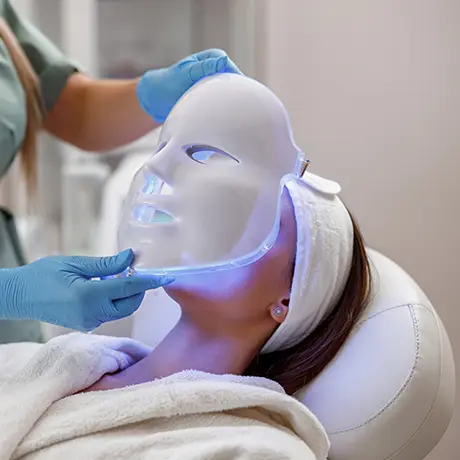
What is an LED mask and how does it work?
An LED mask is a skin care application that exposes the skin to light at specific wavelengths in order to produce a response at cellular level. It involves no heat and no abrasion; its effect comes from the way light is absorbed within the layers of the skin. Because nothing is injected and nothing is removed from the surface, the session is painless and there is no recovery period afterwards.
The colour of the light determines how deep it travels and what it acts on:
- Red light (around 630 nm) reaches the deeper layers and stimulates fibroblasts, the cells responsible for producing collagen. This is why red light is chosen when the goal is skin texture and firmness.
- Blue light (around 415 nm) stays closer to the surface and acts on the bacteria that play a role in the formation of acne.
- Near infrared light travels deepest of all and is preferred for supporting tissue repair and calming an inflammatory response.
In practice a single wavelength or a combination of them is selected according to skin type and the goal of the session. At Zen Polyclinic the LED mask is planned after a skin assessment rather than applied as a fixed, identical programme for everyone.
Which skin concerns is it chosen for?
Active acne. Because of the effect blue light has on the bacteria involved in acne, an LED mask may be used as a support alongside a dermatological treatment plan. It is not an acne treatment on its own and does not replace prescribed medication.
Redness and sensitivity. Red and near infrared light help to calm an inflammatory response, which is why the application is also chosen for skin that looks reactive or is red after another procedure.
Loss of collagen and fine lines. Red light stimulates fibroblasts and over time contributes to the recovery of skin texture. The effect is gradual and cumulative; a visible change should not be expected from a single session.
Healing after other procedures. Following dermapen, peeling or laser applications, an LED mask is frequently used to support the skin during the healing phase.
Uneven tone and dullness. As circulation in the treated area increases and the inflammatory picture settles, the skin often looks more even and less tired. This is a supportive effect rather than a substitute for pigmentation treatments.
How does a session proceed?
Assessment and planning. Skin type, current concerns and any medication in use are reviewed, and the wavelength is selected according to the goal. Sessions are usually planned as a course spread over several weeks rather than as a single appointment.
Cleansing. Make-up, sunscreen and the sebum layer on the face all prevent light from reaching the skin, so every session starts with cleansing.
Application. The mask is positioned and the selected programme runs. Protective eyewear is worn. There is no pain, no burning and no stinging sensation; most people describe only a mild warmth.
Afterwards. A moisturiser and, when needed, sunscreen are applied. There is no waiting period and daily life continues immediately.
Who is it not suitable for?
An LED mask is a low-risk application, but it is not appropriate for everyone:
- People with photosensitivity
- People using photosensitising medication — including some antibiotics and isotretinoin
- People diagnosed with epilepsy, as flashing light may be a trigger
- People with an active skin infection in the treatment area
- People who are pregnant or breastfeeding
Please share the medication you use and your current skin condition before the session. If you have a diagnosed skin disease or are under dermatological follow-up, the application should be planned together with your own physician.
When do results become visible?
The effect is a cumulative one. In the first days the most noticeable change is in redness and sensitivity; where blue light is used for acne, a settling of the inflamed appearance is generally noticed within the first three or four sessions.
Collagen-related effects become clearer once the course is complete. Because the response of the tissue to fibroblast stimulation takes time, changes in fine lines and skin firmness appear last and may continue to develop for four to six weeks after the final session. How pronounced the change is differs from person to person and depends on age, skin condition and daily skin care habits.
Using it alongside other applications
An LED mask can be used on its own, but it is most often planned as a complement to another application. Calming the skin after Hydrafacial and supporting recovery after dermapen are the most frequently chosen combinations. Where injectable procedures are involved, an interval is usually left before the LED session and the timing is decided during planning.