
The Facial Aging Process
Facial aging is not a single change on the surface of the skin. Bone, fat, muscle and skin all change at different speeds, and each layer calls for a different kind of approach.

What actually changes as the face ages?
When people describe an ageing face, they usually mention wrinkles. Wrinkles, however, are the last chapter of a longer story. The face is built in layers — bone, deep and superficial fat compartments, muscle and connective tissue, and finally the skin — and every one of those layers changes with time. The visible result, a face that looks tired, flatter or heavier along the lower border, is the sum of all of them.
Understanding which layer has changed most in a particular face is the reason a consultation begins with an assessment rather than a treatment. Two people of the same age can look different for entirely different structural reasons, and the approach that helps one may do very little for the other.
Bone: the framework that quietly recedes
The facial skeleton is not a fixed scaffold. Bone is living tissue that remodels throughout life, and in the face the balance gradually shifts toward resorption. The changes are not uniform: the eye sockets tend to widen, particularly along the upper inner and lower outer rims; the midface skeleton and the bone supporting the upper jaw lose projection; and the angle of the jaw becomes less defined.
Because everything above sits on this framework, even a small loss of projection has visible consequences. The soft tissue that used to be supported now has less to rest on, so it settles downward and inward. This is why the eye area can look hollow and the midface flat long before the skin itself shows significant damage.
Fat: not simply lost, but redistributed
Facial fat is not one continuous cushion. It is organised into distinct compartments, separated by connective tissue, sitting at both deep and superficial levels. These compartments do not age at the same rate.
The deep compartments — especially those in the midface and around the eye socket — tend to lose volume earlier. The superficial compartments lose volume more slowly and, as their supporting ligaments loosen, descend. The combination is characteristic: a hollow upper cheek with fullness gathering lower down, a deeper fold running from the nose to the corner of the mouth, and a jawline that loses its clean line.
This is the reason the classic youthful “inverted triangle” of the face — wide at the cheekbones, narrow at the chin — gradually inverts. Weight has not necessarily been gained or lost; it has moved.
Skin: collagen, elastin and the quality of the surface
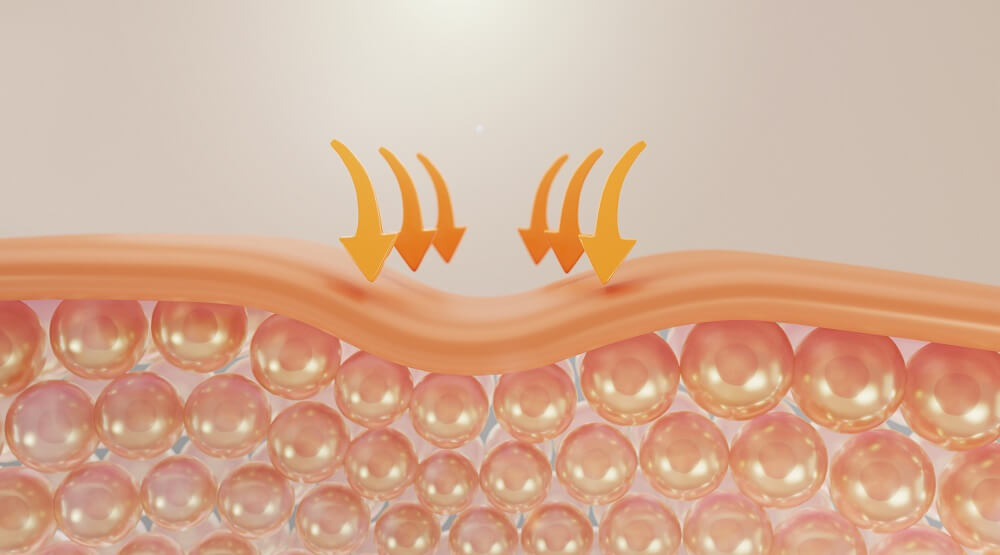
From roughly the mid-twenties, collagen production begins a slow decline, and the elastin network that allows skin to return to shape after movement becomes fragmented. Hyaluronic acid content falls, so the skin holds less water. The dermis thins, and the junction between dermis and epidermis flattens, which reduces the exchange of nutrients between the layers.
These are intrinsic changes, driven largely by time and genetics. Layered on top of them is extrinsic ageing — the damage caused by ultraviolet exposure, smoking, disturbed sleep, chronic stress and poor nutrition. Ultraviolet light is by far the largest external factor, and it is also the most modifiable one. The difference between sun-exposed and habitually covered skin on the same person is usually the clearest illustration of that point.
Practically, this shows as fine lines that are present at rest, a duller and more uneven surface, enlarged pores, pigmentation irregularity, visible capillaries, and skin that creases more readily and recovers more slowly.
Muscle and ligaments: movement that leaves a mark
The muscles of facial expression attach directly to the skin, which is what allows the face to convey emotion. Every contraction folds the skin in the same direction thousands of times. While the skin is young and elastic, the folds disappear as soon as the muscle relaxes. As elastin fragments, the same lines start to remain visible at rest — first faintly, then permanently. Lines across the forehead, between the brows and at the outer corners of the eyes are the usual first sites.
At the same time, the retaining ligaments that anchor the soft tissue of the face to the underlying bone become laxer. As they release, the tissue they were holding shifts downward, which contributes to descent along the cheek and jawline.
Which approaches address which layer?
Treatment categories are easier to understand once they are mapped back onto the layer they act on. No single category addresses all of them, which is why plans are often built from more than one.
- Volume and structural support. Filler applications are used where volume loss or reduced skeletal projection is the dominant change — the midface, the temples, the chin and the jawline. The aim is restoring support, not adding fullness for its own sake.
- Expression-related lines. Botox procedures address lines produced by repeated muscle movement by reducing the strength of that movement. They act on dynamic lines rather than on volume or skin quality.
- Tissue laxity. Energy-based approaches such as HIFU and other non-surgical face lift methods target the deeper connective tissue, with the aim of stimulating contraction and new collagen formation over the following months.
- Skin quality. Mesotherapy, dermapen and skin renewal applications work on the dermis itself — hydration, texture, tone and collagen stimulation. They do not restore volume, but they change the surface on which everything else is seen.
Treating the wrong layer is the most common reason results feel disappointing. Volume added to a face whose main problem is skin quality, or resurfacing applied to a face that has lost structural support, tends to fall short of what was expected.
What can be influenced and what cannot
Genetics determine a considerable part of how and when a face ages — bone structure, skin thickness, the tendency toward pigmentation — and that part is not modifiable. A meaningful proportion of visible ageing, however, comes from cumulative external exposure. Consistent broad-spectrum sun protection, avoiding smoking, adequate sleep, a diet with sufficient protein and antioxidants, and a regular skincare routine all influence the trajectory. Aesthetic applications work considerably better on skin that is being looked after between appointments.
How a plan is usually built
An assessment at Zen Polyclinic considers the face as a whole rather than the single feature a person may have come in about. Skeletal proportions, the distribution of volume, the degree of laxity and the condition of the skin are each looked at, alongside medical history, medications and expectations.
From that, a sequence is agreed. Often the structural layer is addressed before the surface, since support changes how the skin sits; skin quality work then continues over a longer period. Sessions are spaced so that each stage can be assessed before the next is planned. Facial ageing is a continuing process, so plans are reviewed and adjusted rather than completed once.