
Soprano Ice Platinum
A diode laser platform that combines three wavelengths in a single applicator and works with a contact-cooled, gradual heating method, so sessions stay comfortable across a wide range of skin and hair types.

What is Soprano Ice Platinum and how does it work?
Soprano Ice Platinum is a medical laser system used for hair reduction. Like every laser used for this purpose, it works on the principle of selective photothermolysis: the light energy is absorbed by the melanin inside the hair shaft, converted into heat, and carried down to the structures at the base of the follicle that keep hair growing.
What distinguishes the platform is how that heat is delivered. Instead of firing single high-energy pulses onto a static point, the applicator is swept continuously over the treatment area while emitting many low-energy pulses. The temperature of the follicle rises gradually rather than in one sharp spike, and the surface of the skin is cooled at the same time by the contact tip. This method is generally referred to as SHR (Super Hair Removal), and it is the reason most people describe the sensation as a warm massage rather than the snapping feeling associated with older devices.
The tip stays chilled throughout, protecting the epidermis while the deeper target absorbs energy — which is what allows a broader range of skin tones to be treated than early-generation lasers allowed.
Three wavelengths in a single applicator
The platform delivers three wavelengths simultaneously, each of which reaches a different depth and responds differently to hair and skin pigment. Combining them in one pass means several follicle structures and hair types can be addressed at once.
- 755 nm (Alexandrite). The most strongly absorbed by melanin and the shallowest of the three. It is the wavelength that contributes most on fine and lighter hair, and it targets the bulge region of the follicle.
- 810 nm (Diode). The workhorse wavelength for most body areas. It balances melanin absorption against penetration depth and reaches both the bulge and the bulb, which makes it suitable for a wide range of hair thicknesses.
- 1064 nm (Nd:YAG). The deepest-reaching and the least absorbed by surface pigment. This is what allows deeper-seated hair, such as on the back or in the bikini area, to be treated, and it is the safest option for darker or tanned skin.
Which wavelength dominates is decided by the settings chosen for your skin phototype, the coarseness of the hair and the area being treated. Zen Polyclinic plans these parameters after a skin and hair assessment, and a small test area is treated before the first full session.
When is it preferred?
Sensitive and painful areas. The gradual heating method makes areas such as the bikini line, underarms, upper lip and the male facial region considerably more tolerable than single-pulse systems.
Darker and olive skin tones. Because the 1064 nm wavelength is far less attracted to surface pigment, treatment can be planned for skin types where older alexandrite-only devices carried a higher risk.
Large areas. The applicator has a wide scanning window, so extensive regions like legs, back or chest are covered in a relatively short session.
Mixed hair types. Areas that contain both coarse dark hair and finer hair benefit from the simultaneous delivery of all three wavelengths.
With any laser, only follicles in their active growth (anagen) phase respond. Since just a portion of hair is in that phase at any moment, a course of sessions spaced weeks apart is always required.
How does a session proceed?
Assessment. Skin type, hair colour and thickness, recent sun exposure, medications and any hormonal condition that affects hair growth are reviewed. Parameters are set accordingly.
Preparation. The area is shaved rather than waxed or epilated — the hair must remain in the follicle for the laser to have a target, while surface hair would only absorb energy at skin level. A conductive gel is spread over the area and protective eyewear is worn by everyone in the room.
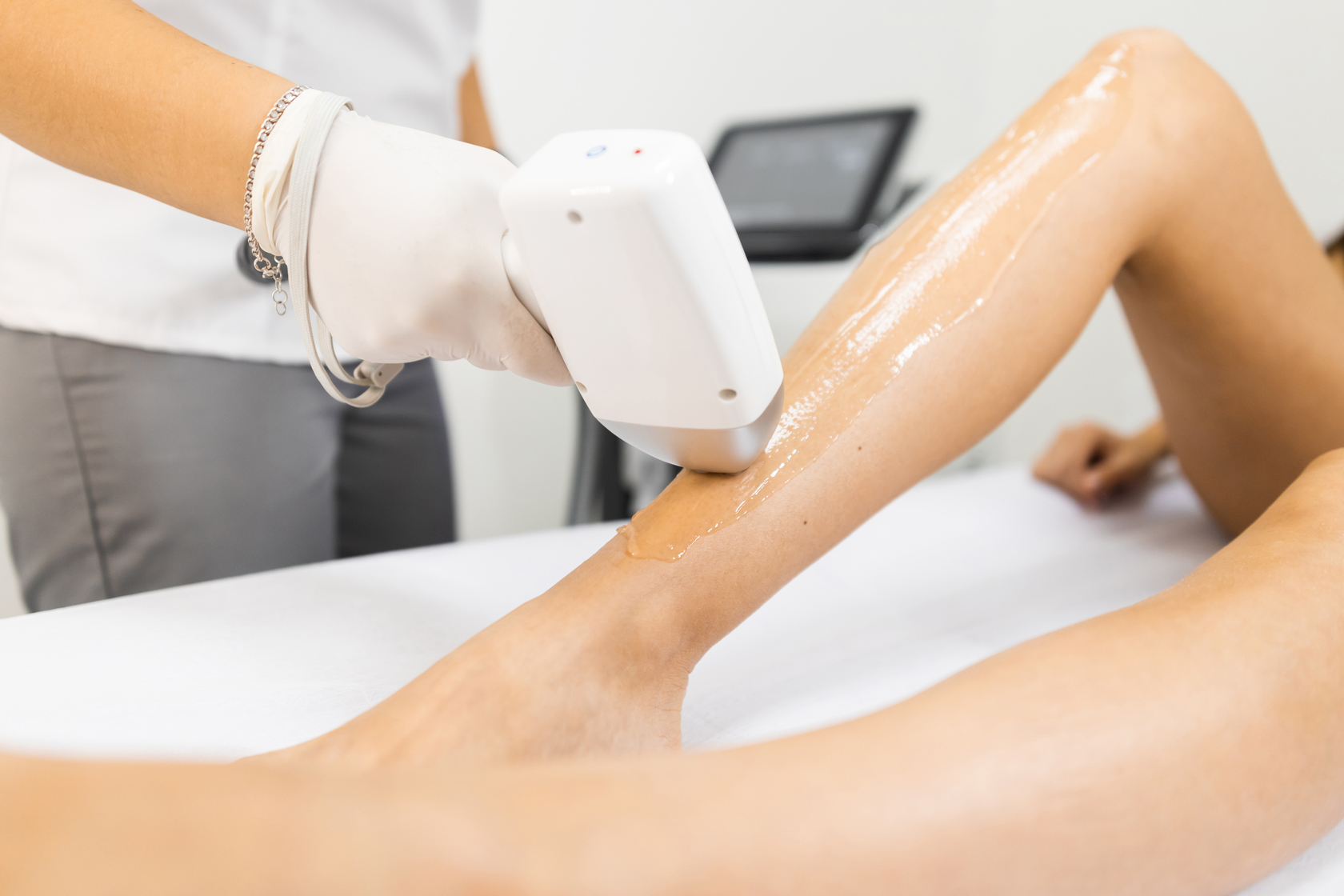
Application. The applicator is moved back and forth in overlapping passes until the target temperature is reached, then the next section is treated. Most people feel building warmth rather than discrete pulses. A small region such as the upper lip takes only a few minutes; full legs take considerably longer.
Afterwards. Gel is removed, and a soothing product and sunscreen are applied. Mild redness or slight swelling around the follicle openings may appear and usually settles within hours. Daily activity can resume immediately; hot baths, saunas, intense exercise and direct sun should be avoided for a couple of days.
Who is it not suitable for?
Laser hair reduction is a well-established procedure, but it is not appropriate in every situation:
- Active infection, open wounds, eczema or psoriasis in the treatment area
- Recent sunburn or a fresh, deep tan on the area to be treated
- Use of photosensitising medication, including isotretinoin within the preceding months and certain antibiotics
- Pregnancy and breastfeeding, as a precautionary measure
- A tendency to keloid or hypertrophic scarring
- Unassessed pigmented lesions or moles in the area — these are covered rather than treated
- White, grey and very light blond hair, which contains too little melanin to absorb the light
Please tell us about any medication you take, any recent sun or solarium exposure, and any skin condition before the session. Hair growth driven by a hormonal cause, such as polycystic ovary syndrome, should also be mentioned, since it affects how the session plan is built.
When do results become visible?
Treated hair does not fall out immediately. Over the following one to three weeks the hair is shed from the follicle, and a visible thinning of the area follows. The reduction after a single session applies only to the follicles that were active at that time, which is why the change looks partial at first.
A course typically runs to six to eight sessions, with intervals of roughly four to six weeks for the face and six to eight weeks for the body — the interval follows the growth cycle of each area rather than a fixed calendar. Hair that regrows during the course tends to come back finer and lighter.
Long-term outcomes vary between individuals. Hair colour and thickness, skin type, hormonal factors and the area treated all influence how much reduction is achieved and whether maintenance sessions are needed later. No laser removes every follicle permanently.
Using it alongside other treatments
Soprano Ice Platinum is one of the devices used within our laser hair removal programme; the choice of platform depends on your skin and hair characteristics, and some areas are planned with the Duetto MT Evo system instead. Sessions are scheduled with an appropriate gap around other treatments on the same area — injectable procedures, chemical peels or resurfacing lasers — so the skin is not asked to recover from two things at once.