
Duetto MT Evo Laser Hair Removal
A dual-wavelength platform that combines Alexandrite 755 nm and Nd:YAG 1064 nm in a single system, allowing the setting to be matched to skin tone, hair depth and the area being treated.
What is the Duetto MT Evo and how does it work?
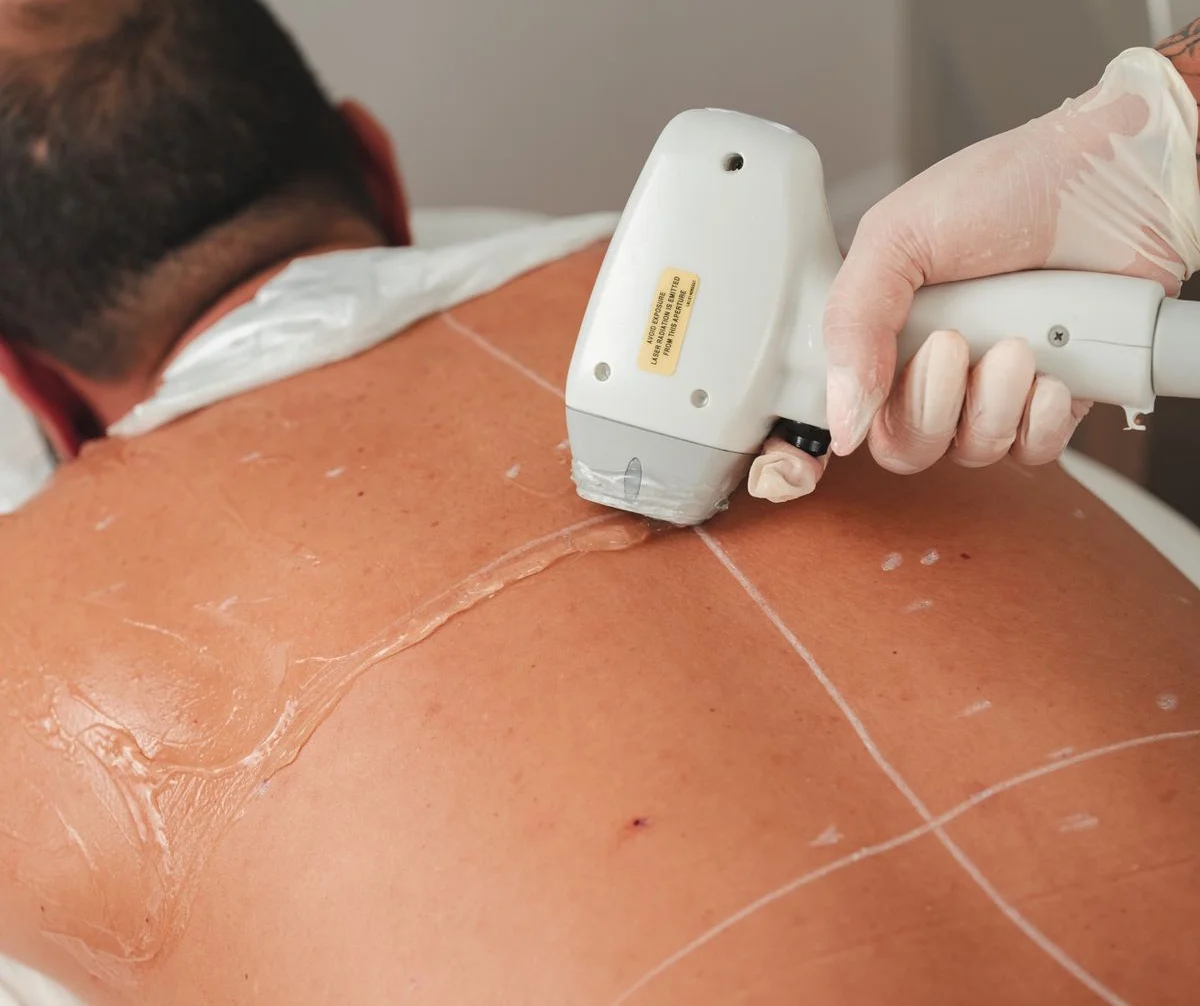
The Duetto MT Evo is a laser platform used for hair removal. What distinguishes it from single-wavelength devices is that it carries two separate laser sources in one body and can deliver them alone or one directly after the other within the same pulse sequence.
Laser hair removal works through selective photothermolysis: light is absorbed by the pigment (melanin) inside the hair shaft, converted into heat, and that heat is carried down to the structures at the base of the follicle that keep it producing hair. The wavelength decides how deep the light travels and how strongly the pigment absorbs it.
- Alexandrite, 755 nm. Strongly absorbed by melanin, so it responds well to fine and light-coloured hair. It stays relatively superficial and is generally chosen for lighter skin tones.
- Nd:YAG, 1064 nm. Absorbed less by melanin but travels deeper. This makes it the safer option on darker or tanned skin, and more suitable for coarse hair sitting deep in the follicle.
When the two are used sequentially, the energy required from each source is lower than it would be if either were used on its own. The practical consequence is that the epidermis is loaded less at a given effective dose, which is why the sequential mode is often preferred on areas that are sensitive or difficult to treat.
The system also has an integrated cooling stage. Cooling the skin surface before and during the pulse protects the epidermis and makes the sensation more tolerable. At Zen Polyclinic the wavelength, pulse duration and energy are selected after the skin and hair are assessed, not set to a fixed protocol.

When is it preferred?
Mixed skin tones within one course. Because both wavelengths are available on the same device, a person whose skin tone changes between winter and summer can continue a course without switching to a different system.
Darker skin tones. Skin with more background melanin competes with the hair for the light. The 1064 nm wavelength reduces that competition, which is why it is the usual choice in these cases.
Fine or light hair. Hair with little pigment absorbs poorly. The 755 nm wavelength has a stronger affinity for melanin and is generally the more appropriate setting here, although hair that is white or entirely without pigment does not respond to laser at all.
Coarse, deeply seated hair. Beard line, underarm and bikini areas often contain thick hair rooted deep in the skin; the deeper reach of the Nd:YAG wavelength matters in these regions.
Ingrown hairs and folliculitis. Areas that react badly to shaving or waxing are frequently referred for laser precisely to break that cycle.
How does a session proceed?
Assessment. Skin type, hair colour and thickness, hormonal history and any medication that increases light sensitivity are reviewed. Test pulses may be applied to a small area before the full treatment.
Preparation. The area is shaved rather than waxed or epilated, because the laser needs the hair root to be in place while the surface hair is short enough not to burn. The skin is cleaned of make-up, deodorant and sunscreen.
Application. Protective eyewear is worn by everyone in the room. The handpiece is passed over the area in overlapping strokes while cooling runs continuously. Most people describe a snapping or warm sensation rather than pain, though this varies by area.
Afterwards. Mild redness and slight swelling around the follicle openings are expected and usually settle within a few hours. A soothing cream and sun protection are applied. There is no recovery period; normal activity resumes the same day, while hot showers, sauna, pool and intense exercise are avoided for a day or two.
Interval. Sessions are spaced according to the growth cycle of the area — roughly four to six weeks for the face, and longer intervals for the body — because only hairs in the active growth phase respond.
Who is it not suitable for?
Laser hair removal is a controlled application, but it is not appropriate for everyone. It is postponed or avoided in the following situations:
- Pregnancy and breastfeeding
- Recent sun exposure, active tan or a solarium session in the previous weeks
- Photosensitising medication, including isotretinoin, some antibiotics and certain herbal preparations
- Active infection, eczema, open wounds or sunburn in the treatment area
- A history of keloid or hypertrophic scarring
- Uncontrolled diabetes and immune conditions affecting wound healing
- Areas with tattoos or permanent make-up, which are worked around rather than through
- White, grey or unpigmented hair, which does not absorb the light
Tell us about every medication and supplement you use, any recent sun exposure and any skin condition before the session. These details change the wavelength and energy chosen, and sometimes mean the session should be rescheduled.
When do results become visible?
Hair does not disappear during the session. In the days that follow, treated hairs are pushed out of the skin and shed — a process that can look like regrowth but is not. A visible reduction in density usually becomes apparent after the first few sessions.
Because hair follicles are at different stages of their cycle at any given moment, a single session reaches only part of them. A course is therefore planned over several sessions spread across months. The number needed varies with the area, hair thickness, hormonal factors and skin type.
Hormonal conditions such as polycystic ovary syndrome or thyroid disorders can stimulate new hair growth over time. In these cases maintenance sessions may be planned at wider intervals after the main course. Outcomes differ from person to person and cannot be predicted in advance.
Use alongside other applications
A laser hair removal course can be combined with other treatments as long as the timing is planned. Injectable procedures, chemical peels and other laser applications on the same area are separated by an appropriate interval. Where a different device suits the skin or the region better, Soprano Ice Platinum may be used instead of or alongside the Duetto MT Evo. An overview of the approach to hair reduction is available on our laser hair removal page.