
Pumpkin Peel Skin Care
A gentle enzyme-based facial that uses pumpkin pulp, fruit acids and vitamin A to loosen dead surface cells without abrasion, leaving the skin smoother and more even in tone.
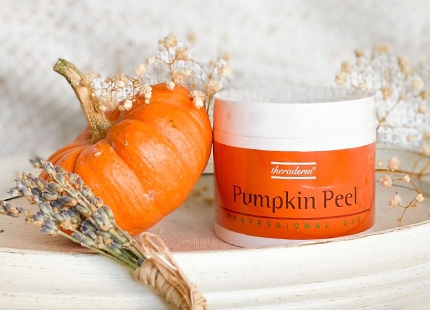
What is a pumpkin peel and how does it work?
Pumpkin peel is a superficial chemical and enzymatic peel. Instead of removing the upper layer of the skin mechanically, it works by softening the bonds that hold dead cells together on the surface, so those cells shed on their own over the following days.
Its effect comes from a combination of ingredients that occur naturally in pumpkin pulp and from acids added to the formulation:
- Enzymes. Pumpkin contains proteolytic enzymes that break down the protein bridges between dead surface cells. This is what makes the peel feel gentle compared with abrasive methods.
- Fruit acids (AHA). Usually glycolic or lactic acid in low concentrations. They support the same shedding process and help refine surface texture.
- Vitamin A and antioxidants. Pumpkin is rich in beta-carotene, vitamin C and vitamin E. These contribute to the skin’s antioxidant defence and support renewal.
- Zinc and minerals. Often present in the pulp itself; they help calm the skin during and after the session.
Because it acts only on the outermost layer, a pumpkin peel is classed as a superficial peel. It does not reach the deeper dermis and is therefore not comparable with medium or deep chemical peels. At Zen Polyclinic the formulation and contact time are decided after a skin assessment, not applied as a single fixed protocol.

When is it preferred?
Dull, tired-looking skin. When dead cells accumulate on the surface, light is scattered unevenly and the skin looks grey. Removing that layer is the fastest way to restore a more reflective surface.
Rough texture and dryness. Flaking that appears in autumn and winter, or after a period of sun exposure, responds well to enzymatic shedding because it is not aggressive on an already compromised barrier.
Congested pores and mild acne. Loosening the plug of dead cells at the pore opening helps reduce blackheads and closed comedones. It is a supportive measure, not a treatment for inflammatory or cystic acne.
Uneven tone and superficial pigmentation. Faint post-acne marks and mild irregularity of tone can soften over a course of sessions. Deeper pigmentation such as melasma needs a different approach and medical evaluation.
Fine lines related to dehydration. Lines that appear because the surface is dry rather than because of collagen loss often look less visible once the skin is exfoliated and rehydrated.
How does the session proceed?
Skin assessment. Skin type, barrier condition, current products and any medication are reviewed. Recent use of retinoids, acids or isotretinoin changes the plan, so it needs to be mentioned beforehand.
Cleansing. Make-up, sunscreen and surface oil prevent the peel from acting evenly. The face is cleansed with a product suited to the skin type — foam, gel or milk depending on whether the skin is oily, dry, sensitive or atopic.
Preparation. A light massage or a preparatory solution may be used to even out the surface so that the peel is absorbed consistently across the face.
Application. The pumpkin formulation is applied in a thin layer, avoiding the eye area and lips. A warm or mildly tingling sensation during the first minutes is normal and settles quickly. Contact time is typically around ten minutes and is adjusted according to how the skin responds.
Neutralisation and aftercare. The peel is removed or neutralised, then a soothing serum and moisturiser are applied. Sunscreen is applied before leaving. The whole session usually takes less than half an hour and there is no recovery period, so normal activity can resume immediately.
Who is it not suitable for?
A pumpkin peel is a low-risk procedure, but it is not appropriate in every situation:
- Known allergy to pumpkin, squash or any component of the formulation
- Active skin infection in the treatment area — including cold sores, impetigo or inflamed lesions
- Open wounds, eczema flare-ups or a visibly damaged skin barrier
- Recent isotretinoin use, or ongoing treatment with medication that thins the skin
- Recent laser, deep peel or other resurfacing procedure that has not fully healed
- Sunburn or intense sun exposure in the days before the session
- Pregnancy and breastfeeding — the plan should be discussed in advance
Tell your practitioner about every product you use at home, particularly retinol, AHA/BHA acids and vitamin C serums. These are usually paused for a few days before and after the session so the skin is not over-exfoliated.
When do results become visible?
The immediate effect is a brighter, smoother surface, and it is usually noticeable on the same day. This first result comes from the removal of dead cells and from improved hydration, so it is real but temporary.
Over the next three to five days the shedding process continues quietly. Some people notice a very light flaking; others notice nothing at all. Texture and pore appearance typically look their best towards the end of the first week.
Changes in tone and in superficial marks build up more slowly. A course of sessions spaced two to four weeks apart is usually planned, and the cumulative effect on evenness of tone becomes clearer after the third or fourth session. Maintaining the result depends heavily on daily sun protection and on a consistent home routine.
Using it alongside other treatments
A pumpkin peel is often planned as part of a wider skin routine rather than in isolation. It pairs naturally with Hydrafacial when deeper cleansing and hydration are also needed, and a session of LED mask afterwards is a common way to calm the skin and reduce transient redness.
For skin that needs a broader plan — persistent congestion, marked textural irregularity or pigmentation — it may be scheduled within a medical skin care programme so that the intervals between different procedures are set safely. Injectable procedures are normally kept on separate days, and the appropriate gap is decided during planning.
Frequently asked questions
Does a pumpkin peel hurt?
No. Most people describe a warm or slightly tingling feeling in the first few minutes, which fades as the peel settles. If the sensation becomes uncomfortable, the peel is removed earlier.
Will my skin peel visibly afterwards?
Usually not in a dramatic way. Because the process is enzymatic and superficial, shedding tends to be fine and easy to miss. Some skin types show light flaking for two or three days.
How often can it be repeated?
Sessions are commonly spaced two to four weeks apart, and the interval depends on how the skin responds. Over-frequent exfoliation weakens the barrier, so the schedule is set individually.
Can it be done in summer?
Yes, provided that sun exposure is limited and broad-spectrum sunscreen is used daily. Freshly exfoliated skin is more reactive to ultraviolet light, which makes protection more important than usual.
Is it suitable for sensitive skin?
Often yes, because it does not rely on mechanical abrasion. The concentration and contact time are reduced, and a patch test may be carried out first. Skin with an active flare-up is treated only once it has settled.
What should I avoid after the session?
Retinol, acid-based products, scrubs, sauna, steam rooms and intense sun exposure are usually avoided for a few days. A simple moisturiser and sunscreen are enough during that period.
Can I wear make-up the same day?
It is preferable to leave the skin bare for the rest of the day so the barrier can settle. If make-up is necessary, a light, non-comedogenic product applied over sunscreen is the usual compromise.