
Blemish Treatments
Laser-based approaches to pigmentation on the face and body, planned after the type and depth of the blemish have been identified.
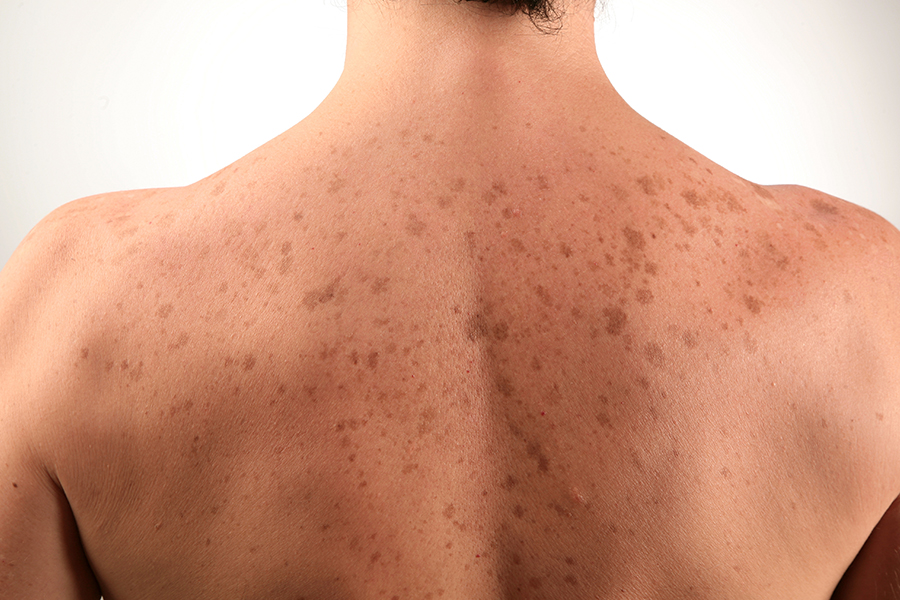
What are skin blemishes and why do they form?
A skin blemish is a patch of skin that carries more pigment than the tissue around it. The pigment involved is melanin, produced by cells called melanocytes. When those cells are stimulated — by ultraviolet light, by inflammation, by hormonal change — they produce more melanin than usual, and the area they occupy becomes visibly darker.
Pigmentation is grouped in two ways, and the distinction matters because it changes how the area is treated:
- An increase in the number of melanocytes. Sun-related spots that accumulate on the face, backs of the hands and décolleté over the years belong in this group. They tend to have defined borders and a light-to-mid brown colour.
- An increase in melanin production by existing cells. Marks left behind by long-standing acne, darkening that appears during pregnancy or with hormonal medication, and diffuse patches on the cheeks and forehead fall here. The borders are usually softer and less clearly drawn.
Depth is the second variable. Pigment sitting in the upper layer of the skin responds differently from pigment that has settled deeper into the dermis, and the deeper it lies, the more gradual the process becomes. Assessing colour, border definition and depth before anything else is what allows a realistic plan to be made.

How does laser work on pigmentation?
Laser light is delivered at a wavelength that melanin absorbs more strongly than the surrounding tissue. The absorbed energy breaks the pigment clusters into smaller particles, which the body’s own clearance mechanisms then carry away over the following weeks. The skin does not lighten during the session itself; it lightens as that clearance takes place.
Q-switched laser. This technology releases its energy in extremely short pulses. Because the pulse is brief, the heat is confined to the pigment and has little opportunity to spread into neighbouring tissue — which is exactly what is wanted when treating discrete spots, since uneven heating is what produces uneven colour. Q-switched systems are the usual choice for well-defined sun and age spots. You can read more on the Q-switched laser page.
Fractional laser. Rather than treating the whole surface, a fractional device divides its beam into many microscopic columns and leaves untouched skin between them. Those intact areas act as a reservoir for repair, so the surface recovers faster than it would after full-field treatment. Fractional work is preferred where pigment is accompanied by texture changes, acne scarring or general dullness, since it addresses the surface and the pigment together.
Which blemishes are suitable?
Sun and age spots. Flat brown areas that have built up over years of exposure on the face, hands and chest are among the most predictable to work with, particularly when their borders are clear.
Post-inflammatory marks. The discolouration left after acne, ingrown hairs or minor skin injury. These often fade to some degree on their own, and treatment is generally considered once the underlying inflammation has settled — which is why active acne is addressed first through acne treatment.
Hormone-related patches. Diffuse darkening on the cheeks, upper lip and forehead associated with pregnancy or hormonal medication. This group is the most sensitive to handle: it recurs readily, it reacts to heat and to sunlight, and it calls for conservative energy settings and disciplined sun protection rather than aggressive treatment.
Uneven overall tone. Where there is no single spot but a general loss of clarity, fractional treatment or a combination with medical skin care may be planned instead.
Any lesion that has changed in size, shape or colour, that has irregular borders, or that bleeds needs dermatological assessment first.
How does the process work?
Assessment. Skin type, the character and probable depth of the pigment, sun exposure habits, current medication and any history of pigmentation problems are reviewed.
Preparation. A pre-treatment period of topical products and strict sun protection is often recommended, especially for hormone-related pigmentation. Skin that has recently been tanned is not treated.
Test area. On sensitive or extensive pigmentation a small area may be treated first and reviewed, to see how the skin responds to the chosen setting.
The session. The area is cleansed and protective eyewear is worn. Most people describe the sensation as a series of quick, warm snaps. Depending on the area and the device, a session typically runs between fifteen and forty minutes; cooling is used during and after.
Afterwards. Mild redness and a warm feeling are usual for a day or so. Treated spots often darken and take on a slightly crusted appearance before flaking away over roughly one to two weeks. That darkening is an expected part of the process and should not be picked or scrubbed.
Who is it not suitable for?
- Skin that is currently tanned, whether from sun or from self-tanning products
- Anyone using isotretinoin, or who has stopped recently — an interval is required
- Active infection, eczema or open lesions in the area to be treated
- Pregnancy and breastfeeding
- A history of keloid or hypertrophic scarring
- Photosensitivity, or use of medication that increases sensitivity to light
- Any pigmented lesion that has not been evaluated by a dermatologist
Tell us about every medication and topical product you use, and about any previous laser or peeling treatment, before your session is planned. This information directly affects which device and which energy setting are appropriate for you.
When do results become visible?
Change is gradual and depends on the type of pigmentation. Superficial sun spots often show a visible difference once the crusting phase of the first session has completed, at around two to three weeks. Deeper or more diffuse pigmentation is worked on across a course, with sessions spaced several weeks apart so the skin can settle in between.
The number of sessions is decided by response rather than by a fixed schedule. Hormone-related pigmentation in particular is best understood as something managed over time — it responds, and it can return if sun exposure and hormonal factors persist.
Daily broad-spectrum sun protection is not an optional extra here. It is the factor that most influences whether treated areas stay clear, and it needs to continue after the course has ended.
Combining with other treatments
Blemish treatment is frequently planned alongside other work rather than in isolation. Medical skin care is used to prepare the skin beforehand and to maintain results afterwards. Dermapen may be combined where texture and scarring accompany the pigmentation. LED mask sessions are often used after laser to help calm the skin during recovery. Spacing between procedures is set individually.