
Plexr Plus Plasma Energy Treatment
A non-surgical, plasma-based procedure used to tighten loose skin and soften fine lines, most often around the eyelids and eye contour, without cutting or stitching the skin.
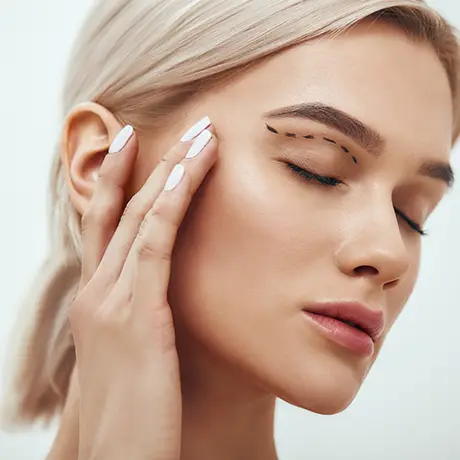
What is Plexr Plus and how does it work?
Plexr Plus is a handheld device that produces a small electrical arc between its tip and the surface of the skin. The air in that tiny gap is ionised — turned into plasma, often described as the fourth state of matter — and the energy released is absorbed by the outermost layer of the skin at a single, precisely placed point.
The tip never touches the skin and no blade or laser beam is involved. At the point of contact the superficial cells sublimate, leaving a small dark spot that later flakes away, while the surrounding tissue contracts. Underneath, the controlled micro-injury signals the skin to begin its own repair process, which over the following weeks involves new collagen being laid down.
Because each point is treated separately and healthy skin is left between the points, the tissue has intact tissue on all sides to heal from. The visible result comes from two effects working together: immediate tightening of the treated surface, and a slower remodelling of the skin underneath.

Which concerns is it used for?
Upper eyelid laxity. This is the most common reason Plexr Plus is chosen. Where the upper lid skin has loosened but the concern is mild to moderate, plasma treatment can tighten the surface without an incision. It is not a substitute for eyelid surgery, and cases with significant excess skin or fat are better assessed surgically.
Fine lines around the eyes and mouth. The superficial creases sometimes described as crow’s feet, and the vertical lines above the upper lip, can be softened where they are caused by skin texture rather than deep volume loss.
Superficial skin lesions. Small raised lesions such as skin tags, seborrhoeic keratoses and some warts can be removed point by point. Any lesion is examined before treatment, and anything with an uncertain appearance is referred for dermatological assessment rather than treated.
Scar and acne scar texture. Raised or uneven scar tissue can be smoothed to a degree. Results here vary considerably between individuals and scar types.
How the session progresses
Assessment. The area is examined, your skin type and medical history are reviewed, and it is decided whether plasma treatment is appropriate at all. Medications that affect healing, a history of keloid scarring, or a recent tan all change the plan. Some people are better served by a different approach, and that is discussed openly.
Preparation. The skin is cleansed and a topical anaesthetic cream is applied, usually for around 30 to 45 minutes, so that the treatment itself is tolerable. Most people describe a warm, prickling sensation rather than pain.
Application. A grid of tiny points is placed across the target area. Treating both upper eyelids typically takes 15 to 25 minutes once the numbing has taken effect. Small dark crusts form immediately at each point.
Immediately after. Swelling begins within a few hours and is usually at its most noticeable on the first and second day, particularly around the eyes. A soothing product is applied and aftercare is explained before you leave.
Recovery and aftercare
The crusts stay in place for roughly five to seven days and fall away on their own. They must not be picked, scratched or scrubbed off — this is the single most important rule, because premature removal is what leads to marks that last.
Swelling around the eyes settles over three to five days. Underneath the crusts the new skin is pink for a few weeks, and this pinkness fades gradually. Makeup is avoided until the crusts have come away completely.
Sun protection is not optional after plasma treatment. The freshly healed skin pigments easily, so a high-factor sunscreen and shade are needed for several weeks, and direct sun, solariums, saunas and steam should be avoided while healing.
Many people return to work the day after treatment, but the crusts are visible and swelling is obvious in the first days, which is worth planning around. Treatment is often scheduled ahead of a quieter week rather than before an event.
Who is it not suitable for?
Plasma treatment is not appropriate for everyone. It is generally avoided in the following situations:
- Darker skin tones with a higher tendency to post-inflammatory pigmentation, where the risk of lasting colour change is greater
- A history of keloid or hypertrophic scarring
- Recent isotretinoin use, or medications and conditions that impair wound healing
- Active infection, eczema or inflammation in the area to be treated
- Recently tanned skin, whether from sun or a solarium
- Pregnancy and breastfeeding
- Pacemakers or other implanted electronic devices
- Uncontrolled diabetes or autoimmune conditions affecting the skin
Cold sores can be triggered by treatment near the mouth, so a history of recurrent herpes labialis should be mentioned in advance.
When do results become visible?
Some tightening is apparent as soon as the crusts fall away, but that early appearance is not the final one — the area is still swollen and the skin is still healing. A clearer picture emerges at around four weeks.
Collagen remodelling continues well beyond that point. The change that comes from new collagen typically develops over two to three months, so the fullest effect of a session is judged at around the twelve-week mark rather than immediately.
The number of sessions depends on the area and on how much laxity is present. Some concerns respond to a single session; others are planned as two or three, spaced at least six to eight weeks apart so that each round has healed fully before the next. This is decided during assessment, not in advance.
Results are not permanent. Plasma treatment tightens the skin that is there now; it does not stop the ageing process, and skin continues to change over the following years.
Use alongside other treatments
Plexr Plus addresses skin surface and laxity, which makes it a different tool from injectables that address volume or muscle movement. Where a plan combines them, timing matters — the treated area needs to have healed completely before anything else is carried out there.
For overall skin texture and collagen support without downtime of this kind, Dermapen and HIFU work through different mechanisms and are sometimes more appropriate. A broader overview of the options is available on our skin renewal page.