
Beard Transplant
Follicular units taken from the donor area are placed one by one into the beard and moustache region, following the natural direction and angle of facial hair growth.
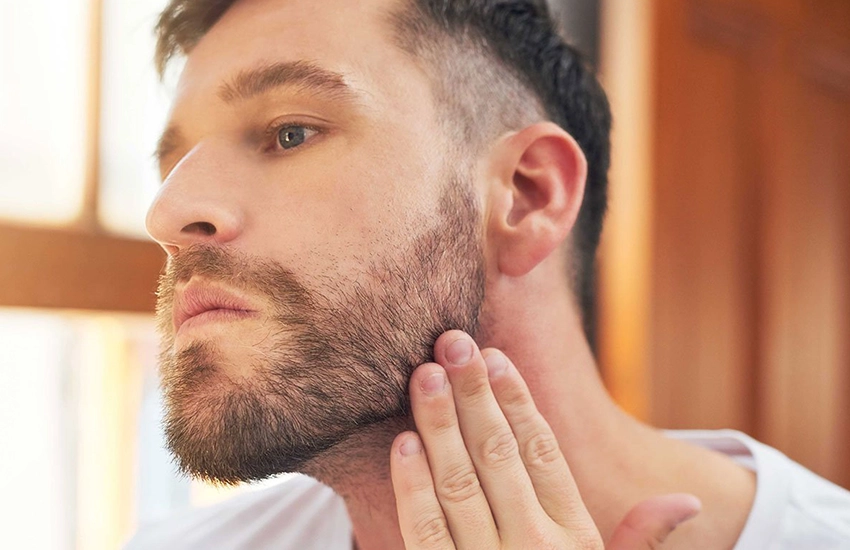
What is a beard transplant and how does it work?
A beard transplant is a procedure in which hair follicles are moved from an area where growth is dense — most often the back of the scalp — to regions of the face where the beard is sparse, patchy or absent. The principle is the same as in scalp hair transplantation: follicles taken from the donor area keep their own growth characteristics after being relocated, which is why the transplanted hairs continue to grow in their new position.
What makes the face different from the scalp is the geometry. Facial hair grows at a much sharper angle to the skin, the direction of growth changes across the cheek, jawline, moustache and chin, and the density is lower and less uniform than on the scalp. For that reason a beard transplant is planned less around the number of grafts and more around angle, direction and distribution.
The grafts themselves are also selected differently. Single-hair grafts are preferred along the border zones — the outer edge of the beard, the moustache line, the sideburn transition — while denser two- and three-hair grafts are placed further inside the beard field.
The design is agreed before anything is harvested. The beard line is drawn on the face while the person is sitting upright, checked in a mirror, and adjusted; only then is the number of grafts estimated. In a typical procedure covering the cheeks and jawline, a range of roughly 1,500–2,500 grafts is common, though the actual figure depends on the size of the area, the existing density and the capacity of the donor region.

Which methods are used?
DHI (Choi implanter pen). In this technique the graft is loaded into the cylindrical tip of an implanter pen, and the channel is opened and the follicle placed in a single movement. Because there is no separate channel-opening stage, the grafts spend less time outside the tissue and the operator has direct control over the depth and angle of each placement. This makes DHI a frequent choice for beard work, where sharp angles and close spacing matter.
FUE with channel opening. Here the recipient channels are opened first, with fine steel blades or sapphire-tipped instruments, and the grafts — held in a preservation solution in the meantime — are then placed one by one. Sapphire tips create channels sized to the thickness of the follicle, which helps limit tissue trauma. This approach gives a broad overview of the whole field before placement begins and is often used for larger areas.
Neither method is universally superior. The choice depends on the size of the area, the structure of the donor hair, the skin type and the density planned. In practice the two are sometimes combined within one session — for example, DHI along the border and channel-based placement across the wider cheek area.
Who is it considered for?
Patchy or uneven beard growth. Gaps on the cheeks or along the jawline that have persisted since adolescence are among the most common reasons for the procedure.
Scars. Areas where hair no longer grows because of an old injury, a burn or a surgical scar can be covered, provided the tissue is healthy and has completed its healing.
Weak beard borders or an unclear jawline. Adding density to the outer edge can strengthen the visual line of the jaw without touching the rest of the beard.
Asymmetry. Where one side is noticeably sparser than the other, transplantation may be used to even out the distribution.
An adequate donor area is a precondition in every case. The occipital region of the scalp is used most often; where it is insufficient, the possibility of using other body areas is assessed individually.
How does the procedure progress?
Consultation and planning. Facial hair pattern, donor density, skin condition, medications in use and any underlying conditions are reviewed. The beard design is drawn and confirmed.
Local anaesthesia. Both the donor area and the recipient area are numbed. The procedure is performed under local anaesthesia; the patient remains awake throughout.
Harvesting. Follicular units are extracted individually from the donor area with a micromotor punch. They are counted, sorted by the number of hairs they contain and kept in a preservation solution.
Placement. The grafts are transferred to the face in the planned direction and angle. Single-hair grafts go to the borders, multi-hair grafts to the interior. Depending on the number of grafts, the whole session usually takes several hours.
After the session. The face is dressed as required and aftercare instructions are given. Most people are able to return home the same day.
Who is it not suitable for?
A beard transplant is an elective procedure, and there are situations in which it is postponed or not performed at all:
- An insufficient donor area, or ongoing loss in the donor region itself
- Active skin infection, inflammation or untreated dermatological disease in the treatment area
- A tendency to keloid or hypertrophic scarring
- Uncontrolled diabetes, bleeding disorders or conditions affecting wound healing
- Ongoing treatment with blood thinners or medications that require review before any procedure
- Very young age, where the beard pattern has not yet settled
Please share your full medical history, current medications and any previous procedures during the consultation. Some of these do not rule out a beard transplant but change how it is planned or timed.
What happens afterwards, and when do results appear?
Small crusts form around the transplanted follicles in the first days and clear over roughly the first week to ten days. Mild swelling and redness in the treated area are usual in this period. Washing follows the schedule given after the session; the area should not be rubbed, and shaving of the transplanted region is avoided until it is permitted.
Between the second and the sixth week, most of the transplanted hairs shed. This is an expected part of the cycle and does not mean the follicles have been lost — the follicle remains in place and enters a resting phase.
New growth generally begins around the third to fourth month. Density builds gradually from that point, and the beard is usually assessed as settled at around 9–12 months, since the hairs thicken and lengthen at different rates. Facial hair that has grown in can be shaved and trimmed like the rest of the beard.
Use alongside other procedures
Beard transplantation shares its technique and its donor area with other transplantation procedures, so it is sometimes planned together with them. DHI hair transplant uses the same implanter-pen approach on the scalp, and eyebrow transplantation follows the same logic of single-hair grafts placed at a sharp angle. When more than one area is to be treated, the total draw on the donor region is calculated in advance and the procedures may be spread across separate sessions.
Frequently asked questions
Is the procedure painful?
It is performed under local anaesthesia, so no pain is felt during the session. Some tenderness in the donor area and around the face is normal in the first days and is managed with the medication recommended after the procedure.
Where are the grafts taken from?
Most often from the back of the scalp, where the follicles are dense and resistant. If that area is not sufficient, other options are assessed individually during the consultation.
Will the transplanted beard look natural?
The natural appearance depends on the angle, the direction of growth and the choice of graft along the border. This is why the design is drawn and confirmed before the session, and why single-hair grafts are used at the edges.
When can I shave again?
The transplanted area is left alone for the period specified after the procedure. Once new growth has come through, the beard can be shaved and trimmed normally. The exact timing is given as part of your aftercare instructions.
Do the transplanted hairs fall out?
The transplanted hairs shed within the first weeks, which is an expected stage. The follicle stays in place and produces new hair from around the third to fourth month.
Can it be combined with a scalp hair transplant?
It can, but the shared donor area has to be taken into account. The total number of grafts is planned in advance and, where necessary, the areas are treated in separate sessions.