
FUE Hair Transplantation
A follicular unit extraction technique in which hair follicles are harvested one by one from the donor area and placed into micro-channels opened at the natural growth angle, without a linear incision.
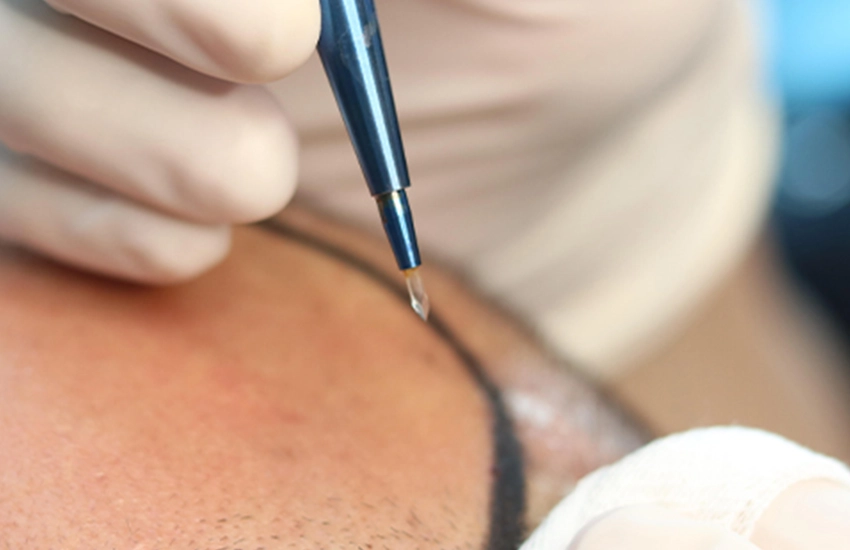
What is FUE hair transplantation and how does it work?
FUE stands for Follicular Unit Extraction. Hair follicles are removed individually from a donor area — most often the back and sides of the scalp — using a punch of less than one millimetre in diameter. No strip of skin is cut and no linear suture line is left behind; each extraction site heals as a pinpoint mark that becomes difficult to see once the surrounding hair grows out.
Hair does not grow as isolated strands. It emerges in natural groupings of one to four hairs called follicular units, and FUE is built around keeping these groupings intact. The unit is lifted with its own sheath and supporting tissue, held in a cooled preservation solution, then placed into the recipient area in the same orientation it had before. The procedure has three stages, and the quality of the result depends on all three:
- Extraction. Follicular units are harvested from the donor area at a spacing that protects its overall density.
- Channel opening. Micro-channels are created in the recipient area. Their depth, width, direction and angle determine how natural the outcome looks.
- Implantation. Each unit is placed into its channel one by one, with single-hair units at the front hairline and denser multi-hair units further back.
At Zen Polyclinic the channel-opening stage is carried out with fine diamond-tip instruments rather than conventional metal slits. A sharper, harder tip passes through the tissue with less resistance, allowing narrower channels sized closely to the follicle and reducing trauma to the surrounding skin.
Why the channel angle matters
Hair does not leave the scalp vertically. Depending on the region it exits at an angle of roughly 40 to 45 degrees, and in the crown it also follows a spiral direction. If channels are opened more steeply than the surrounding hair, the transplanted hair stands up differently from the native hair and the result reads as artificial even when the follicles survive perfectly well. Narrower channels also allow units to be placed closer together without compromising the blood supply between them. The hairline itself is planned individually: facial proportions, forehead height, the pattern of existing loss and the family history of hair loss are all considered before a single channel is opened.
Who is FUE suitable for?
Pattern hair loss. The most common indication is androgenetic hair loss in men and women, where the donor area at the back of the head remains resistant to thinning.
A receding or thinning front line. The frontal region and temples respond well because single-hair units can be used to rebuild a soft, irregular natural border.
Scar areas. Regions that no longer grow hair after a burn, injury or previous operation can often be covered, provided the tissue has adequate circulation.
Beard, moustache and eyebrow work. The same extraction principle is used to restore density in facial hair, with finer units selected for the eyebrow region.
Suitability is not decided from a photograph. Donor capacity, the stage and speed of hair loss, scalp condition, age and general health are assessed in person. In some cases the sensible plan is to stabilise ongoing loss first and to schedule transplantation afterwards, so that newly transplanted hair is not framed by hair that is still receding.
How the procedure proceeds
Consultation and planning. The scalp and donor area are examined, hair loss is staged, blood tests are requested and the hairline design and graft number are planned together with you.
Preparation. The donor area is trimmed and cleaned, the planned hairline is drawn on the scalp, and local anaesthesia is applied. The session typically lasts several hours, with short breaks.
Extraction and implantation. Follicular units are harvested one by one and kept in a cooled preservation solution, micro-channels are opened according to the planned direction and angle, and the units are then placed. In some plans the channel and placement steps are combined using an implanter pen.
Same-day discharge. The donor area is dressed and you go home the same day. Sleeping position, medication and the do-not-touch rules for the first nights are explained before you leave.

The first days and recovery
Small crusts form around the transplanted units within the first two to three days, and mild swelling of the forehead is common in the same period. The first wash is carried out at the clinic, usually on the third day; washing then continues daily at home with the routine you have been shown, and crusts generally clear within about ten days.
Most people return to desk work within a few days. Activities that raise blood pressure or cause heavy sweating — gym training, sauna, steam rooms, swimming pools and the sea — are postponed for around a month, and the scalp is kept out of direct sunlight in the same period.
Please share your chronic conditions, any blood thinners or other regular medication, and any previous scalp procedure before the session. Some medications need to be paused or adjusted in advance, and this decision belongs to your physician.
Who is it not suitable for?
- People whose donor area is insufficient to cover the area of loss
- Those with rapid, active loss that has not yet been stabilised
- People with an active scalp infection or an untreated skin condition of the scalp
- Those with uncontrolled diabetes, a bleeding disorder, or a condition making local anaesthesia inadvisable
- People with diffuse loss caused by an underlying problem — thyroid disease, iron or vitamin deficiency, certain autoimmune conditions — where the cause should be treated first
- Those with a tendency to keloid scarring
- Anyone under 18, and generally those whose loss pattern has not yet settled
When do results become visible?
Transplanted hair does not grow continuously from day one. Within the first two to six weeks most of the transplanted shafts shed while the follicle stays in place beneath the skin. This shedding phase is expected and is not a sign of failure.
New growth usually starts between the third and fourth month and is fine at first. Through months six to nine the hair thickens and the density becomes visible. The full picture settles at around twelve months, and in the crown it may take longer. The outcome varies from person to person, so no fixed density figure can be stated in advance.
Use alongside other treatments
Transplantation replaces hair in areas that no longer grow; it does not stop loss where hair is still present. For that reason it is often planned together with supporting treatments. Hair mesotherapy and hair growth factor applications support the scalp and existing hair, while DHI is an alternative placement technique preferred in certain plans, such as work between existing hair.