
Q Switched Laser
A pigment-selective laser that releases its energy in billionths of a second, breaking down brown spots, sun damage and tattoo ink into fragments the body can clear on its own.
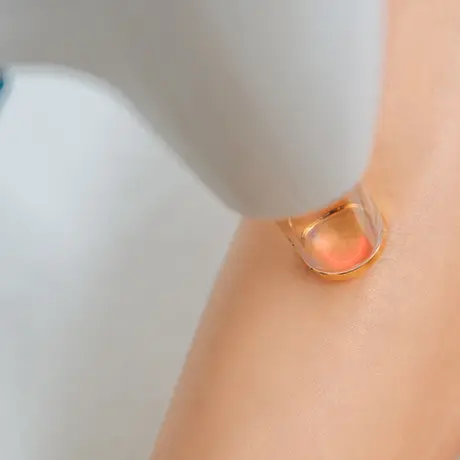
What is Q Switched laser and how does it work?
The name refers to the way the device stores and releases its energy. Instead of delivering a continuous beam, a Q Switched laser holds energy back and then discharges it in an extremely short pulse — measured in nanoseconds, that is billionths of a second. The total amount of energy is modest, but because it arrives so quickly, the peak power reaching the skin is very high.
That timing is what makes the laser selective. Dark pigment absorbs the light far more readily than the surrounding tissue does, so the energy is concentrated where the colour sits. The pulse ends before meaningful heat can spread outward, which means the pigment particle is shattered mechanically rather than the area being burned. This principle is known as selective photothermolysis.
Once the pigment is broken into smaller fragments, the laser’s job is finished. The rest is done by the body: the immune system gradually recognises and removes the debris through the lymphatic system, and superficial pigment may also shed with the skin surface. This is why the visible change continues to develop over weeks rather than appearing the moment the session ends.
Different wavelengths are absorbed by different colours, so device settings are chosen according to what is being treated — the shade of a pigmented lesion, the ink colour of a tattoo, and the natural tone of the surrounding skin all influence the plan.

When is it preferred?
Individual brown spots and sun spots. Discrete, well-defined pigmented marks respond well because the laser can target each one directly. Spots on the face, décolleté, forearms and lower legs — areas with years of cumulative sun exposure — are among the most common reasons for treatment.
Tattoo ink. The same shattering effect works on tattoo pigment held in the deeper layer of the skin. Black and dark blue inks absorb the widest range of wavelengths and generally respond most predictably; green, light blue, yellow and red behave differently and may need different settings or more sessions.
Small congenital or acquired pigmented marks. Certain benign pigmented lesions may be suitable, but only after they have been examined. Any mark that is changing in size, shape or colour must be assessed by a physician before any laser is considered.
Q Switched laser is best suited to a limited number of defined spots. When pigmentation is widespread, diffuse or melasma-type, a spot-by-spot approach is not the right tool — in those cases other options among our blemish treatments are discussed instead. Redness and visible vessels are a separate concern and are handled through capillary treatments.
How does a session proceed?
Assessment. The area is examined, your skin type is noted, and your medical history is reviewed — including any photosensitising medication, recent sun exposure and previous treatments in the same area. The nature of the pigment is confirmed before anything is treated.
Test spot. For tattoos and for larger pigmented areas, a small test area is often treated first. The response is observed before the full session is planned.
Preparation. The skin is cleansed and protective eyewear is fitted for both you and the practitioner. For tattoo work, a topical numbing preparation is usually applied and given time to take effect, since ink sits deeper and the sensation is stronger.
Application. The handpiece is passed over the target and the pulses are delivered. Most people describe a sharp flick, similar to an elastic band snapping against the skin. A stream of cold air is directed at the treatment area throughout to keep the surface comfortable.
Immediate response. Treated pigment typically turns grey or white for a few minutes — a normal, expected sign that the energy has been absorbed. Mild swelling and redness follow and settle over the following hours.
Aftercare. A soothing product and, where appropriate, an ointment are applied. Sun protection instructions and wound care guidance are given before you leave.
Who is it not suitable for?
The treatment is not appropriate for everyone. It is generally avoided or postponed in the following situations:
- Pregnancy and breastfeeding
- Recently tanned skin, whether from sun or from a tanning device
- Active infection, open wound or eczema in the treatment area
- Use of photosensitising medication, including isotretinoin and certain antibiotics
- A history of keloid or hypertrophic scarring
- Any pigmented lesion that has not been examined, or that is changing in appearance
- Light-sensitivity disorders
Tell us about every medication and supplement you use, along with any recent sun exposure, before your session. Some of these require only a delay rather than cancelling the treatment altogether.
What happens afterwards, and when are results visible?
A warm, stinging sensation is common for the first few hours. The treated spots darken over the next day or two and a fine scab or crust forms. That crust is part of the healing process — it must be allowed to separate on its own, usually somewhere between three days and two weeks depending on the site and how well it is protected. Picking it off risks a mark that lasts far longer than the original one.
Once the surface has healed, the area may look pink for a while before settling. Pigmented spots often show a clear change after the first session, though a second or third may be needed to even out the remaining colour. Tattoos work differently: each session lightens the ink in stages, sessions are spaced several weeks apart to give the body time to clear the fragments, and the total number required depends on ink colour, density, depth and how long the tattoo has been in place.
Sun protection is the single most important factor in the outcome. Ultraviolet exposure on healing skin can trigger new pigmentation in exactly the area that was just treated, which is why daily sunscreen and covering the area are part of the plan rather than an optional extra.
Use alongside other treatments
Q Switched laser addresses defined pigment; it does not change skin texture, pore appearance or fine lines. For that reason it is often planned as one element of a broader schedule rather than on its own. Where overall tone and texture are also a concern, other approaches may be sequenced around it, with enough recovery time between treatments so that healing skin is never treated twice in quick succession.
When several concerns exist together, the order matters. Pigment is usually addressed first, and other work follows once the treated areas have fully settled. The sequence is set during your assessment.