
DHI Hair Transplant
A hair transplantation technique in which follicular grafts are implanted directly through a fine implanter pen, without a separate channel-opening step.
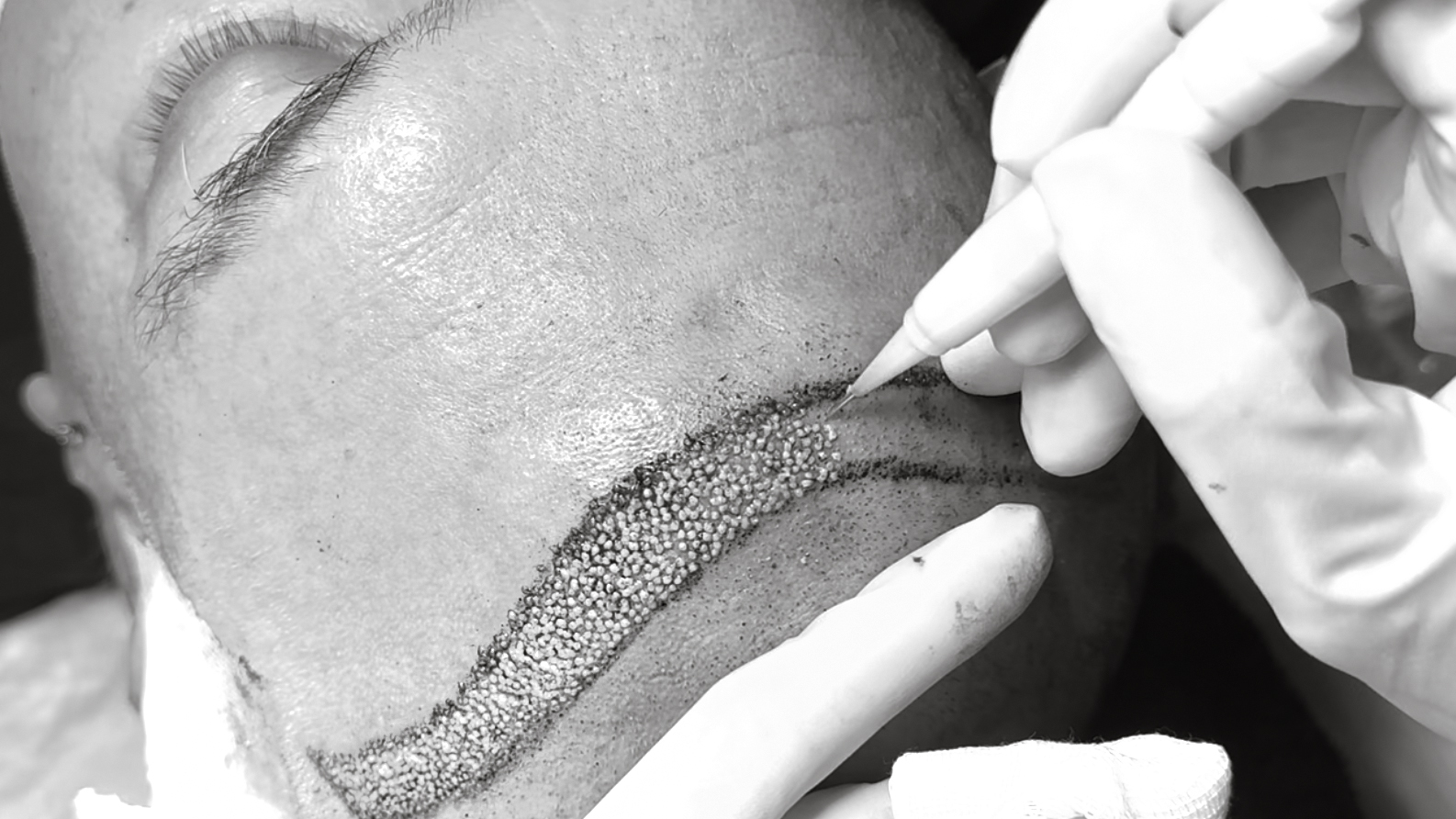
What is DHI hair transplantation?
DHI stands for Direct Hair Implantation. Like every modern hair transplant technique, it is based on moving follicular units from a donor area that is genetically resistant to hair loss — usually the back and sides of the scalp — to the area where hair has thinned or receded.
What distinguishes DHI is the way the grafts reach the recipient area. Instead of first opening recipient channels with a blade and then placing the grafts into them, the surgical team loads each graft into a hollow, cylindrical-tipped implanter pen. The pen creates the opening and releases the follicle into it in a single movement.
This changes three practical things during the procedure:
- Time outside the body is shorter. Grafts are implanted shortly after harvesting rather than waiting in a preservation solution while channels are opened.
- Angle, direction and depth are set graft by graft. The tip of the pen determines all three at the moment of placement, which is why DHI is often chosen for the hairline and other areas where direction is visually critical.
- Dense placement is easier to control. Because each opening is made immediately before a graft goes into it, follicles can be positioned closely without the openings being prepared in advance.
At Zen Polyclinic, DHI is planned after an examination in which the donor area, the pattern of hair loss and the general health of the scalp are assessed together.

How does DHI differ from FUE?
DHI and FUE are not competing philosophies; they differ mainly in the implantation stage. In classic FUE, harvesting, channel opening and graft placement are three separate steps. In DHI, the last two are merged into one.
Neither approach is superior in every situation. FUE remains practical when a very large area has to be covered in one session, since preparing channels in advance can be more efficient over a wide surface. DHI is frequently preferred for the frontal hairline, for small and medium sessions, and for cases where the recipient area still contains existing hair that must not be damaged.
In practice, the two are often combined within a single session — the hairline implanted with the pen, the rest of the area covered with the technique that suits it best.
When is DHI preferred?
Frontal hairline and temples. These are the areas people look at first, and they depend almost entirely on the angle at which hair emerges from the scalp. Setting that angle at the moment of implantation is the main reason DHI is chosen here.
Thinning rather than complete baldness. When native hair is still present, placing grafts between existing follicles without harming them is easier with a pen than with pre-opened channels.
Unshaven and partially shaven planning. DHI makes it possible, in suitable cases, to work without shaving the recipient area. Whether this is appropriate depends on the number of grafts needed, the length and density of existing hair and the size of the area.
Eyebrow and beard areas. Direction matters even more in these regions than on the scalp, which is why the same technique is used in eyebrow transplantation and beard transplantation.
How does the procedure progress?
Consultation and planning. Hair loss pattern, donor density, scalp condition and medical history are reviewed. Blood tests are requested before the procedure. The hairline is designed together with you and drawn before anything else begins.
Anaesthesia. The procedure is carried out under local anaesthesia. Sedation may be added so that the session, which usually lasts several hours, is more comfortable.
Harvesting. Follicular units are extracted one by one from the donor area with micro punches. Harvesting is distributed across the donor region so that its overall appearance stays even.
Implantation. Grafts are loaded into the implanter pens and placed one at a time, following the planned direction and density. This is the longest stage of the day.
Afterwards. Dressing and aftercare instructions are given the same day. The first wash is performed at the clinic, and follow-up appointments are scheduled to monitor healing.
Who is it not suitable for?
Hair transplantation is a surgical procedure, and suitability is decided individually. It is generally postponed or not recommended in the following situations:
- Insufficient donor capacity relative to the area that needs coverage
- Active, unstable hair loss that has not yet been evaluated and managed medically
- Uncontrolled chronic conditions, bleeding or clotting disorders
- Active scalp infection, or dermatological conditions in a flare-up phase
- Recent isotretinoin use, or medications that affect wound healing and bleeding
- Pregnancy and breastfeeding
- Under the age of eighteen, or an age at which the pattern of loss has not yet stabilised
Share your full medication list, chronic conditions and any previous scalp procedures during the consultation. Some medicines need to be paused before the procedure, and this decision belongs to the physician who examines you.
When do results become visible?
The timeline is the same for all follicular unit techniques, DHI included. Transplanted hairs typically shed within the first weeks — this is expected and is known as shock loss. It reflects the hair shaft being released, not the loss of the follicle itself.
Regrowth generally starts around the third to fourth month. The first hairs to appear are fine and light; they thicken gradually over the following months. Most of the change becomes visible between the sixth and ninth months, and the final appearance is usually assessed at the end of the first year.
Redness and small crusts in the recipient area settle within the first one to two weeks. Returning to desk work is usually possible within a few days, while exercise, swimming, sauna and direct sun exposure are restricted for a period specified by your physician.
Use alongside other treatments
A transplant relocates existing follicles; it does not stop the process that caused the thinning. For this reason, DHI is usually planned as part of a broader programme rather than as an isolated intervention.
Supportive applications such as hair mesotherapy, hair growth factor and Exosome and Stem Cell Treatment may be used to support the scalp and the native hair around the transplanted area. Whether and when they are added is decided according to your examination findings. Female patients are evaluated separately, since the pattern of loss and its causes differ — this is covered under hair transplantation for women.
Frequently asked questions
Is DHI painful?
The procedure itself is performed under local anaesthesia, so pain is not felt during harvesting or implantation. The injection of the anaesthetic is the part most people describe as uncomfortable. Mild tenderness in the donor area for a few days afterwards is common and is managed with the medication prescribed to you.
How long does a session take?
Most sessions take six to eight hours, including breaks. The exact duration depends on the number of grafts planned and the size of the area to be covered.
Do I have to shave my head?
The donor area is shaved in nearly all cases. The recipient area can be left unshaven in suitable situations, particularly in smaller sessions. This is assessed during planning, not decided on the day.
Is the transplanted hair permanent?
Follicles taken from the donor region keep their own genetic characteristics after being moved, which is why they are generally not affected by pattern hair loss. However, the untransplanted hair around them can continue to thin over time, so long-term follow-up matters.
Will there be visible scarring?
Both the harvesting punches and the implanter pen leave micro-openings rather than a linear incision. These heal as small points that are not usually noticeable once the hair grows, though healing characteristics vary from person to person.
Can a second session be performed later?
Yes, if the donor area still has sufficient capacity. A second session is normally considered only after the first has fully matured, which means waiting at least around twelve months.
When can I go back to work?
Office work is usually possible within three to five days. Physically demanding work, exercise, sauna, swimming pools and direct sunlight are restricted for longer, according to the aftercare plan given to you.