
Capillary Vessel Treatment
Visible capillaries on the face and legs are treated with laser light that is absorbed by the haemoglobin inside the vessel, closing it without damaging the surrounding skin.

What are visible capillaries and why do they appear?
Capillaries are the smallest blood vessels in the body and normally sit deep enough in the skin to stay invisible. When the vessel wall loses its elasticity and the vessel widens permanently, it starts to show through the skin as a fine red, purple or blue line. In medical terms this is called telangiectasia.
The face is the most common location, particularly around the nostrils, on the cheeks and on the chin, where the skin is thin and the vessels sit close to the surface. On the legs, wider vessels tend to appear on the thighs and behind the knees.
Several factors make the appearance more likely or more pronounced:
- Thin, fair or reactive skin, where vessels are visible with less dilation
- Rosacea, which involves persistent flushing and vessel dilation
- Long-term sun exposure, which weakens the collagen supporting the vessel wall
- Repeated exposure to extreme heat, cold or wind
- Dry and atopic skin with a compromised barrier
- Long-term use of topical corticosteroids, which thin the skin
- Hormonal changes, including pregnancy
- Frequent alcohol consumption, which triggers repeated flushing
- Genetic predisposition and a family history of the same pattern
- Vascular lesions such as spider angioma or port-wine stain
Visible capillaries are usually a cosmetic concern rather than a health risk. Because they can also accompany rosacea or an underlying venous problem in the legs, the cause is assessed before treatment is planned.
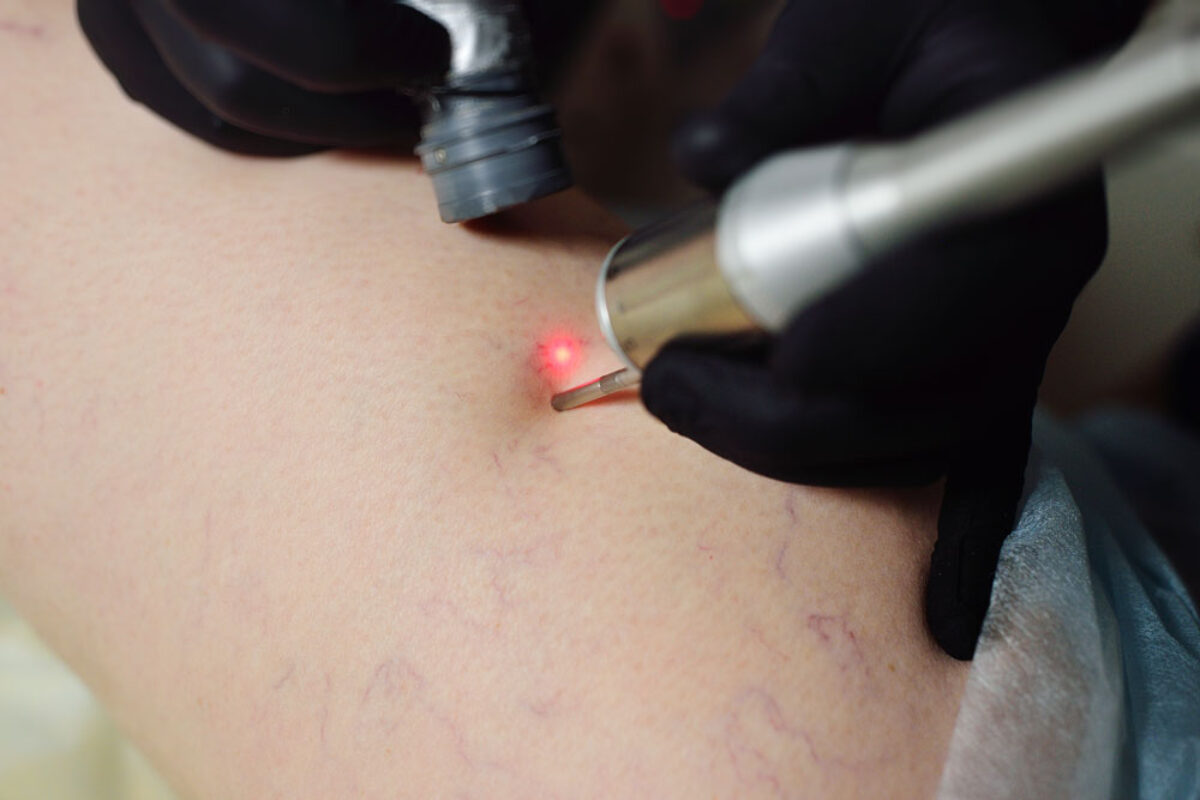
How does laser treatment work?
Laser treatment for capillaries is based on selective photothermolysis. The laser emits light at a wavelength absorbed far more strongly by haemoglobin, the red pigment inside the blood, than by the surrounding tissue. The absorbed light turns into heat inside the vessel, the wall collapses, and the vessel is cleared away by the body over the following weeks, leaving the skin around it largely unaffected.
At Zen Polyclinic, Nd:YAG laser is used for the dark red and blue-purple vessels visible on the skin surface. This wavelength reaches deeper than shorter ones and suits slightly thicker vessels and a wider range of skin tones.
This approach replaced the older technique of cauterising or “burning” the vessels, which spread heat through the skin in an uncontrolled way and reached only the most superficial vessels.
Which vessels respond well?
Fine facial capillaries. The thread-like red lines around the nose, on the cheeks and on the chin are the most common reason for treatment and generally respond well.
Diffuse redness and rosacea-related vessels. When the redness comes from many small dilated vessels rather than a few distinct ones, treatment is planned as part of the overall management of rosacea. Laser addresses the visible vessels; it does not remove the tendency to flush.
Spider angiomas. These small lesions with a central point and radiating branches are treated by targeting the central feeding vessel.
Leg veins of small diameter. Fine surface veins on the legs can be treated. Bulging varicose veins are a different condition and require assessment by a vascular specialist.
Vessel size, depth and colour all influence the response. Very fine, superficial vessels usually clear in fewer sessions than deeper or thicker ones.
How does a session proceed?
Assessment. The pattern of the vessels, the skin type and the medical history are reviewed. Medications, recent sun exposure, a history of cold sores and any bleeding disorder are all relevant and should be mentioned.
Test spot. The parameters are often trialled on a small area first, so that the response of your skin can be observed before the whole area is treated.
Preparation. The area is cleansed and protective eyewear is worn by everyone in the room. Contact cooling protects the surface of the skin during the pulses.
Application. The handpiece is guided along the course of the vessel and pulses are delivered point by point. A session for a small facial area typically takes fifteen to thirty minutes.
Afterwards. Treated vessels may darken or disappear immediately. Redness and mild swelling along the treated lines are expected and settle over the following hours to days.
What should be expected afterwards?
Temporary redness is the most common reaction, and it may last from a few hours to a couple of days. Slight swelling, a numb or tingling feeling, and occasional small bruises along the treated vessel are also within the expected range.
During this period the skin is more reactive than usual, so it helps to avoid heat sources such as ovens, hair dryers, saunas and hot showers, along with strenuous exercise, for the first day or two. Sun protection matters throughout the course of treatment and for several weeks afterwards.
Where a vessel lies very close to the surface, a small area of crusting can form. It should be left to heal and not picked. If crusting, blistering or any change in skin colour appears, contact the clinic rather than treating it yourself.
Who is it not suitable for?
Laser treatment of capillaries is a low-risk application, but it is not appropriate for everyone:
- People with bleeding or clotting disorders, or those using blood-thinning medication
- People with a known vascular disease or an untreated venous problem in the legs
- People taking photosensitising medication, including isotretinoin and certain antibiotics
- People with a recent tan or sunburn in the area to be treated
- People with an active skin infection or inflammation in the area
- People with a tendency to keloid scarring
- People with a photosensitivity disorder
- During pregnancy and breastfeeding
Share your full medication list, your recent sun exposure and any circulatory or bleeding condition before the session. Some of these require a delay rather than ruling treatment out altogether.
When do the results become visible?
Some vessels vanish during the session itself. Others darken first and then fade gradually as the body clears them, a process that usually takes two to six weeks. This is why the outcome of a session is assessed after that interval and not on the same day.
Most people need more than one session. Fine facial vessels often require two to four sessions spaced four to six weeks apart, while leg vessels and larger-calibre vessels generally take longer. The number depends on how many vessels are present, how deep they lie and how the skin responds.
A treated vessel is closed, but treatment does not stop new ones from forming. Where an ongoing cause such as rosacea or continued sun exposure remains, new vessels may appear over time and maintenance sessions may be considered.
Use alongside other applications
Capillary treatment is often planned together with other applications addressing the same area. When redness accompanies pigmentation, it may be scheduled alongside blemish treatments or a Q-switched laser session, with an appropriate interval between them. In rosacea, laser treatment of the visible vessels is combined with the topical or oral treatment prescribed by your doctor, since the two address different parts of the same problem.
Applications that heat or abrade the skin are not performed on the same area on the same day; the sequence and spacing are decided during planning.