
Hydrafacial
A device-assisted facial that combines gentle exfoliation, vortex cleansing of the pores and the delivery of hydrating serums in a single session, without needles or downtime.
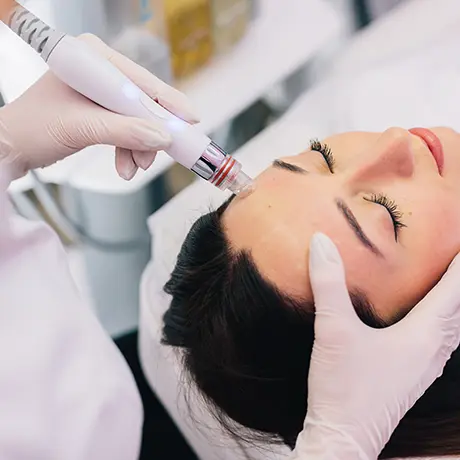
What is Hydrafacial and how does it work?
Hydrafacial is a medical skin care procedure carried out with a device that uses a spiral tip and controlled suction. The tip moves across the skin while a fluid circuit softens the surface, lifts away dead cells and the contents of clogged pores, and leaves a serum behind in the same pass. Because the suction is gentle and the abrasion is fluid-based, the skin is not scraped in the way that classic mechanical dermabrasion works.
A session is usually described in three connected stages:
- Cleansing and exfoliation. The surface layer of dead cells and the oily film that sits over it are loosened, so that the steps that follow can actually reach the skin.
- Acid peel and extraction. A mild glycolic and salicylic solution softens the plugs inside the pores; the vortex suction then draws out blackheads and sebum without squeezing.
- Hydration and antioxidant infusion. Serums containing hyaluronic acid, peptides and antioxidants are applied to skin that has just been cleared, which is the point at which it absorbs them most readily.
The serum content and the strength of the peel step are not fixed. At Zen Polyclinic the parameters are chosen after a skin assessment, according to skin type, sensitivity and the concern you want to address.

When is it preferred?
Congested pores and blackheads. This is the most common reason for choosing Hydrafacial. Suction-based extraction reaches the pore content without the pressure and irritation of manual squeezing.
Dull, tired-looking skin. Removing the accumulated dead cell layer changes how light reflects off the surface, so the skin looks brighter and more even shortly after the session.
Dehydration and rough texture. Skin that feels tight and flaky despite the use of moisturisers often responds well, because the exfoliation step removes the barrier that was preventing products from being absorbed.
Oily and acne-prone skin. The salicylic component helps with sebum control. Hydrafacial is a supportive care procedure here, not a treatment for active inflammatory acne, and it does not replace a dermatological plan.
Before an event. Since it does not usually leave visible redness for long, it is often planned a few days before an occasion. It is still sensible to leave a margin rather than booking it for the same day.
How does a session proceed?
Assessment. Skin type, sensitivity, current products, medication and any recent procedures are reviewed. Anything containing a retinoid or an acid is relevant, so mention it.
Preparation. Make-up and sunscreen are removed and the face is cleansed. Protective measures are taken around the eye area.
Application. The tip is passed across the face in sections. Most people describe the sensation as a cool, slightly scratchy pull rather than pain. A session generally lasts around 30 to 45 minutes depending on the steps included.
Finishing. A moisturiser and, when the session is during daytime, a sunscreen are applied. There is no waiting period; you can return to your day immediately, and make-up can normally be worn the following day.
Who is it not suitable for?
Hydrafacial is a low-risk procedure, but it is not appropriate for everyone:
- Anyone with an active skin infection, an open wound or a herpes outbreak in the area
- Skin with active, inflamed and widespread acne lesions, until it has settled
- People with a known allergy to any component of the serums used
- Anyone currently taking isotretinoin, or who recently finished a course of it
- Skin with severe rosacea or a marked sensitivity to contact and suction
- Skin that has recently undergone a laser procedure, a medium or deep peel, or a similar intervention that has not fully healed
Tell the clinic about the products you use and any medication you take before the session. Acids and retinoids in particular are usually paused for a few days beforehand so that the skin is not over-exfoliated.
When do the results become visible?
The change in surface quality is the fastest part. Clearer pores, a smoother feel and a brighter tone are usually noticeable the same day, and the effect tends to look its best a day or two later once any transient redness has faded.
The effect is not permanent. As the skin renews itself, dead cells and sebum accumulate again, which is why Hydrafacial is generally planned as a repeated routine rather than a one-off. Depending on skin type and the concern being addressed, sessions are commonly spaced about four weeks apart, and the interval is reviewed as the skin responds. Concerns that involve deeper layers, such as fine lines or established pigmentation, are not the target of this procedure and require a different plan.
Use alongside other procedures
Hydrafacial is often combined with other applications rather than used alone. Adding an LED mask session immediately afterwards is a frequent choice, since the skin has just been cleansed and the light reaches it without a barrier. When a more intensive renewal is planned, it may also be scheduled as preparation for or recovery support around a dermapen application, with an appropriate interval between the two. Whether the procedures are combined and in what order is decided during the assessment.