

Regenera Activa
A single-session procedure that uses a small sample of the person’s own scalp tissue to prepare a cell suspension, which is then injected into thinning areas to support the activity of weakened follicles.
What is Regenera Activa and how does it work?
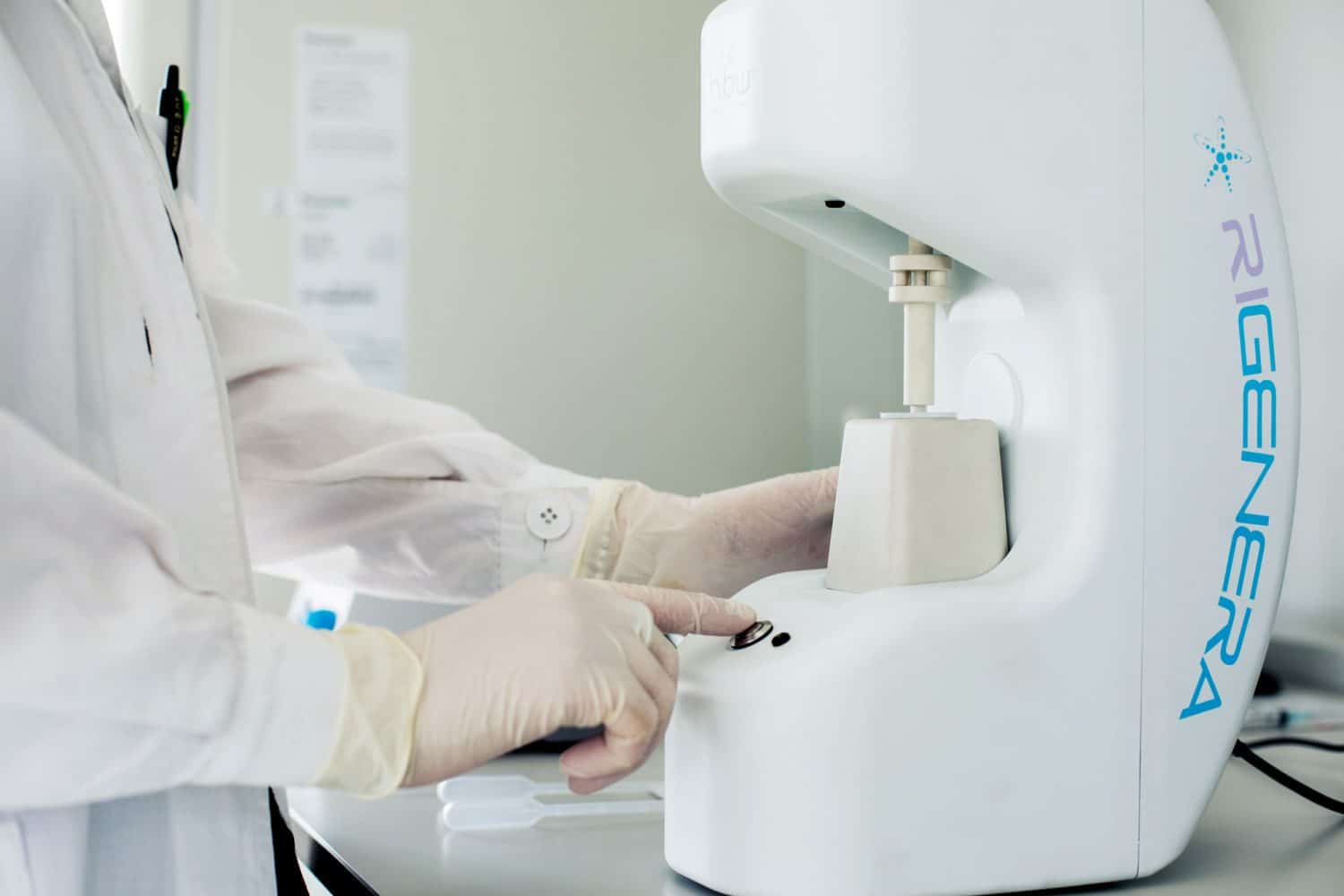
Regenera Activa is a regenerative scalp procedure carried out with the person’s own tissue. A few very small skin samples are taken from a healthy area of the scalp, processed mechanically in a dedicated device, and the resulting suspension of cells and cell fragments is injected into the regions where hair has thinned.
The rationale is that follicles in a thinning area are rarely lost all at once. Many of them shrink first — a process known as miniaturisation — producing shorter, finer, less pigmented hairs before they stop growing altogether. The aim of the procedure is to deliver regenerative and signalling elements from healthy follicular tissue into that environment, so that miniaturised follicles are supported rather than replaced.
Three points distinguish it from other supportive scalp treatments:
- The material is autologous. Nothing synthetic is added; the injected suspension is prepared from the person’s own scalp during the same appointment.
- The preparation is mechanical. The tissue is disaggregated and filtered by the device rather than treated chemically or cultured, which is why the whole process takes place in one visit.
- It is planned as a single session. Unlike treatments built around repeated monthly appointments, the standard protocol involves one application, with reassessment after several months.
Regenera Activa supports follicles that are still present but weakened. It does not create new follicles in an area where hair has been completely absent for a long time, and it is not a substitute for hair transplantation in advanced pattern loss.

When is it preferred?
Early and moderate pattern hair loss. The clearest candidates are people whose hair has become finer and sparser across the crown or frontal area but who still have visible hair in that region. The more miniaturised follicles remain, the more there is to support.
Diffuse thinning in women. Thinning that spreads over the mid-scalp while the hairline is preserved often responds better to supportive approaches than to surgery, particularly when there is no clearly defined bald area to cover.
Preparation for or support after hair transplantation. It may be planned to improve the condition of the existing hair around a planned graft area, or used later to support the native hair that was never transplanted.
People who prefer a single-session approach. For those who cannot commit to a series of monthly appointments, a one-visit protocol with a follow-up review is often more realistic.
How does the session proceed?
Assessment. The scalp is examined, the pattern and stage of thinning are recorded, and the density of remaining hair is evaluated. Medical history, current medication, and any diagnosed scalp condition are reviewed at this stage. If the loss appears to have a cause that needs investigating — thyroid disorder, iron deficiency, an inflammatory scalp condition — that is addressed first.
Preparation and local anaesthesia. The donor area, usually behind the ear or at the lower back of the scalp, is cleaned and numbed with a local anaesthetic. The areas to be treated are marked.
Sampling. Two or three very small skin samples, roughly 2.5 mm across, are taken from the healthy donor area. Because the samples are small and taken from a densely haired region, the sites are not visible once healed.
Processing. The samples are placed in the device, where the tissue is broken down and filtered into an injectable suspension. This takes only a few minutes and happens in the treatment room.
Injection. The suspension is distributed through multiple superficial injections across the thinning areas. The scalp has already been anaesthetised, so this stage is generally described as tolerable rather than painful.
Afterwards. The session as a whole usually takes under an hour. Mild redness or tenderness at the donor and injection sites is common and settles within a day or two. Washing the hair is normally postponed until the following day, and heavy exercise, saunas, and swimming pools are avoided for a short period.
Who is it not suitable for?
The procedure is minimally invasive, but it is not appropriate in every situation:
- Areas that have been completely bald for many years, where no follicular structures remain to support
- Scarring alopecia, where the follicle has been replaced by scar tissue
- Active infection, inflammation, or an untreated skin condition on the scalp
- Bleeding disorders or ongoing anticoagulant therapy that has not been reviewed by the prescribing physician
- Uncontrolled systemic disease, or active malignancy
- Pregnancy and breastfeeding
- Hair loss caused by an untreated underlying condition — the cause is investigated before any supportive treatment is planned
Please tell us about any medication you take, including blood thinners and supplements, and about any diagnosed scalp or systemic condition, before the session is scheduled.
When do results become visible?
Change is gradual, because it follows the natural rhythm of the hair cycle rather than overriding it. In the first weeks there is usually nothing visible; some people notice reduced shedding before they notice anything else.
Around the second and third month, hairs that were in a resting phase begin to re-enter growth, so new short hairs may be seen at the treated area. The most commonly described change is in hair quality — strands feel thicker and hold better — before any change in overall coverage is apparent.
The clearest assessment point is usually the fourth to sixth month, when the newly stimulated hairs have had time to grow to a visible length. A comparison at that stage, ideally supported by trichoscopic imaging taken before the session, gives a far more reliable picture than day-to-day observation.
Outcomes vary considerably between individuals. Age, how long the thinning has been present, its extent, genetic predisposition, and general health all affect the response, and no result can be promised in advance. Because pattern hair loss is a progressive condition, follow-up assessment is recommended, and a repeat session may be considered depending on how the scalp develops.
Use alongside other treatments
Regenera Activa is rarely planned in isolation. It is often combined with hair mesotherapy, which delivers vitamins and micronutrients into the scalp over a series of sessions, or with hair growth factor treatment, since these work through different mechanisms and address different parts of the problem.
Where hair loss is more advanced, it is considered a supportive rather than an alternative measure, and is planned around a surgical approach rather than instead of one. An overview of the supportive options available is given on the hair support treatments page.