Onda or Schwarzy? Different Goals for Fat and Muscle Tone
Do Onda and Schwarzy Serve the Same Purpose?
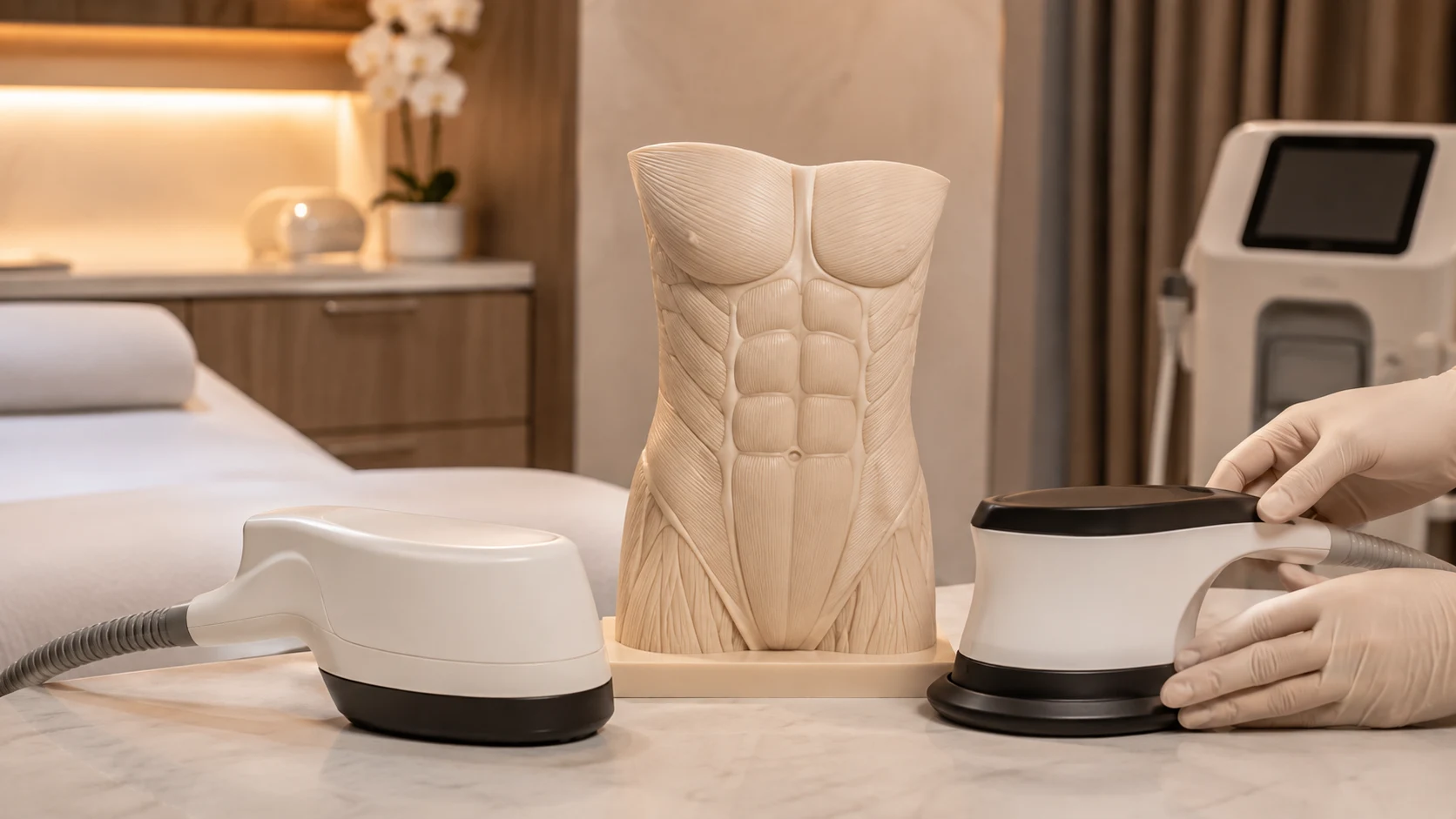
Onda and Schwarzy are often mentioned in the same sentence, which gives the impression that the two are interchangeable. In reality, these two technologies target different tissues and answer different questions. Onda is a microwave-based system that targets subcutaneous fat tissue and connective tissue. Schwarzy, by contrast, is a method that uses electromagnetic stimulation to force the target muscle groups into repeated contractions.
A single area can show both excess fat tissue and reduced muscle tone at the same time, which is why the two technologies can appear one after another in the same plan. However, this combination is not an automatic rule. Which technology takes priority — or whether both are even needed — becomes clear only through the tissue assessment carried out during the consultation. The decision depends as much on how the tissue behaves as on what the person wants to see.
The concrete consequence of confusing the two methods is starting the process with the wrong expectation. If someone who comes in with a muscle-tone goal is offered a fat-tissue-focused technology instead, the visible change will differ from what was expected. For this reason, the mechanism, application area, session experience, and limits of each technology are addressed separately below. The goal is not to decide which one is “better”, but which tool matches which goal.
How Does Onda Work, and Which Areas Is It Preferred For?
What Does Microwave Energy Do to the Tissue?
The Onda device sends controlled microwave energy into the subcutaneous tissue, creating a heat-based response in the fat cells and connective tissue. This response is not instant melting; it is a biological process that contributes to a gradual change in tissue quality over time. The goal is not to reduce the thickness of the fat layer in a single session, but to support the firmness of the tissue. That is why the effect is felt within the tissue’s own structure rather than on the skin surface.
Application Areas and Selection Criteria
Because the energy can reach different depths, it is not simply a surface-heating tool; it also targets the deeper connective tissue and fat cells. Skin temperature is monitored throughout the session, and the energy level is adjusted based on this feedback. This controlled approach aims to keep the tissue within a safe threshold without overheating. As a result, a tissue-level response occurs without leaving a visible mark on the surface.
The application area is chosen based on the person’s tissue thickness and the nature of their concern:
- Abdomen and the sides of the waist
- Inner and outer thigh
- Back of the arm
- Upper back and, in some cases, around the bra line
The choice of area is based not solely on visual preference but on the tissue assessment made during the consultation. Another factor considered when selecting the area is skin quality and the degree of existing tissue laxity. If sagging is advanced, Onda alone may not be sufficient. The energy level is adjusted gradually according to the person’s pain threshold and how the tissue responds during the session; a series is generally planned as four to eight sessions, and the total number varies depending on the initial condition of the area.
How Does Schwarzy Affect Muscle Tone?
Electromagnetic Stimulation and the Contraction Cycle
Schwarzy is a technology that puts the target muscle group through repeated contraction cycles using electromagnetic stimulation. This cycle occurs at a repetition frequency that would be difficult to reach through voluntary exercise. The goal is not to artificially increase muscle volume, but to contribute to increased tone in the muscle fibers. This distinction matters, because some patients come in expecting noticeable volume growth.
Contraction intensity is increased gradually during the session; the energy level is raised according to the person’s tolerance. Someone who exercises regularly and someone who is sedentary may experience a different intensity in the same session. The response of the muscle tissue to this repeated stimulation can contribute to working capacity over time. However, this contribution does not replace regular physical activity — it complements it.
Which Muscle Groups Is It Preferred For?
Schwarzy is applied to areas where muscle mass is relatively pronounced, such as the abdomen, buttocks, and thighs. When selecting the area, the fat ratio above the muscle group is considered along with its thickness, because a thick fat layer can change how intensely the contraction is felt. If there is noticeable fat accumulation around the waist, Schwarzy alone may not be sufficient. The muscle group’s relationship with posture is also taken into account when choosing the area.
A series generally covers a certain number of sessions, and this number is personalized according to the muscle group’s initial condition. The first visible change is usually noticed around the middle of the series. Wearing thin, comfortable clothing during the session helps the contraction be felt more clearly. Schwarzy is a more meaningful option in areas where muscle mass is already noticeable but tone is insufficient.
What Do You Feel During the Session?
The Onda Session Experience
The dominant sensation during an Onda session is gradual warming; the energy level is increased in a controlled way based on the skin’s response, and no uncomfortable stinging is expected. Skin temperature is checked at regular intervals to keep the energy within safe limits. Some people describe a mild pressure sensation midway through the session, but it does not reach the level of pain. Session length varies by area and is generally planned around half an hour.
After the session, mild redness and a warm sensation in the area subside on their own within a few hours. There is no downtime — the person can return to work or their routine immediately. It is recommended not to expose the area to direct sunlight for a few hours after the session. Rarely, a mild feeling of tightness can last around a day; this is not outside the expected course.
The Schwarzy Session Experience
During a Schwarzy session, strong, repeated muscle contractions are felt; for some people this is a tiring but painless experience. The contraction intensity is kept low at the start of the session and increased gradually according to the person’s tolerance. Throughout the session, a rhythmic pulsing is felt in the muscle group, similar to the final repetitions of an intense workout. The session is generally completed in around half an hour.
During the session, it is enough to lie still — the contractions are triggered by the device. A mild feeling of fatigue in the area may occur right after the session ends. Swelling is not expected; the following day, a muscle fatigue similar to that after an intense workout is normal and subsides within a day or two. Heavy training of the same muscle group should be postponed during this period.
How Are the Number and Frequency of Sessions Determined?
Number of Sessions with Onda
With Onda, the number and interval of sessions vary depending on the area and the targeted change — there is no single standard number. A series is generally planned as four to eight sessions. A gap of several weeks is left between sessions, which is necessary for the tissue to recover. After the first few sessions, the tissue response is reviewed to decide whether the plan should continue.
The tissue response is not evaluated by visual judgment alone; photographs and, when needed, circumference measurements help ground the plan in objective data. If no noticeable response is seen after the first four sessions in some areas, the energy level is reconsidered. As long as there is no major change in the person’s lifestyle, the series proceeds within the initially defined framework.
Number of Sessions with Schwarzy
With Schwarzy, a series generally covers a certain number of sessions, personalized according to the muscle group’s initial condition. Sessions can be scheduled several times a week, because the recovery speed of muscle tissue differs from that of fat tissue. The first visible change is usually noticed around the middle of the series. The tone increase achieved by the end of the series can be evaluated with the help of photographs.
When determining session frequency, the person’s daily level of physical activity is also taken into account. If the muscle group has a history of previous injury, this information is factored into the plan. Whether additional benefit is gained as the number of sessions increases is assessed at regular intervals. In the end, the number of sessions is determined less by a fixed formula than by individualized follow-up.
Why Is the Interval Between Sessions Planned This Way?
Recovery Time with Onda
With Onda, the interval between sessions is based on the time the tissue needs to respond to the heat effect and recover, and it is generally planned as a few weeks. Tissue remodeling is a process that takes time at the cellular level; more frequent repetition does not speed it up. A subsequent session performed before recovery is complete can make it harder for the tissue to respond with the same intensity. That is why increasing session frequency can delay the expected benefit rather than speed it up.
The length of the interval can vary by area; areas with a thicker tissue structure may need slightly longer to recover. The person’s sleep pattern and eating habits can also indirectly affect recovery speed. For this reason, the interval is not fixed at exactly the same number of days for everyone. Sticking to the planned interval matters for the consistency of the response achieved by the end of the series.
Muscle Rest with Schwarzy
With Schwarzy, the interval is based on the time given for the muscle fibers to rest and respond after an intense contraction cycle. Doing sessions too close together can increase muscle fatigue but does not speed up tone increase. If the interval is kept too short, a new stimulus is given before the tissue’s recovery process is complete, which can reduce the expected benefit. That is why the weekly frequency is adjusted according to how intensively the muscle group is used day to day.
If the person does regular heavy training, Schwarzy sessions can be planned so they do not overlap with training days. Interval planning takes into account not only physical fatigue but also the muscle’s long-term adaptation process. Both technologies follow a planned, patience-requiring series approach. Sticking to the session schedule is necessary for a consistent evaluation to be made at the end of the series.
How Do Swelling, Sensitivity, and the Healing Process Differ?
The First Hours and Days After Onda
No significant swelling is expected in the area after Onda, because the procedure does not cut or puncture the skin. Mild redness and a feeling of warmth are normal in the first few hours and usually subside by evening on their own. Some people may experience mild sensitivity in the area for a few days, especially if the energy level was kept high. This sensitivity is not severe enough to restrict daily activities.
On the first day, it is recommended not to expose the area to excessive heat, sauna, or a hot tub, because the skin has already undergone a heat-based procedure. Rarely seen bruising occurs in people with sensitive vascular structure and disappears on its own within a few days. Applying a gentle moisturizer to the area can improve skin comfort, but it is not a mandatory step. A return to daily life is possible immediately after Onda.
The First Hours and Days After Schwarzy
Swelling is again not expected after Schwarzy, because the procedure does not puncture or cut the tissue. On the other hand, muscle fatigue similar to that after an intense workout may be felt the following day and subsides within a day or two. This feeling of fatigue may be more pronounced in the first sessions and eases as the body gets used to the contraction cycle. Apart from mild tightness in the area, no change is expected on the skin surface.
During this period, drinking plenty of water is a simple habit that supports the muscles’ recovery process. Light stretching movements can reduce the feeling of fatigue, but heavy training of the same muscle group should be postponed for a few days. The need for pain relief medication is rarely seen during recovery; what is felt is generally not pain but mild fatigue. In both methods, the healing process is short and predictable, although individual response can vary.
Is the Appearance of Cellulite the Same as Regional Fat?
The appearance of cellulite and regional fat are often confused, but they point to two different tissue characteristics. Cellulite is a dimpled appearance on the skin surface caused by the relationship between subcutaneous fat tissue and connective tissue fibers, whereas regional fat is a relatively large fat volume in a specific area. Both can be seen together in one person, but one is not directly the cause of the other. Clarifying this distinction matters for choosing the right method.
Onda’s effect on connective tissue can contribute to the tissue irregularity that is one component of the appearance of cellulite; however, this does not mean cellulite will disappear completely. The appearance of cellulite is influenced by multiple factors such as genetic predisposition, hormonal factors, and tissue structure. In regional fat, the target is more about tissue volume and firmness, and Onda’s effect plays a more direct role at this point.
Schwarzy’s role in this distinction is different; by increasing muscle tone, it can indirectly help the tissue above look more toned, but it does not directly target the appearance of cellulite. If both the appearance of cellulite and loss of muscle tone are seen in the same area, using both methods together for different purposes in the same plan can be considered. The decision depends on the tissue assessment made during the consultation and varies from person to person.
Which Tissue Characteristics Bring Which Method Into Consideration?
If subcutaneous fat tissue is pronounced and the main concern is tissue volume, Onda may be considered a priority. If muscle mass appears weak and the goal is a more defined muscle line, Schwarzy may come to the fore. This distinction is not a strict rule; it is personalized through the tissue and posture assessment made during the consultation. Priorities can change over time in the same person, because tissue response and lifestyle are not constant.
For example, it is possible to focus on fat tissue in the first series and then move on to muscle tone in a later stage. If there is postural imbalance or muscle imbalance, this is also factored into the assessment. If skin elasticity is low, focusing on fat tissue alone may not seem sufficient. All of these assessments are considered together with the person’s general health history.
Body mass index and overall weight distribution are among the factors that affect tissue characteristics; in an area with significant excess weight, Onda’s effect may remain limited. How frequently the muscle group is used daily is another determining factor — muscle tone loss can be more pronounced in a sedentary lifestyle. In these cases, Schwarzy is considered as a complement to regular movement. Determining the right method relies on assessing multiple factors together.
Can Onda and Schwarzy Be Planned Together, and How Is the Order Decided?
When excess fat tissue and reduced muscle tone are seen in the same area, applying the two technologies in sequence on different days can be considered. In some approaches, the fat-tissue-focused series is completed first, and muscle tone is addressed afterward, because as the fat layer decreases, the visibility of the muscle line can be assessed more clearly. For example, in the abdominal area, tissue volume may first be reduced with a few Onda sessions, and then the muscle line is worked on with Schwarzy. This order is not always mandatory, but it is a commonly seen preference.
There are also cases where the order is reversed; if muscle tone is markedly low and fat tissue is relatively minor, priority may be given to Schwarzy first. This decision is based on consultation findings about which tissue affects the visual outcome more. Rather than applying the two technologies on the same day, spreading them over different days is generally preferred. This planning is shaped according to the person’s tissue condition.
Combined planning is not necessary in every case — it is only an option; sometimes a single technology is considered sufficient for the targeted change. This decision is not based on personal preference alone but on the tissue assessment. The evaluation made during the consultation clarifies which method will actually contribute. This approach is also meaningful for reducing unnecessary session numbers.
These Methods Are Not a Weight-Loss Program
Neither Onda nor Schwarzy is used for the purpose of weight loss or obesity treatment. They do not aim for a general reduction in body weight; they are supportive approaches that contribute to the regional appearance of tissue. Weight loss happens through a metabolic process across the whole body, whereas these two methods create an effect only in the area where they are applied. Turning to these methods with a general weight-loss expectation creates an unrealistic expectation.
They do not replace a balanced diet and regular movement — on the contrary, they gain meaning alongside these habits. In a person who does not maintain regular physical activity, the supported tissue firmness or muscle tone may not be maintained at the expected level over time. Some people may see these methods as a quick fix, but a realistic expectation plays an important role in preserving the result.
In a person diagnosed with obesity, these methods are not offered as a primary solution — a different medical approach may be considered. No result is guaranteed in centimeters or kilograms; tissue response varies from person to person, by lifestyle, and by starting condition. This uncertainty does not mean the method is ineffective — it is simply a natural consequence of individual variation.
Who Is It Not Suitable For, and When Is It Postponed?
In situations such as pregnancy, active skin infection, or the presence of a pacemaker or metal implant in the area, one or both of these methods may not be suitable. In such cases, the procedure is not canceled but can be postponed to a suitable time, or a different area can be considered instead. The main points questioned during the consultation before the suitability decision are:
- Pregnancy or breastfeeding period
- Presence of a pacemaker or metal implant in the area
- Active skin infection or open wound
- Use of blood thinners or a history of bleeding disorders
A history of chronic illness, medications used, and previous surgeries should be shared during the consultation. The suitability decision becomes clear only after this information and the tissue structure of the area are assessed.
If blood thinners or medications that increase skin sensitivity are being used, this information should also be shared, because the session plan can be adjusted accordingly. If another aesthetic procedure was recently performed on the area, performing the two procedures too close together is not recommended. In people with a history of cardiac arrhythmia or a serious musculoskeletal condition, the suitability of Schwarzy is assessed separately. If there is an open wound or serious irritation, Onda treatment in that area is postponed.
Suitability during breastfeeding is assessed individually — the decision is based on the person’s health condition rather than a standard rule. If the person recently had a serious illness or is in the recovery process after surgery, the procedure can be postponed. These postponements do not mean a permanent ban; the procedure can be reassessed once the appropriate time comes. Being cautious in uncertain situations provides a safer outcome in the long run.
The Role of Lifestyle in Preserving the Result
After the series is completed, preserving the achieved change is largely related to diet, activity habits, and weight stability. Sudden weight gain can affect both the tissue quality supported with Onda and the visibility of the muscle line worked on with Schwarzy. Even after the series ends, maintaining lifestyle habits directly affects how long the result remains visible. This shows that neither method is a sufficient solution on its own.
Regular water intake, a balanced diet, and weekly physical activity create a supportive foundation for both fat tissue and muscle tissue. Disrupted sleep patterns and chronic stress can indirectly affect tissue appearance by disturbing hormonal balance. These factors alone do not determine the outcome of a procedure, but they do affect how long the result is preserved. Large, sudden changes in lifestyle can cause the achieved change to reverse faster than expected.
Follow-up sessions are an important opportunity to assess whether the result is being maintained. For some people, a touch-up session once or twice a year can be planned, but this is not a standard requirement for every patient. Preserving the result is possible through a sustainable lifestyle rather than through a single procedure. For this reason, patients are clearly told before the procedure that the process is not a one-time solution.
Measurement, Realistic Expectations, and Common Misinformation
In tracking results, the scale alone is not a reliable measure, because these methods target tissue appearance, not weight loss. Circumference measurements and photographs taken at a standard angle and lighting are practical ways to track change more objectively. These measurements are compared before the sessions and at the end of the series to assess how much tissue response has actually occurred. A realistic expectation starts with accepting that these measurements will show a moderate change rather than a dramatic one.
Some of the common misinformation circulating online stems from an incomplete understanding of how the two technologies work:
- “A single session gives a permanent result” — whereas both Onda and Schwarzy work on a cumulative series logic
- “It replaces exercise or diet” — whereas both play a supportive role and do not work independently of lifestyle
- “The more often it is applied, the faster the result” — whereas ignoring the tissue’s recovery time can reduce the expected benefit
If unexpectedly prolonged redness, severe pain, or a permanent change in skin color is noticed in the area after a session, consulting the clinic is recommended. Such findings are not common, but when noticed, it is more appropriate to request an assessment rather than wait for them to resolve on their own. If the expected change does not appear at all during the planned series, this is also a reason for a check-up. Consultation and follow-up processes are the fundamental steps that ensure the procedure proceeds safely and in line with its purpose.
The information in this article provides a general framework; which technology or combination is suitable for you becomes clear only after a personal tissue assessment, and what is shared here does not replace a medical diagnosis or a guarantee of a specific result. For detailed information about Onda, see the Onda page; for Schwarzy, see the Schwarzy page; to plan according to your goal, you can request an appointment.
Frequently Asked Questions (FAQ)
Can Onda and Schwarzy be applied in the same session?
Onda and Schwarzy can be planned on different areas or in separate time slots on the same day, but combining the two is not a mandatory rule. The decision is made based on the tissue assessment done during the consultation and the person’s priority; in some cases, a single technology is considered sufficient for the targeted change. Rather than applying the two methods to the same area back to back, they are generally spread over different days so each tissue can comfortably complete its own recovery process. Combined planning only comes up when excess fat tissue and reduced muscle tone are seen together in the same area.
How long does muscle soreness last after Schwarzy?
The muscle fatigue felt after Schwarzy generally subsides on its own within one to two days, following a course similar to the fatigue felt after an intense workout. Swelling is not expected during this process; what is felt is mostly the muscle’s natural response to repeated contractions. If the pain is severe, lasts longer than three days, or there is unexpected swelling in the area, an assessment should be requested. During this period, heavy training of the same muscle group should be postponed, and light stretching movements are preferred instead. Drinking plenty of water and getting adequate rest are simple habits that support the muscle’s recovery process.
How many sessions does Onda require?
The number of Onda sessions varies depending on the tissue thickness of the area, the nature of the concern, and the scope of the targeted change — there is no single standard number. A series is generally planned as four to eight sessions, with a gap of several weeks left between sessions. This interval is based on the time the tissue needs to respond to the heat effect and recover, and it should not be skipped. After the first few sessions, the tissue response is reviewed to decide whether the plan should continue and whether the energy level needs to be updated. The exact number of sessions becomes clear only through the tissue assessment done during the consultation.
Do Onda or Schwarzy cause weight loss?
No, Onda and Schwarzy are not used for weight loss or obesity treatment; neither aims for a general reduction in body weight. They are supportive approaches that contribute to the regional appearance of tissue, and they do not replace a balanced diet and regular movement. No result is guaranteed in centimeters or kilograms, because tissue response varies from person to person, by lifestyle, and by starting condition. Turning to these methods with a general weight-loss expectation creates an unrealistic expectation and can lead to dissatisfaction. In people diagnosed with obesity, the priority is to consider a different medical approach.
Is the appearance of cellulite the same as regional fat?
The appearance of cellulite is a dimpled look on the skin surface caused by the relationship between subcutaneous fat tissue and connective tissue fibers, whereas regional fat is a relatively large fat volume in a specific area. Both can occur together in one person, but one is not directly the cause of the other, and they need to be assessed separately. Onda’s effect on connective tissue can contribute to one component of the appearance of cellulite, but this does not mean the condition will disappear entirely. The appearance of cellulite is influenced by multiple factors, such as genetic predisposition and hormonal factors, so no single technology can promise a definitive solution.
In which situations are these procedures postponed?
In situations such as pregnancy, active skin infection, or the presence of a pacemaker or metal implant in the area, one or both of these methods may not be suitable. Conditions such as blood thinner use, a history of serious musculoskeletal problems, or cardiac arrhythmia are also questioned separately during the consultation. If another aesthetic procedure was recently performed on the area, performing the two applications too close together is not recommended. These situations do not mean a permanent ban — the procedure can generally be reassessed once the appropriate time comes. The final suitability decision becomes clear only after the person’s health history and the tissue structure of the area are assessed together.
When do results start to become visible?
Although tissue response varies from person to person, visible change is generally noticed in the later weeks of the series, with the first noticeable effect usually appearing around the middle of the series. A sudden, dramatic result should not be expected from a single session, because change in both tissue and muscle tone is a cumulative process. The assessment is supported with circumference measurements and photographs taken at a standard angle as the series progresses. How quickly the result becomes noticeable is also closely related to the area’s starting condition and the person’s lifestyle habits.
Are these methods necessary for people who exercise regularly?
Even in people who exercise regularly, tone or tissue volume in certain areas may not reach the targeted level; in this case, Onda or Schwarzy can be considered as a supportive option. Neither method replaces exercise — on the contrary, they can contribute to a more consistent result in people who maintain regular physical activity. Schwarzy can be a more meaningful option in areas where muscle mass is already noticeable but the tone is not at the desired level. In areas with regional fat resistance, Onda can be included in the assessment. The decision is shaped by the person’s individual goal and the tissue assessment made during the consultation.