Jawline and Beard Line Aesthetics for Men: Defined Contours with Filler and Beard Transplant
Jawline aesthetics for men is the whole set of mostly non surgical treatments aimed at improving the sharpness and width of the jaw line and the clarity of the transition between the lower face and the neck. A jaw line that has become indistinct, a chin that sits too far back, fat accumulation in the submental area, volume loss in the lower face and an irregular or sparse beard border are the most frequently seen findings of this picture. In the male face the jaw line is a structural line that carries the strength and symmetry of the expression; even a small amount of indistinctness can therefore make the face look tired and shapeless. So how exactly are jawline aesthetics for men planned, why are jawline filler and beard transplantation considered together, how long do results last, who is suitable and what should a realistic expectation look like? In this comprehensive guide, we address all these questions in detail.
What Are Jawline Aesthetics for Men?
Jawline aesthetics for men is not the name of a single procedure but a planning approach that treats the lower face as a whole. This planning works on three separate layers: the visible frame of the bone skeleton, the volume and distribution of the soft tissue, and at the very top the visual border drawn by the beard line. In one patient only the chin may sit too far back, while in another the bone structure may be adequate yet the fat line in the submental area is hiding it. At Zen Polyclinic the first step is therefore not to choose a procedure but to determine which layer is responsible. When the correct layer is not identified, even the best technique fails to give the expected result.
What Determines a Defined Jawline?
A sharp jaw line has four anatomical components. The first is adequate forward projection of the chin. The second is the definition of the gonial angle, the rear corner of the jaw bone; this corner is the bony prominence felt below the earlobe. The third is that the line running along the jaw border is uninterrupted and straight. The fourth is that the cervicomental angle beneath this line, that is, the transition angle between chin and neck, is narrow. When any one of these four components weakens, the jaw line disappears visually. Aesthetic planning begins with determining which component is lacking, because each component requires a different solution.
Why Does the Jawline Become Indistinct?
The causes of an indistinct jaw line fall into two groups, genetic and acquired. The genetic group includes a small or posteriorly positioned chin, a narrow gonial angle and congenitally weak bone support. The acquired group includes age related bone resorption, downward displacement of the fat pads under the skin, skin laxity due to collagen loss, fat accumulation in the submental area with weight gain and excess skin after weight loss. In addition, long term poor head posture and weakening of the neck muscles widen the transition angle and hide the line. More than one of these causes is present at the same time in most patients, and treatment is therefore planned as a combination.
What Is the Difference Between Male and Female Jawline Aesthetics?
This distinction is the most critical determinant of a natural result. In the male face the goal is to build a wide, angular frame for the lower face: the chin should be broader and flatter, the gonial angle should be defined and emphasised outward, and sharpness should be maintained along the line. In the female face, by contrast, the goal is a softer lower face that tapers forward and narrows into a V shape. Applying the same product in the same quantity to the same points gives very different results in the two sexes. If a male patient is treated with a female template the face looks feminine and artificial. The practitioner must therefore be experienced in male facial anatomy. We also discuss medical aesthetics for men in a separate guide.
What Is Jawline Filler?
Jawline filler is a non surgical application in which the bone frame is visually strengthened with filler material placed along the jaw border and into the gonial angle region. The aim is not to inflate the skin but to add a structural support layer on top of the bone; the injection is therefore made in a deep plane, directly onto the bone. The procedure takes twenty to forty minutes, is comfortably tolerated with topical anaesthetic cream or the lidocaine in the product, and the result is visible the same day. Jawline filler is considered first of all in male patients whose bone support is insufficient, who have irregularity along the line and who are not considering surgery.
Which Products Are Used in Jawline Filler?
The fillers used in this region differ from those used in the lips or under the eyes. Because the goal in the jawline is structural support, hyaluronic acid fillers with high cross linking, high cohesivity and a high G prime value are preferred; these products keep their shape under pressure and create a lasting frame on the bone. Soft fillers spread in this region and do not create sharpness. In some cases products containing calcium hydroxyapatite, which stimulate collagen production, may also be used. As important as product choice is the quantity used: a male jawline typically requires a volume of between four and eight millilitres, and this amount may not be given in a single session.
How Is Jawline Filler Applied?
Before the application the patient is assessed in a seated position and the jaw border, gonial angle and chin are marked with a pencil. Entry points are determined with the routes of vessels and nerves taken into account. The product is usually placed onto the bone in small deposits with a blunt tipped cannula or a sharp needle, and then gently shaped with the fingers. The order of application matters: structural points such as the gonial angle and the chin are supported first, and then the line between them is completed. If this order is not followed the line may look wavy. At the end of the procedure the patient is assessed in front of a mirror and, if necessary, symmetry is corrected in the same session. The total duration does not exceed forty minutes.
What Does Chin Filler Add to the Jawline?
The chin is the centre of the lower face, and when this point sits too far back the entire jaw line is visually erased. In men the goal of chin filler is to project the tip forward and widen its base; no tapering is created. Ideally the chin, viewed in profile, should be on the same plane as the front line of the lower lip or only very slightly behind it. When this support is provided, the transition angle between neck and chin also narrows indirectly and the submental appearance decreases. Chin filler is therefore regarded as an inseparable part of jawline filler; when the two are planned together the result is markedly more balanced.
How Long Does Jawline Filler Last?
Longevity varies according to the density of the product used, the area treated and the person’s metabolism. The highly cross linked hyaluronic acid fillers used in the jawline region usually maintain their effect for between twelve and twenty four months; because they are placed onto the bone and there is little movement in this region, they last longer than in mobile areas such as the lips. With products containing calcium hydroxyapatite the duration may be longer. In men with a fast metabolism, who do regular and intense sport, or who smoke, absorption occurs more quickly. When the effect begins to fade a top up session is planned; this session usually requires less product than the first application.
How Does Masseter Botox Affect the Jawline?
The masseter is the strong chewing muscle that closes the jaw, and when it becomes overdeveloped it widens the lower face and makes the face look square. In women this muscle is reduced with botox to narrow the face; in men the situation is more nuanced. In men a certain masseter volume is a desirable feature for a strong, angular lower face. However, when excessive hypertrophy develops due to clenching and night time grinding, the muscle overflows well below the gonial angle and blurs the line. In this situation botox applied at a controlled dose both clarifies the line and reduces complaints such as jaw joint pain and headache. The dose must be chosen more moderately in men than in women.
How Does a Double Chin Hide the Jawline?
Fat accumulation beneath the chin visually eliminates the jaw line even when the bone structure is adequate, because what creates sharpness is the shadow beneath the line and fat fills this shadow. Fat in this region is one of the most resistant to diet and exercise. Non surgical options include injection lipolysis, in which substances that dissolve the fat cell membrane are injected, cryolipolysis, which crystallises the fat cell with cold, and radiofrequency applications that tighten the skin. You can find the details of these approaches in our double chin reduction guide. Two to four sessions are usually required.
What Is Beard Line Aesthetics?
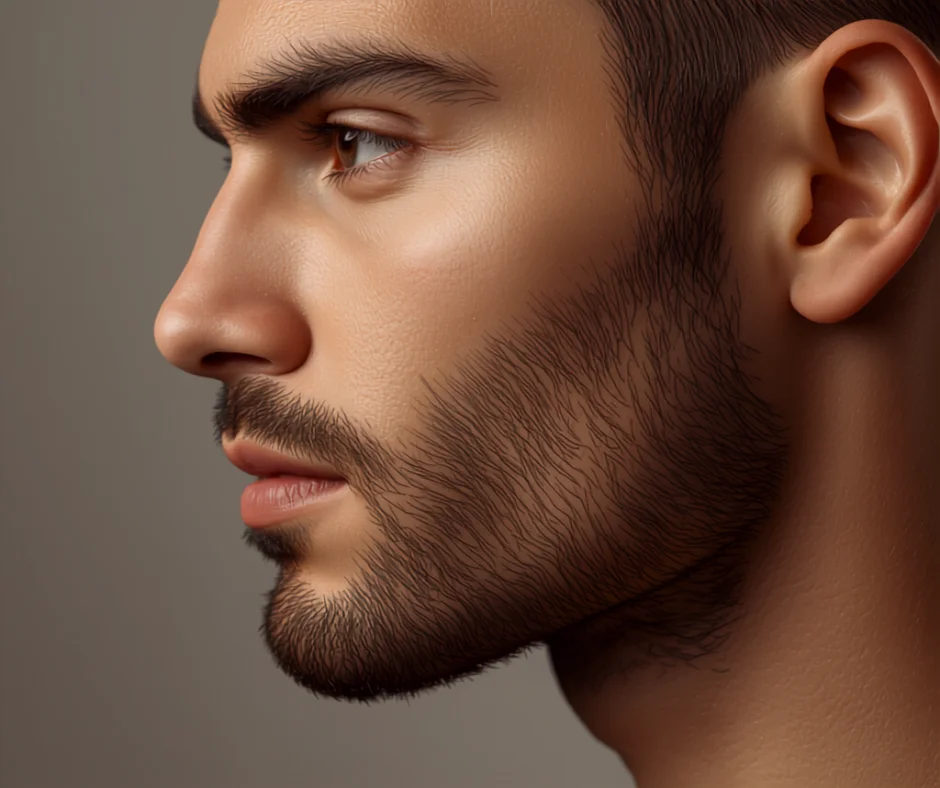
The beard line is a second line that sits on top of the jaw line and visually emphasises it. A well defined beard border can make the lower face look defined even when the bone structure is moderate; conversely, a sparse, patchy or irregular beard hides even a strong bone structure. The goal of beard line aesthetics is to create a clear upper border on the cheeks, uninterrupted density along the jaw border and a clean lower border on the neck. When these three borders are achieved the face is optically perceived as more angular. For this reason the state of the beard must always be assessed when planning the jawline; the two structures cannot be considered independently of each other.
What Is a Beard Transplant and How Is It Performed?
A beard transplant is a procedure in which permanent hair roots from the nape region are removed one by one and placed into the sparse or empty areas of the beard at their natural exit angle. It is performed under local anaesthesia, takes three to six hours depending on the number of grafts and is carried out on an outpatient basis. The critical point in a beard transplant is the angle: beard hairs emerge from the skin at a very narrow, almost flat angle and point downward. If the channels are not opened at this angle the hairs stand upright and look artificial. Single hair grafts are used in the cheek region, while a limited number of double hair grafts are used in the chin and sideburn areas.
How Many Grafts Are Needed in a Beard Transplant?
The number of grafts needed varies considerably according to the targeted area. To define only the border of the jaw line, eight hundred to one thousand five hundred grafts may be sufficient. If there are obvious gaps in the cheeks this number rises to between one thousand five hundred and two thousand five hundred. When a full beard design including sideburns and moustache is involved it may reach three thousand grafts and above. The capacity of the donor area sets the limit of this planning; in patients who may need a hair transplant in the future, work must preserve the donor reserve. More grafts do not always give a better result; in the beard a natural appearance comes from distribution and directional harmony rather than density.
How Does Recovery Progress After a Beard Transplant?
Mild swelling and redness of the face are seen in the first two days after the procedure. Small crusts form in the transplanted area and fall off on their own between the fifth and tenth day; the crusts must not be picked. The area is not wetted for the first three days, after which gentle washing is started as recommended by the physician. Shaving can usually be done after the tenth day, at first with a machine; waiting three weeks is recommended before using a razor. Sport, saunas, swimming pools and sleeping face down are avoided in the first week. Most patients return to daily life the next day; however, because of the redness it is comfortable to plan leave for the first three to four days. The punctate marks remaining in the donor area are covered by hair.
When Are the Results of a Beard Transplant Visible?
The transplanted hairs enter shock loss within two to four weeks; this is a completely expected stage and does not mean the follicle has been lost. New hairs start to emerge in the third month, obvious density forms in the sixth month, and the final appearance becomes clear between the ninth and twelfth month. Because beard hairs are thicker than scalp hair, their covering power increases rapidly as the result develops. The graft survival rate averages between eighty five and ninety five per cent. Because they originate from the nape, the transplanted hairs are permanent and grow like a normal beard; regular shaping is therefore required. In patients who want more density a second session can be planned a year later.
Why Is the Combination of Filler and Beard Transplant Effective?
These two applications are not alternatives but complementary solutions, because they work on different layers. Filler organises the bone frame and volume distribution of the lower face; that is, it creates the line itself. A beard transplant adds a visual emphasis on top of this line and increases how clearly the line is perceived. In a patient with weak bone support, a beard transplant alone leaves the line indistinct even if the beard is dense. Conversely, in a patient who has had filler but whose beard is patchy, the sharpness of the line is visually broken up. When the two layers are planned together the result is more defined than the sum of the two procedures taken separately.
Which Procedure Should Be Done First?
Sequencing is a planning decision that directly affects the quality of the result. The general approach is to create the bone frame with filler first and then plan the beard transplant, because the beard design is positioned more accurately when it is drawn onto the newly formed jaw line. Waiting at least two to three weeks after filler is necessary for the oedema to resolve completely and for the true position of the line to become clear. If the beard transplant was done first, filler waits for the complete healing of the transplanted area, that is, at least three months. If there is excess fat in the submental area, this problem is ideally addressed before both procedures, because the true potential of the line is only seen once the fat has reduced.
How Is Facial Analysis Performed in Jawline Planning?
Assessment is not made by looking only at the chin region; the face is analysed as a whole. The patient is examined in a seated position, in a natural head posture and from the front, from the profile and at a forty five degree angle. Chin projection, definition of the gonial angle, the chin to neck transition angle, the volume situation of the midface, skin elasticity and the thickness of fat in the submental area are each evaluated separately. Beard density, the regularity of the borders and the distribution of empty areas are mapped. Photographic records are kept both for planning and for comparison of results. At Zen Polyclinic no procedure is planned without this analysis, because different anatomical causes lie behind the same complaint in different patients.
How Is Preparation Made Before the Procedure?
Preparation consists of simple steps that reduce the risk of complications and speed up healing. Blood thinning medicines and aspirin are stopped with the physician’s approval and, where possible, a week beforehand; supplements such as fish oil, vitamin E and ginkgo are also stopped because they increase the risk of bruising. Alcohol is not consumed for twenty four hours before the procedure. If there is an active skin infection, active acne or a cold sore the procedure is postponed. In patients planned for a beard transplant blood tests are requested and smoking is reduced at least a week in advance, because smoking lowers the graft survival rate. If there is an important social event, the procedure should be planned at least two weeks beforehand.
How Are Aftercare and Swelling Managed?
For the first forty eight hours after filler the area must not be massaged, the patient must not sleep face down and heavy sport must be avoided. Saunas, Turkish baths and hot showers are not recommended for the first three days. Cold compresses reduce swelling but direct contact with ice is avoided. Swelling is usually at its highest on the second day and decreases markedly by the fifth day; if there is bruising it resolves within one to two weeks. After a beard transplant the area may itch; scratching must be strictly avoided because it leads to graft loss. After both procedures, drinking plenty of water, reducing salt intake and sleeping with the head slightly elevated speed up the resolution of oedema.
What Are the Risks and Side Effects?
These applications are safe in experienced hands; however, like every medical procedure they carry risk. The expected effects of filler are swelling, tenderness and bruising, and they resolve on their own. Rarely seen situations include asymmetry, irregular distribution of the product, nodule formation and, very rarely, vascular occlusion; for this reason it is essential that the application be performed by a physician who knows the vascular anatomy of the region. The existence of a dissolving agent for hyaluronic acid fillers is an important safety advantage. In beard transplantation, folliculitis, temporary numbness, redness and rarely graft loss may be seen. In both procedures sterile conditions and correct patient selection markedly reduce the risk.
Who Is Not Suitable?
People with an active skin infection or inflammation in the treatment area, uncontrolled diabetes or a bleeding disorder, an autoimmune disease in an active phase, a known allergy to the filler material, or a high tendency to keloid formation are not suitable candidates for these procedures. The procedure is not recommended in patients with unrealistic expectations who want a surgical level of change in a single session. In beard transplantation, active alopecia areata, insufficient donor capacity and being under eighteen are important limitations. In addition, the donor reserve must be preserved in young patients with progressing hair loss. At Zen Polyclinic a procedure is not recommended to an unsuitable candidate; an alternative plan targeting the cause is offered first.
Common Misconceptions About Jawline Aesthetics
Some of the information circulating in this field is wrong. The belief that filler will inflate the face does not hold when work is done with the right product and the right plan; because jawline filler is placed in a deep plane on the bone it creates contour rather than volume. The claim that jaw exercises and chewing gum sharpen the jaw line is also unfounded; these movements may enlarge the masseter muscle but do not change the bone structure or the distribution of fat. The idea that hairs transplanted in a beard transplant will not be permanent does not reflect reality; hairs originating from the nape are permanent. Another misconception is that filler will accumulate permanently; hyaluronic acid fillers are absorbed by the body over time.
Which Factors Affect the Price?
The cost of these applications cannot be reduced to a single item. In jawline filler the main variable is the quantity of product used; a male jawline usually requires four to eight millilitres and this amount may not be given in one session. The brand of the product, its cross linking technology and its duration affect the cost. In beard transplantation the determinants are the number of grafts, the technique used and the number of sessions. If masseter botox and treatments for the submental area are part of the plan the total cost changes. The practitioner’s experience, the clinical infrastructure and the scope of follow up sessions are also included in the price. When deciding, a natural result requiring no correction should take priority over the lowest price.
How Is the Right Practitioner Chosen?
It is essential that the physician treating this region knows the vascular and nerve anatomy well, because the facial arteries run along the jaw border. Seeing before and after photographs of male patients taken by the practitioner is the most reliable way to assess their gender appropriate design approach. In procedures using hyaluronic acid, having the dissolving enzyme available in the clinic is an important indicator of safety. In the consultation the procedure, alternatives, risks and realistic outcome should be explained clearly, and no pressure should be applied for a hasty decision. In beard transplantation, angle discipline, the use of single hair grafts and design experience should be asked about. A sterile environment and written informed consent are basic requirements.
What Should a Realistic Expectation Be?
Non surgical jawline treatments do not change the bone structure; they optimise the existing anatomy. The result is therefore not a change at the level of an implant or orthognathic surgery but the best version of the jaw line. In patients with obvious skin laxity and advanced submental excess, filler alone is not sufficient and a combined approach is needed. In beard transplantation the final result requires waiting a year, and donor capacity sets the limit of the design. Results are not permanent; top up sessions must be planned for filler. When this framework is clarified from the start satisfaction rises markedly, because the strongest determinant of satisfaction is correct information.
Lifestyle Habits That Support Lower Face Aesthetics
The result of these treatments is either preserved or quickly lost through daily habits. Because weight fluctuations directly affect the fat line in the submental area, a stable weight should be the goal. Reducing salt intake and drinking enough water markedly decrease oedema in the lower face. Correcting head posture and strengthening the neck muscles improve the chin to neck transition angle. Giving up smoking both slows collagen loss and increases the graft survival rate in a beard transplant. Using sunscreen preserves skin elasticity. Shaping the beard regularly and keeping the borders clean, meanwhile, is the fastest visual gain requiring no procedure at all.
Jawline and Beard Line Aesthetics for Men at Zen Polyclinic
At Zen Polyclinic, jawline aesthetics for men is carried out not through a single procedure but through a plan that treats the lower face as a whole. In the first consultation a facial analysis is performed; chin projection, the gonial angle, the chin to neck transition, skin quality and the beard map are each assessed separately. If the bone frame is weak, jawline and chin filler are planned; if there is masseter hypertrophy, botox at a controlled dose; if there is excess fat in the submental area, non surgical reduction treatments; and if there are gaps in the beard border, a beard transplant, with these steps applied in the correct order. You can arrange an appointment for an assessment at our clinic in Ataşehir, Istanbul.
Conclusion
Jawline aesthetics for men is not a procedure solved with a single injection but a planning discipline that addresses the three layers of the lower face together. The bone frame is supported with jawline and chin filler, the chewing muscle is balanced with a controlled dose where necessary, fat in the submental area is reduced with non surgical methods, and the beard line is defined with transplantation. When these steps are applied in a way suited to male facial anatomy and in the correct order, the result is strong, angular and natural. Staying away from feminine templates, keeping the quantity of product moderate and adopting a realistic timeline are the elements that determine success. A well planned lower face balances the whole facial expression and provides a fresher appearance.
Frequently Asked Questions (FAQ)
Do jawline aesthetics for men require surgery?
In most patients they do not. A defined jaw line can be achieved with jawline filler, chin filler, masseter botox and non surgical treatments for the submental area. However, in advanced skin laxity and very marked bone insufficiency, surgical options are considered.
How many millilitres of jawline filler are needed in men?
A male jawline usually requires between four and eight millilitres of product; this amount varies with the state of bone support and the sharpness targeted. The necessary volume may be given in two sessions rather than one. More volume is needed than in women.
Does jawline filler inflate the face?
When planned correctly it does not. Jawline filler is placed in a deep plane, directly onto the bone, and creates contour rather than volume. A puffy appearance usually results from using a soft product, injecting superficially or applying an excessive amount.
Are the hairs permanent after a beard transplant?
Yes. Because the grafts are taken from the permanent donor area at the nape, they are resistant to hormonal loss and are considered permanent. The transplanted hairs grow like a normal beard, so regular shaping and shaving are required. The graft survival rate averages between eighty five and ninety five per cent.
Can jawline filler and a beard transplant be done in the same period?
They are not done in the same session. The general approach is to create the bone frame with filler first and, once the oedema has resolved, to draw the beard design onto this new line. If the beard transplant was done first, filler waits for complete healing of the area, that is, at least three months.
Does masseter botox weaken the jaw line in men?
It does not when the dose is chosen correctly. In men the aim is not to shrink the muscle completely but to balance the excess volume overflowing below the gonial angle. A more moderate dose is therefore used than in women. It also reduces complaints of clenching and jaw joint pain.
How many grafts are needed in a beard transplant?
Eight hundred to one thousand five hundred grafts may be sufficient to define only the border of the jaw line. If there are obvious gaps in the cheeks, one thousand five hundred to two thousand five hundred are needed, and a full beard design may require three thousand grafts or more. Donor capacity sets the limit of the planning.
When are the results visible?
With jawline and chin filler the result is visible the same day and becomes clear within two weeks as the oedema resolves. In a beard transplant, new hairs emerge in the third month after shock loss, obvious density forms in the sixth month, and the final appearance becomes clear between the ninth and twelfth month.