Masseter Botox or a Night Guard? What Assessment Teeth Grinding Needs
Teeth grinding is not a simple habit that can be traced to a single cause. Stress, sleep patterns, the way the jaw closes, and sometimes daytime habits a person isn’t even aware of can combine to create what we call bruxism. This multifactorial nature also makes it pointless to present any single treatment as a way to eliminate the whole picture on its own. Some people who come to the clinic with a teeth-grinding complaint ask about masseter Botox and a night guard as if they were interchangeable alternatives, but the two actually target different things.
This article looks separately at what each approach targets, when one comes to the fore over the other, and why the assessment should start with dentistry. The aim isn’t to present the two methods as competitors, but to clarify where they complement each other. If there are findings such as jaw joint sounds or pain, we’ll also cover how the assessment expands to cover them. The final sections summarize concretely when it’s time to contact the clinic or a dentist.
Where Does the Multifactorial Nature of Bruxism Come From?
Grinding or clenching the teeth isn’t simple enough to explain with a single trigger. It usually results from several factors overlapping at the same time, so each person shows a different balance of causes. In some people stress is the dominant factor, while in others a mismatch related to jaw structure is what really drives it. Sometimes small daytime habits a person doesn’t even notice also contribute. This variety is exactly why the assessment needs to be tailored to the individual.
The Role of Stress and Sleep Quality
Most nighttime teeth grinding is linked to transitions between sleep stages and brief moments of waking. Tension that builds up during the day can set the stage for the jaw muscles to contract involuntarily during sleep. As sleep quality drops, these involuntary contractions can become more frequent. That’s why disruptions in sleep patterns are considered a topic that shouldn’t be overlooked in a bruxism assessment. Reducing stress on its own won’t eliminate the grinding, but it can ease the overall picture.
Dental Bite and Jaw Structure
How the upper and lower teeth meet, in other words the bite, is another factor that determines how much strain the jaw muscles are under. Missing teeth, restorations that are incomplete or don’t fit properly, and deviations from the jaw joint’s natural alignment can all cause the muscles to work unevenly. Structural factors like these can’t be corrected with behavioral measures alone and require a separate dental assessment. When a problem is found in the bite, the treatment plan is reshaped around that finding. This is why assessing the bite is a step that shouldn’t be skipped in the bruxism process.
Daytime habits such as biting a pen, clenching hard while chewing gum, or unconsciously tensing the jaw muscles can also contribute to this picture. These habits are usually carried out without the person noticing, and even if someone only complains about grinding at night, questioning their daytime behavior can reveal an additional contributing factor. Noticing habits like these can add a layer of behavioral awareness to the assessment. That’s why history-taking covers daytime behavior as well as nighttime grinding.
Do Masseter Botox and a Night Guard Target the Same Thing?
The answer is no, and most of the rest of this article is built around this distinction. The two approaches offer solutions for different consequences of bruxism: one targets the muscle’s behavior, the other targets the physical load the tooth is exposed to. Comparing them without making this distinction clear frames the question as “which method is better,” which is the wrong starting point. The right question isn’t which one is better, but which problem each one addresses. When these two questions get mixed up, expectations drift away from reality.
What Masseter Botox Targets
Masseter Botox is applied to reduce excessive activity in the chewing muscle. Injected into the muscle tissue, it works by partially lowering the force the muscle generates when clenching. This effect doesn’t mean the muscle stops functioning altogether, and everyday chewing function is generally preserved. The treatment doesn’t directly intervene in the structure of the teeth or the bite; it only tries to reduce the muscle-driven load placed on those teeth. So it can be thought of as an approach that targets the muscle force accelerating wear, rather than the wear itself.
What a Night Guard Targets
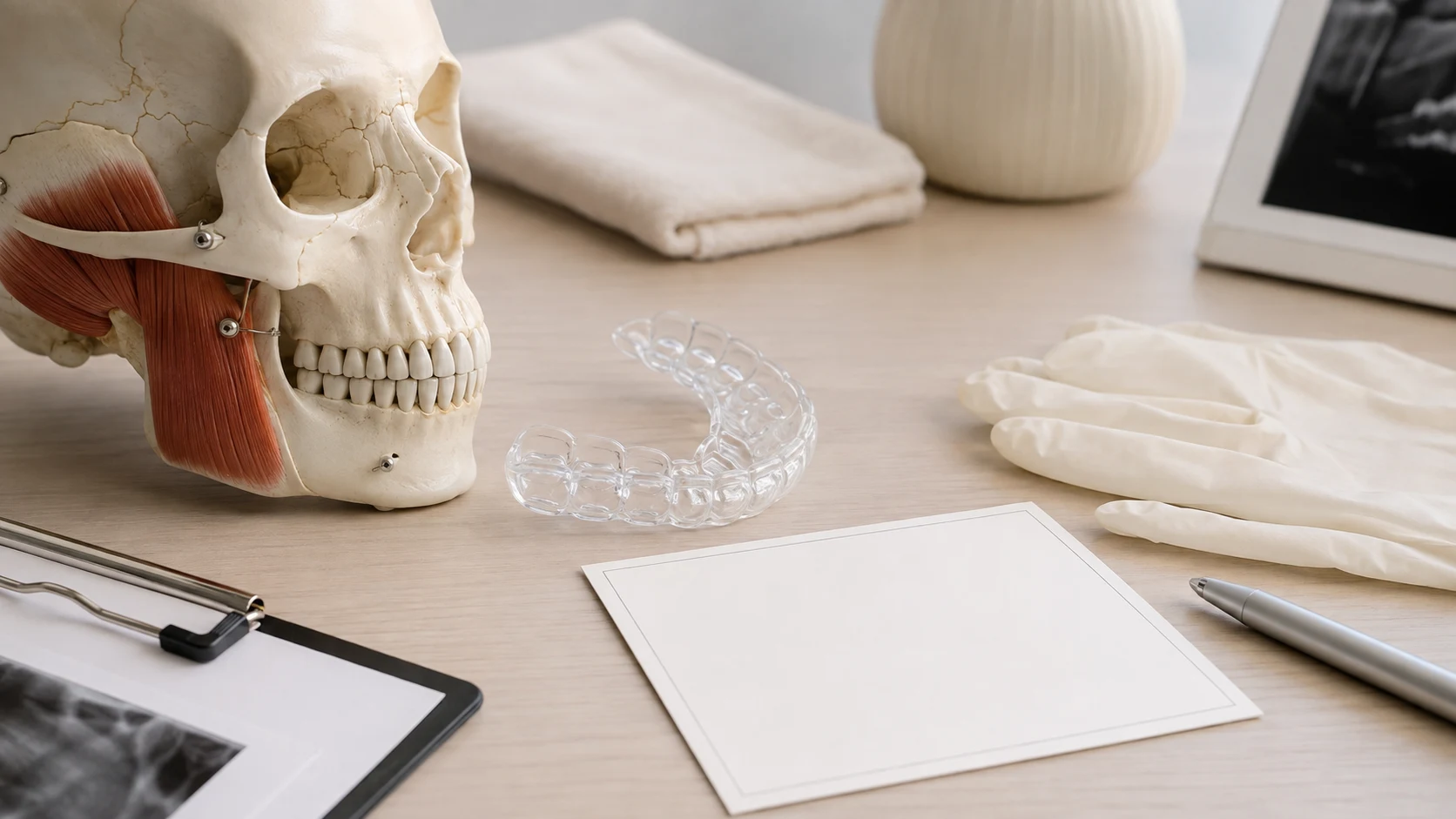
A night guard, on the other hand, is a purely physical protective device that doesn’t change muscle activity. Custom-made for the upper or lower teeth, it tries to reduce wear and the risk of fracture by preventing the teeth from making direct contact with each other during sleep. The muscle can still perform the clenching motion; the guard doesn’t stop that motion, it simply acts as a buffer between the teeth. That’s why a night guard can be defined not as a method that reduces muscle activity, but as a barrier that protects the tooth from the muscle’s effect. This definition also clarifies what shouldn’t be expected from a guard.
Placed side by side, the picture is clear: one tries to reduce the muscle-driven clenching force, the other tries to prevent the physical consequence that force has on the tooth. If someone has both a high clenching force and noticeable tooth wear, a single method shouldn’t be expected to solve both problems at once. At that point, which approach takes priority becomes clear through a dental assessment based on the person’s findings. In some cases, as covered later in this article, the two methods are planned together.
Why Is a Dental Assessment the Priority First Step?
For someone presenting with a teeth-grinding complaint, the first step is usually a dental assessment rather than an aesthetic one. This is because the underlying mechanism of bruxism can stem from a mismatch related to tooth and jaw structure. Moving straight to a muscle-focused approach without this assessment can cause an underlying structural problem to be missed. A dental assessment is the basic step that determines both whether a night guard is needed and what type of guard should be made. This order ensures the following steps move forward on the right footing.
What the Assessment Looks At
This assessment separately examines the wear pattern on the teeth, the bite, the condition of the gums, and the jaw joint’s range of motion. Which teeth show the most wear can give a clue about the direction of the clenching behavior and can directly affect the guard’s design. The condition of the gum tissue is a finding that can also affect which material the guard is made from. All of these examinations may sometimes be completed over several appointments rather than in a single visit.
If needed, the structure of the jaw joint can also be assessed separately with imaging, a step usually taken specifically when a joint sound or limited motion is noticed. All of these steps together clarify which method, which combination, or which additional assessment the next decision requires. The findings from the assessment aren’t necessarily limited to recommending a night guard. In some cases, whether a muscle-focused approach also comes into play is decided at this stage.
The plan that emerges from this process isn’t a one-time decision; the approach set at the first check-up can be updated based on findings from follow-up visits. That’s why the decision made at the first consultation should be seen as a starting point that may change over the course of treatment. If a person’s findings change over time, the plan may need to be reviewed again. This flexibility is an expected and necessary approach for a condition as multifactorial as bruxism.
When Does Jaw Joint Sound, Locking, or Pain Require a Separate Assessment?
A sound heard when opening and closing the jaw, the jaw catching at a certain point, or ongoing pain in the area are findings that suggest the problem may not be purely muscle-related. When symptoms like these appear, the assessment is expanded to cover the jaw joint (TMJ) as well. Because masseter Botox is aimed at reducing muscle activity, it doesn’t directly address a problem in the joint structure. In that case it may not be enough on its own, and an additional assessment may be needed. This distinction matters so that the person’s complaint is addressed under the right heading.
Jaw joint sound or pain can sometimes occur as its own condition, independent of bruxism. That’s why, when such a finding is noticed, the joint’s own history is looked at as well as the teeth-grinding history. A past jaw injury is asked about as a factor that can affect joint movement for a long time afterward. Details like these determine the scope and direction of the assessment.
Distinguishing Features of TMJ Findings
Joint-related findings often come with limited jaw range of motion, the jaw shifting to one side when opening the mouth, or tension that’s more pronounced in the morning. These findings form a distinct picture that needs to be told apart from muscle tension alone. In such cases, the assessment is carried out together with a dental specialty experienced in the jaw joint, if needed. A muscle-focused treatment shouldn’t be expected to resolve these findings on its own. That’s why, for people with joint findings, the plan is expanded to cover both muscle and joint assessment together.
Noticing these findings in time matters for preventing the condition from progressing. Joint complaints that are ignored for a long time can further limit everyday jaw movement. That’s why, when a sound, locking, or pain is noticed, it’s recommended not to delay the assessment. An early assessment makes it possible to build a clearer plan on both the muscle and joint sides.
What Does a Night Guard Do, and What Doesn’t It Do?
A night guard is a protective device that reduces wear, fracture, and damage to existing restorations by preventing the teeth from making direct contact with each other. In this way it focuses on protecting the tooth’s physical integrity; it doesn’t stop the clenching behavior itself, it tries to limit the damage that occurs during clenching. Understanding this distinction also shows why it isn’t realistic to expect a guard to put an end to teeth grinding entirely. The guard’s success is directly tied to consistent, correct use. A guard used irregularly may not provide the expected level of protection.
Types of Night Guards
Night guards can be made in different types depending on their hardness and the area they cover; some cover the entire tooth surface, while others protect only certain areas. Which type is appropriate is determined by the dentist based on the intensity of clenching, tooth structure, and the existing level of wear. Choosing the wrong type can reduce both the guard’s comfort and its protective effect. That’s why guard selection isn’t made from a standard template, but tailored to the individual.
- Hard acrylic guards may be chosen to provide more durable protection for people with a strong tendency to clench.
- Soft guards can be used in milder cases, but they may wear out faster with intense clenching.
- Partial guards can be designed to cover only certain areas of the teeth.
The Adjustment Process
The process of getting used to a night guard varies from person to person; in the first few days temporary symptoms such as a feeling of a foreign object in the mouth and increased saliva can occur. These symptoms usually ease within a few days; if they continue, the guard needs to be checked again by the dentist. The guard fitting the tooth surface exactly matters for the continuity of its protective effect. A loose or ill-fitting guard may not provide the expected protection and can increase discomfort. That’s why a check-up during the first weeks of use is generally recommended.
Over time, fine scratches or slight deformation can appear on the guard’s surface; this can also be seen as a sign that the guard is doing its job. Once wear reaches a certain level, replacing the guard comes up as an option. This change is noticed during regular check-up appointments and addressed in time. This way, the guard’s protective function continues without interruption.
How Does Masseter Botox Take Effect, and How Long Does It Last?
A noticeable change shouldn’t be expected right after masseter Botox is applied; the effect appears as muscle activity gradually decreases. This process usually becomes apparent within a few weeks and can vary from person to person. Factors such as the muscle’s starting level of activity and the size of the treated area can change how long it takes for the effect to settle in. That’s why it’s recommended to be patient in the first few weeks and not to judge the result too early.
Some people notice a slight difference while chewing in the first few days; this early sensation may not reflect the muscle’s final level of activity. The real assessment is made once the effect has fully settled in. If this period takes longer than expected, it’s appropriate to review the situation again at a check-up. Setting clear expectations about the process is something that should be discussed before the treatment.
Why the Effect Isn’t Immediate
The effect on the muscle tissue requires a certain biological process, so it isn’t realistic to expect a sudden change in chewing force right after the treatment. As the muscle’s activity level decreases over time, a change can be noticed both in clenching force and, in some people, in the appearance related to muscle volume. This effect isn’t permanent; muscle activity can move back toward its previous level over time. That’s why reassessment at certain intervals is needed.
Continuing to use the night guard throughout this process is a separate necessity for protecting the teeth; before Botox’s effect has fully settled in, clenching behavior can still place physical load on the teeth. That’s why the two methods can be considered together during the transition period rather than one replacing the other. Even once the effect has settled in, stopping the guard entirely is a separate decision that needs to be assessed based on wear history. This decision is reviewed together with the dentist.
How Should Changes in Chewing Function and the Lower Face Be Interpreted?
When masseter muscle activity decreases, some people report a reduction in the fatigue they feel while chewing; this is linked to the muscle being under less strain. That said, chewing function isn’t expected to change entirely. Everyday functions such as eating hard foods are generally preserved. This change is considered a subjective finding that varies from person to person.
In some people, a visible change in the lower face may be noticed due to a reduction in muscle volume. This change varies from person to person and can’t be presented as a guaranteed aesthetic outcome. This change in appearance is regarded as a secondary consequence of the treatment’s primary goal, which is reducing muscle activity. It isn’t the treatment’s primary purpose.
Keeping expectations within this frame matters for satisfaction after the treatment. If a person’s main goal is reducing the physical consequences of teeth grinding, any possible change to the facial contour should be treated as a secondary observation. Mixing up these two expectations is something that needs to be clarified in the pre-treatment consultation. This way, no unrealistic expectation about the outcome forms after the treatment.
A change in the activity of the chewing muscles can also indirectly affect the face’s overall symmetry; this effect is usually subtle and becomes apparent over time. In some people, this change may not become noticeable at all. This variation depends on the muscle’s starting volume and level of activity. That’s why, rather than making a definite prediction about the outcome, the process is followed and assessed over time.
How Do the Repeat Logic and Check-up Intervals Work?
Both masseter Botox and the night guard are approached not as one-time solutions, but as processes that need follow-up over time. The two methods also have different repeat logic. One depends on muscle activity gradually returning over time, the other on physical wear of the tooth surface and the guard. Understanding this difference also explains why the two methods’ check-up schedules are planned separately.
Check-up appointments are scheduled regularly at set intervals, not only when a problem arises. This regular follow-up allows changes in both muscle activity and the tooth surface to be noticed early. The frequency of check-ups can vary depending on how intensely the person clenches and their previous findings. That’s why an individualized check-up plan is followed rather than a standard schedule.
The Botox Repeat Plan
Because muscle activity can move back toward its previous level over time, masseter Botox is planned as a treatment repeated at certain intervals. How often it’s repeated depends on the person’s muscle activity and their response to the previous treatment. Rather than a fixed schedule, an interval set at check-up visits is followed. This interval can be adjusted again over time based on the person’s findings.
The Guard Check-up Interval
A night guard, on the other hand, can change over time due to physical wear; if wear, cracks, or a fit problem are noticed on its surface, it may need to be replaced. Going for regular dentist check-ups is the most reliable way to find out whether the guard is still fulfilling its protective function. Check-up frequency can vary depending on the guard’s material and how heavily it’s used. These check-ups provide the most concrete information about when the guard needs to be replaced.
In What Situations Are the Two Planned Together?
In some cases, reducing muscle activity and physically protecting the teeth are addressed at the same time; these two approaches don’t exclude each other and can be used as complements instead. In a plan like this, masseter Botox continues to reduce the muscle’s clenching force while the night guard keeps protecting the teeth from physical wear that can still occur while the muscle is active. A combination like this is considered especially in cases with a high level of wear and pronounced muscle activity. Making this decision requires dental and aesthetic assessment to be carried out together.
The decision to combine isn’t limited to the opinion of a single specialty; findings from both sides are assessed together. This approach comes up especially in cases that have persisted for a long time and haven’t been adequately controlled with a single method. The duration and frequency of the combination are reviewed again over time based on the person’s response. That’s why the combination is treated as a dynamic plan rather than a fixed prescription.
When a combination is planned, the two methods’ schedules can run independently of each other; the Botox repeat interval and the guard’s check-up interval may not fall on the same date. This can mean the person needs to follow two separate appointment schedules. This detail is shared with the person in advance when a combination is recommended. This way, expectations are clarified from the start.
A combination isn’t necessary in every case; a single method can provide a sufficient result for some people. Which approach is sufficient is determined based on findings from the initial assessment and subsequent check-ups. Recommending both methods together unnecessarily can increase both cost and the burden of follow-up. That’s why a combination is only brought up when the findings call for it.
Who Isn’t It Suitable For, and When Is It Postponed?
There are situations in which neither approach is appropriate, or where it needs to be postponed. Assessing these situations requires a thorough history-taking and examination process. A treatment carried out by skipping the suitability assessment can lead to unexpected outcomes. That’s why a detailed consultation takes place beforehand for both methods.
The suitability assessment isn’t limited to a physical examination; medications being used, past health issues, and general lifestyle are also part of this consultation. This information provides important details that determine which method can be used, and when. Information shared incompletely can cause the plan to be shaped incorrectly. That’s why open and complete information sharing during the consultation is important.
When Botox Is Postponed or Not Suitable
Pregnancy and breastfeeding, certain health conditions affecting the muscular or nervous system, and an active infection at the treatment site are among the situations that may require postponing or avoiding masseter Botox. In such cases, the decision is made after a detailed health history is taken. In some cases the treatment is postponed entirely, while in others only the timing changes. This decision can be reassessed once the person’s overall health situation becomes clear.
Situations Where the Guard Is Postponed
If there’s active tooth decay, advanced gum disease, or another untreated oral health issue, these may need to be addressed before the night guard is made. A guard made on an unsuitable base may not provide the expected level of protection. That’s why oral health status is clarified before making the guard. Once the necessary treatments are completed, the guard process is planned again.
Why Shouldn’t the Sleep and Stress Side Be Neglected?
Masseter Botox and the night guard are approaches aimed at the consequences of teeth grinding; they don’t directly change the sleep and stress factors that trigger the clenching behavior. That’s why focusing only on these two methods while ignoring sleep patterns and stress levels means addressing the picture incompletely. Identifying the factors affecting sleep quality, and assessing them together with relevant specialties when needed, can positively affect the long-term course. Steps toward managing stress can similarly help reduce the overall severity of muscle tension.
A disruption in sleep patterns can sometimes be the actual trigger for bruxism; in that case, an approach focused only on the muscle or the tooth eases only the consequences without reaching the source of the problem. That’s why, in a bruxism picture that’s persistent and recurring over a long time, it’s recommended to look into sleep quality as well. A referral to a separate specialty can be made on this if needed. This referral is a natural part of a comprehensive assessment.
Stress management can be approached with different methods depending on the person; the choice of method depends on the individual’s lifestyle and preference. No single method should be expected to eliminate teeth grinding on its own. However, a reduction in stress load can make an indirect contribution by easing overall muscle tension. This contribution should be seen as a complement to muscle- and tooth-focused approaches.
Assessing these three axes together, muscle, teeth, and sleep/stress, makes it possible to approach the overall course of bruxism within a more realistic frame. A plan that focuses on only one axis may provide short-term relief but can fall short in the long run. That’s why all three areas are looked at during the assessment process. This comprehensive approach helps make the plan more sustainable.
What Are the Common Misconceptions About Teeth Grinding?
Some information circulating online oversimplifies the complex nature of bruxism and can lead to misleading expectations. Information like this often presents a single method as a miracle solution. As explained earlier, though, bruxism is a multifactorial condition, and expecting it to be eliminated entirely with a single treatment isn’t realistic. This section covers a few common misconceptions along with why they’re inaccurate.
- The claim that “masseter Botox completely stops teeth grinding” isn’t accurate; the treatment reduces the muscle’s force, it doesn’t eliminate the clenching behavior itself.
- The idea that “if I wear a night guard, I won’t need Botox” is also incomplete; the guard protects the tooth but doesn’t change muscle activity, so the two needs remain distinct.
- The view that “teeth grinding is caused only by stress” overlooks structural factors such as jaw structure and the bite.
- The idea that “getting a guard made once is enough, no need for further check-ups” skips over the fact that the guard can wear out over time.
What these misconceptions have in common is reducing bruxism to a single cause or a single solution. As explained from the start of this article, though, the right approach goes through an individualized assessment. This assessment is expanded to cover the muscle, the teeth, and the sleep/stress side together. That’s why generalizations found online shouldn’t take the place of a personal plan.
A process that begins with an expectation based on misinformation can end in disappointment. That’s why giving realistic information before the treatment matters. Answering a person’s questions clearly and openly helps the process move forward in a healthier way. This transparency applies to both muscle- and tooth-focused approaches.
Having access to accurate information allows a person to take part in the treatment process more knowledgeably. This awareness contributes to both realistic post-treatment expectations and better adherence to follow-up appointments. That’s why providing information is seen as an integral part of the treatment. Questions can be asked again at any stage.
When Should You Contact the Clinic or a Dentist?
Noticing pronounced tension or pain in the jaw area upon waking in the morning can be a sign that teeth grinding continued throughout the night. If this happens regularly, seeking an assessment shouldn’t be delayed. A one-off feeling of tension usually isn’t a cause for concern. However, it becoming more frequent is a change worth paying attention to.
Flattening of the tooth surfaces, cracks, or increased sensitivity are similarly findings that call for an early assessment; these findings usually indicate that wear is progressing. When findings like these are noticed, it’s recommended to see a dentist without waiting. Wear caught early can be controlled with simpler measures. Delay can set the stage for the problem to grow.
If jaw joint sound, locking, or noticeable restriction while opening and closing is noticed, the assessment needs to be expanded to cover the jaw joint as well. Findings like these should be addressed primarily with a dental assessment rather than a muscle-focused approach. If the findings progress, everyday speaking and chewing function can also be affected. That’s why an early visit also matters for preserving quality of daily life.
This content is for general informational purposes and doesn’t promise a specific improvement or outcome; the right approach for you is determined after a thorough assessment. You can explore our Botox treatments or request an appointment. During the assessment, the muscle, the teeth, and, if needed, the jaw joint side are all addressed together. This comprehensive view matters for a more sustainable outcome in the long term.
Frequently Asked Questions (FAQ)
Does masseter Botox replace a night guard?
No, the two serve different purposes and neither one takes over the other’s function. Masseter Botox is aimed at reducing the chewing muscle’s activity, while a night guard protects the teeth from physical wear. For someone with high muscle activity, using only a guard won’t reduce the muscle-driven load; likewise, a muscle-focused treatment alone won’t protect the teeth from physical wear. That’s why which method, or combination, is appropriate is assessed based on the person’s findings.
Which specialist should I see first for a teeth-grinding complaint?
The first step is usually a dental assessment, because the underlying cause can stem from tooth structure, the bite, or the jaw joint. This assessment is made by examining the wear pattern on the teeth and the condition of the jaw joint. Based on the results, a night guard, a muscle-focused approach, or a combination of both may be recommended. If needed, the assessment can also lead to an additional referral for the sleep or stress side. If the level of tooth wear is recorded at this first assessment, it becomes easier to track changes at follow-up check-ups.
I hear a sound in my jaw, is this related to masseter Botox?
A sound or pain in the jaw joint is a finding that suggests the problem may not be purely muscle-related. If findings like these are present, the assessment should be expanded to cover the jaw joint as well. Masseter Botox is aimed at reducing muscle activity and doesn’t directly address a problem in the joint structure. That’s why, when a sound or pain is noticed, it’s recommended to have a dental assessment first. If the sound occurs together with pain, locking, or difficulty opening the mouth, the assessment should be carried out without delay.
How long does it take to see the effect of masseter Botox?
The effect isn’t immediate; it becomes apparent within a few weeks as muscle activity gradually decreases. This process can vary from person to person depending on the muscle’s starting level of activity and the size of the treated area. The effect isn’t permanent; muscle activity can move back toward its previous level over time. That’s why check-ups at certain intervals, and repeating the treatment if needed, are recommended. How long the effect lasts varies from person to person depending on muscle mass and the intensity of the clenching habit.
Is there a link between stress and teeth grinding?
Yes, nighttime teeth grinding is often linked to changes in stress levels and sleep quality. Tension that builds up during the day can set the stage for the jaw muscles to contract involuntarily during sleep. These factors are among the topics that shouldn’t be overlooked in a bruxism assessment. Reducing stress won’t eliminate the grinding on its own, but it can ease the overall picture. Noting sleep patterns, caffeine intake, and periods of tension during the day makes it easier to notice the triggering pattern.
How often should a night guard be checked?
Because the guard’s fit and level of wear can change over time, regular dentist check-ups are recommended. Check-up frequency can vary depending on the guard’s material and how heavily it’s used. If cracks, wear, or a fit problem are noticed on the guard, an appointment should be made without waiting for the scheduled check-up. Regular check-ups are the most reliable way to find out whether the guard is still fulfilling its protective function. The guard loosening in the mouth or increased morning jaw fatigue are practical signs that it’s time for a check-up.
Does masseter Botox change the shape of the face?
In some people, a change in the lower face may be observed as the chewing muscle’s activity decreases. This change varies from person to person and isn’t a guaranteed aesthetic outcome. This change in appearance is regarded as a secondary consequence of the treatment’s primary goal, which is reducing muscle activity. Keeping expectations within this frame is something that needs to be clarified in the pre-treatment consultation. How noticeable the change will be depends on the starting muscle thickness, so expectations are discussed individually.
Does it make sense to do both at the same time?
In some cases, muscle activity and tooth protection can be addressed together; these two approaches don’t exclude each other. In a plan like this, masseter Botox continues to reduce the muscle’s clenching force while the night guard keeps protecting the teeth from physical wear. A combination like this is considered especially in cases with a high level of wear and pronounced muscle activity. The decision requires dental and aesthetic assessment to be carried out together. In a plan like this, the two treatments’ check-up schedules run separately; the guard’s fit and muscle activity are assessed at different intervals.