When Does Swelling Go Down After Lip Filler? Normal Recovery and Warning Signs
swelling after lip filler is an expected finding; both procedural trauma and the water-binding property of hyaluronic acid contribute to this appearance. Swelling usually peaks within the first 24-48 hours and gradually decreases over the following days, with the final appearance settling within a few weeks. A sudden increase, disproportionate pain or a change in colour requires urgent assessment. This article is for general information only; your individual follow-up plan is set during your consultation.
Why does swelling occur?
The mechanical trauma that a needle or cannula creates in the tissue triggers a local inflammatory response, and this response causes fluid to leak from blood vessels into the surrounding tissue. In the first hours of inflammation, small blood vessels temporarily widen, which can create a feeling of redness and warmth in the area. Hyaluronic acid-based fillers also have the property of binding water molecules; because of this, the product can draw in slightly more water than its own volume in the first days after treatment, creating temporary extra swelling. The lips’ thin, vessel-rich tissue makes these changes appear far more pronounced than in other parts of the body.
The injection technique used can directly affect the degree of swelling; with cannula-based application, tissue trauma may in some cases remain more limited than with a needle, because the cannula’s blunt tip moves by pushing vessel walls aside rather than cutting through them. Needle injections, on the other hand, can cause more local trauma, particularly in mobile, vessel-rich areas such as the edge of the lip. The properties of the injected product are also a factor; denser gels with a higher degree of cross-linking can, in some cases, bind more water. As the number of injections and entry points increases, the total tissue trauma can also increase.
The lips are one of the most mobile areas of the face; the surrounding muscles that work continuously during speaking, smiling and eating can contribute to the treated tissue moving more and the swelling becoming more visible. The skin in this area is noticeably thinner than in other parts of the body and has little fatty tissue, which means changes underneath show through more clearly on the surface. Capillary density is also high, so even a small amount of trauma can produce a visible reaction. When these anatomical features combine, swelling in the lips can appear more pronounced than after a similar procedure on the cheek.
The body’s inflammatory response subsides on its own over time; the signalling molecules released in the first hours increase vessel permeability, but within a few days this process slows and the lymphatic system starts clearing the excess fluid from the tissue. The speed of lymphatic drainage varies from person to person, and this difference can explain why two people recover at different rates after the same amount of product. Restoring fluid balance can take a few days, while the product’s own volume settling into the tissue can take weeks. For this reason, the reduction of swelling and the emergence of the filler’s final shape follow two separate timelines.
Who is it not suitable for, and what should be reported beforehand?
An active lip infection, a history of uncontrolled autoimmune disease, or a known allergy to the filler’s ingredients are factors that directly affect the treatment decision, and this information must always be shared during the consultation. People undergoing immunosuppressive treatment may have a different recovery process, so this should also be reported beforehand. For pregnancy and breastfeeding, the decision for this type of treatment is left to the doctor’s assessment, since the body’s swelling and healing response can change during these periods. People with a history of chronic skin disease should also share this information, as it helps assess possible complication risks in advance.
In people taking blood-thinning medication, high-dose fish oil or certain supplements, the risk of bruising can increase, so this must be reported beforehand; in some cases, the doctor may consider pausing these products for a certain period before treatment. People on regular medication should share their full medication list, as this is important for correctly assessing possible interactions and bleeding risk. Anyone who has previously reacted to a different filler should describe this history in detail, as it helps anticipate the risk of a new reaction. Because smoking can also affect tissue healing, this information may be asked as part of the general assessment.
If a lip has active acne, a cold sore lesion or skin irritation, treatment is postponed until the area has healed; this both reduces infection risk and makes the result more predictable. If there has been recent surgery or dental treatment around the lips, sharing this information also helps determine an appropriate waiting period. For people with a history of a serious bleeding disorder, the treatment decision is assessed in cooperation with the relevant physician. Concealing such a history can result in unexpected bruising or prolonged healing after the procedure.
Anyone who has had a significant complication with a previous lip filler should describe this experience in detail, as it forms an important reference point for planning the new treatment. Whether expectations are realistic is also assessed together during the consultation; an expectation of excessive volume may not be recommended in some cases. People undergoing active dermatological treatment that affects skin integrity should share this information, as it is needed to correctly time the procedure. All of this information helps the treatment be planned safely and predictably.
What is the typical course?
Swelling usually reaches its highest level within the first 24-48 hours after treatment. A noticeable decrease is expected over the following 3-7 days; this varies with the individual, the amount of product and the technique used. The water-binding effect fully settling and the final shape becoming clear can typically take 2-4 weeks. Following this process hour by hour helps distinguish which appearance is part of the expected course.
The first 6 hours
In the first few hours, a feeling of fullness and mild tightness in the lips is dominant; at this stage, swelling may not yet have visually reached its peak. Slight redness and warmth may be felt at the injection points, which is a normal part of the early inflammatory response. In some people, the lip tissue may feel slightly numb during these hours; this is related to the local anaesthetic effect applied during the procedure still being active. Because the appearance has not yet stabilised at this stage, an early assessment in front of the mirror can be misleading.
6-24 hours
In this window, swelling increases noticeably and a temporary irregularity in the lip contour may be seen. As vessel permeability increases and more fluid leaks into the tissue, the appearance can change from hour to hour during this period. In some people, a mild feeling of tightness or tenderness to touch may continue during these hours. It is expected for the lips to look markedly different from their everyday appearance at this stage, and this alone is not a cause for concern.
24-48 hours
Around 24 hours, the visual peak is approached; at this point the lips may look noticeably fuller than their everyday appearance. By around 48 hours, swelling reaches a plateau, and a slow decline begins after this point. During this window, bruising also usually starts to approach its darkest colour, so swelling and colour change can reach their most pronounced states at the same time. No lasting assessment should be made based on how things look during these two days, since this is the most variable stage of the process.
48-72 hours
By 72 hours, most people have moved past the most intense appearance of the first days, though a mild degree of swelling may still be felt. During this period the lip contour starts to become more defined, and the irregularity seen in the early days largely decreases. Tenderness to touch also tends to decrease during this window. Still, in some people a mild feeling of tightness can last for about a week; this alone is not an unusual finding.
The main factors that influence this timing are:
- The amount of product injected and the number of injections
- The technique used (needle or cannula)
- The individual’s tendency to swell and their circulation
- Temporary factors such as salty food or alcohol intake in the first days after treatment
For this reason, a lasting assessment should not be made based on how things look right after the procedure; early photos do not reflect the final result. Those who want to follow how healing is progressing may prefer to take photos at regular intervals in similar lighting and angle. Such a comparison helps distinguish day-to-day fluctuations from the overall trend. Waiting for the follow-up appointment before discussing the final appearance is the most reliable approach.
When is asymmetry normal, and when is it not?
Seeing a different degree of swelling on each side in the early period is common and usually temporary; the lips’ natural anatomical asymmetry can also contribute to this appearance. The order of injection can also play a role; the side injected first may temporarily look fuller because the product has been sitting in the tissue slightly longer. The side that is used more — for example, a habit of always sleeping on one side — can also widen the difference in the early period. These differences usually decrease on their own within a few days.
If a noticeable and bothersome asymmetry continues even after swelling has settled, this should be assessed at the follow-up visit. A practical way to tell the difference is this: a difference seen during the first 3-4 days, when swelling is at its most intense, may be related to the side of the lip that is used more, sleep position or the order of injection, and it usually decreases on its own. In contrast, if a difference is still visible after oedema has substantially reduced — from around day 10 onwards — and even a third person notices it, this is no longer likely to be a coincidental finding. At this point, it is appropriate for it to be assessed at the follow-up visit, with a plan drawn up if needed.
A practical way to tell whether an asymmetry is temporary or lasting is to compare photos taken a few days apart in similar lighting and angle. If the trend is decreasing, this is usually part of the normal healing process. Taking photos from the same distance, with the same smiling or resting expression, increases how reliable the comparison is. Photos taken in different lighting conditions can lead to misleading results because of differences in shadow.
A decision about the lasting appearance should not be made before the follow-up appointment, at which point oedema has significantly reduced. A mild asymmetry that already exists in the lips’ natural structure may also have been present before treatment, so the pre-treatment appearance should also be taken into account. In some people, the position of the jaw and teeth can also affect the appearance of the lips, which can complicate the assessment. In such cases, a detailed assessment at the follow-up visit is important for the right decision.
Why do bruising and swelling follow different timelines?
Small bruises related to needle entry are common and fade over a few days, changing through purple, green and yellow tones; blood-thinning medication or certain supplements can prolong this process. The size of a bruise usually depends on local blood vessel structure and the injection point, not directly on the quality of the product. In some people, blood vessels run closer to the skin surface, so a more noticeable bruise can occur even with the same technique. This does not mean the procedure was done incorrectly — it relates to individual anatomical differences.
The timeline of bruising is different from that of swelling: while swelling peaks in the first 24-48 hours, bruising usually appears a few hours after treatment. It reaches its darkest colour on day 2-3, when a purple or dark blue tone can dominate. It then turns to lighter, greenish and yellowish tones, disappearing completely within 7-10 days. This sequence of colour change relates to the breakdown of haemoglobin by-products under the skin over time.
For this reason, it is normal to see swelling decreasing by day three or four while bruising is still noticeable; these two findings are explained by different biological processes — oedema and capillary leakage. Oedema decreases as excess fluid is cleared from the tissue by the lymphatic system, while bruising fades as red blood cells are broken down and absorbed under the skin. The speed of these two processes is independent of each other, so they are not expected to finish at the same time. In some people, a faint trace of bruising can remain for a few more days even after swelling has fully gone.
Makeup can be used to cover a bruise, but applying product to the area before the injection points have closed can carry an infection risk. Green-toned colour correctors can be a practical option for balancing the red-purple tone of bruising, though this choice is entirely personal. If bruising lasts longer than expected or keeps growing, it is appropriate to share this at the follow-up appointment. Although rare, such a change can point to an underlying bleeding issue and requires assessment.
Why does a history of cold sores matter?
In people with a history of cold sores (herpes), the trauma of injection can trigger reactivation, so this information must always be shared before treatment; preventive measures can be considered if needed. This risk is particularly relevant because the lip area is the direct site of treatment. Not sharing this information can also make it harder to correctly interpret a symptom that appears after treatment. For this reason, even a single past episode of cold sores is information that should be described in detail.
How does reactivation develop?
This is because the trauma of injection can temporarily change the local immune balance, creating the conditions for the dormant virus to reactivate; this risk is particularly higher in people who have had frequent cold sores in the past. After the initial infection, the virus can remain dormant in nerve tissue and reactivate with triggers such as stress, trauma or changes in immunity. The injection procedure is considered one of these triggers, which is why giving this information in advance matters. Reactivation usually appears a few days after treatment as tingling or small blisters around the lip.
Other information that should be reported beforehand
For people with a history of cold sores, how many episodes they have had before and when the last one occurred are also valuable pieces of information; a frequently recurring history can be decisive in deciding whether a preventive approach is needed. If there is an active blister or symptom on the day of treatment, the procedure is usually postponed until the area has healed. If there is a chronic condition affecting the immune system, sharing this information also contributes to the overall risk assessment. Sharing this information in full is important both for the safety of the procedure and for recognising a possible symptom early.
If reactivation is noticed, informing the clinic early helps the situation be assessed appropriately. Early symptoms such as tingling or a small blister should not be confused with the lip filler itself; the two arise for different reasons. If symptoms continue or spread, assessment should be requested without delay. Open communication on this matter is the basis for both proper post-treatment follow-up and the correct management of a possible symptom.
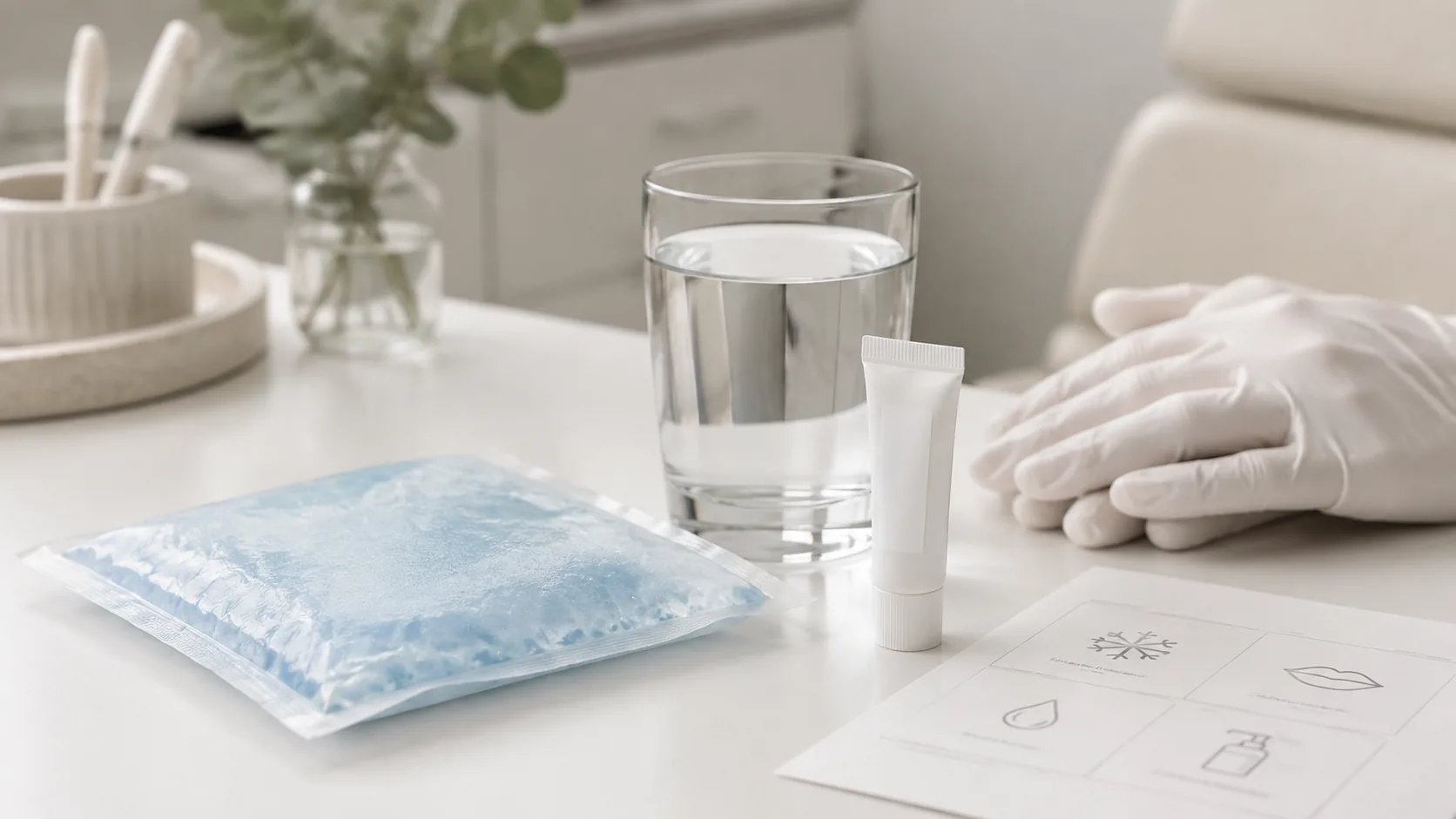
How should ice be applied?
Ice application is a simple method that is often recommended to increase comfort after lip filler. When applied correctly, it can provide mild relief and reduce the feeling of swelling somewhat. However, since it can damage the skin if applied incorrectly, a few basic rules must be followed. How and how often this should be applied should be determined by the clinic’s instructions.
How and how often should it be applied?
When considered appropriate, a cold compress wrapped in cloth can be soothing when applied at short intervals, for example for a few minutes at a time. Because direct contact between ice and the skin can cause tissue damage, a thin cloth layer should always be used. Extending the duration of application does not increase the benefit — on the contrary, it can create a risk of cold burn. For this reason, it is recommended not to go beyond the clinic’s written instructions.
What should be avoided?
Pressing ice directly onto the skin, using a frozen gel pack without a cloth, or applying it for a single long session are approaches that are not recommended. Some people may prefer to repeat cold application frequently to make swelling go down faster, but there is no clear evidence that this approach provides an additional benefit. Cold application does not eliminate swelling entirely; it can only help increase comfort and limit potential bruising to some extent. Since the frequency and duration of application can vary by individual and by the extent of the procedure, the clinic’s guidance on this should be followed.
Warm compresses or contact with hot water are not recommended in the first days, because heat can increase local blood flow and temporarily make swelling more pronounced. The period when ice application is most useful is generally the first 24-48 hours; the benefit can decrease after this time. Consulting the clinic whenever there is uncertainty prevents irritation that could result from incorrect application. These simple measures can help make the healing process more comfortable.
How do salt, alcohol, sleep position and exercise affect swelling?
Daily habits can affect the course of swelling after lip filler to some extent. None of these factors is decisive on its own, but taken together they can make the recovery process more comfortable. The headings below summarise points that are particularly worth paying attention to in the first few days. These recommendations are general information and do not replace the clinic’s individual instructions.
Diet and alcohol
Eating high-salt food can increase overall water retention in the body; this can contribute to swelling in the lip feeling slightly more pronounced in the first days after treatment. For this reason, a balanced, low-salt diet is recommended for the first 24-48 hours. Through its vessel-widening effect, alcohol can temporarily increase redness and the feeling of swelling; it can also contribute to blood thinning and raise the risk of bruising. For this reason, avoiding alcohol on the first day supports a more predictable course for both swelling and bruising.
Sleep position and exercise
Sleeping face-down or pressure from a pillow can make swelling on that side look slightly more pronounced than on the other. Sleeping on your back with your head slightly elevated can help with how oedema is distributed and support a more balanced appearance on waking. Activities that quickly raise blood pressure, such as intense cardio or weight training, should be postponed for the first few days, since the resulting increase in blood flow can increase swelling and bruising. Low-intensity activities such as a light walk generally do not pose a problem, but the clinic’s guidance should also be followed here.
Hot environments — such as saunas, steam rooms or prolonged sun exposure — can increase blood flow and temporarily make swelling more pronounced in the first days, so it is recommended to postpone these. Because smoking can slow tissue healing, reducing or stopping it is preferred during this period. Drinking plenty of water can support the overall healing process, but it is not on its own a method that speeds up swelling reduction. None of these daily habits guarantees the outcome; they can only help make the process more comfortable.
When can I return to makeup and daily life?
When makeup can be worn after treatment and when a return to daily life is possible are frequently asked questions. This timing varies depending on how quickly the injection points close and on the individual healing process. A general framework is summarised below, but the specific timing given by the clinic should always take priority. Rushing in the early period is not recommended, as it can increase the risk of infection.
Returning to makeup
It is generally recommended to wait somewhere between a few hours and a day for the injection points to close; applying makeup products directly to the lip before this time can increase the risk of infection. During this period, it is recommended to avoid products such as lipstick, gloss or lip liner. Following the timing given by the clinic both reduces the risk of infection and helps ensure the filler settling process is not negatively affected. Once makeup is resumed, it can also help to avoid applying excessive pressure to the area.
Work and social life
Most people can return to their daily tasks and work the day after treatment; although visible swelling or mild bruising may still be noticeable during this period, it is not expected to prevent daily activity. Before an important social event, the timing of treatment should be planned to leave enough time for swelling to settle; this generally means leaving a margin of at least a few weeks. Avoiding hot food and drinks on the first day can help prevent heat from increasing local blood flow and temporarily making swelling more pronounced. Everyday movements such as talking and smiling are not restricted, but avoiding unnecessary touching of the area in the first days is recommended.
Daily actions such as brushing teeth, eating and drinking can continue normally, but it is recommended not to apply direct pressure to the injection points. For close-contact activities such as kissing, following the waiting period recommended by the clinic is important for both comfort and infection risk. Anyone with travel plans should time their treatment accordingly, so the first days can be spent resting. In general, the first 48-72 hours is the period that requires the most care when gradually returning to your daily routine.
What are the warning signs?
The great majority of swelling is part of an expected, harmless healing process; however, some very rarely seen findings call for a different kind of assessment. Recognising these findings early can be decisive in managing a possible complication. The list below summarises symptoms that are considered outside the usual course and require attention. If any of these symptoms is noticed, contacting the clinic without delay is recommended.
The following findings are not part of the usual healing process and require contacting the clinic or emergency medical care without delay:
- Marked whitening or pallor of the lip
- Disproportionate or increasingly severe pain
- An abnormal coldness felt on touch
- A net-like purple-blue discolouration (livedo-type pattern)
These signs should be taken seriously, as they can point to the possibility of vascular occlusion. Vascular occlusion is a rare but urgent condition that can occur when the injected product directly affects a blood vessel, or affects it indirectly through surrounding pressure. In this situation, early intervention rather than waiting can be decisive in managing a possible complication. For this reason, not hesitating to call the clinic when something seems wrong is the most effective way to reduce the risks that delay can bring.
Besides these signs, swelling that is far more severe than expected, fever, progressive firmness in the area, or severe pain lasting more than a few days can also be considered findings that require assessment. A symptom that seems unrelated to the lip area — such as blurred vision — but appears in the same time frame must also always be reported. Although such findings are rare, it is important to have them assessed without delay when noticed. The general rule is this: any symptom that feels out of the ordinary, is getting worse, or cannot be explained is a reason for assessment.
Should you massage the area?
Massage after lip filler should only be done if the practitioner has given a clear instruction to do so. Trying to shape the area yourself can irritate the tissue, affect how the filler is distributed, or make the follow-up assessment more difficult. For this reason, “self-massage” tips seen online should not be followed without the clinic’s instruction. Incorrectly directed pressure can cause product that has not yet settled to shift to an unwanted area.
Some clinics may recommend gentle, guided massage after a certain day; however, this is entirely an individual decision and should not be attempted on your own. When such a recommendation is given, the frequency, duration and technique of the massage are explained in detail. Following these instructions is important both for safety and for achieving the expected result. If no instruction has been given, it is preferable to let the natural healing process take its course rather than touching the area yourself.
Another reason to avoid massage is that touching injection points that have not yet fully closed can carry an infection risk. Hands should always be clean, and the area should not be touched unnecessarily often. Even if a feeling of swelling or firmness is uncomfortable, this is not a reason to rub the area. If discomfort continues, it is more appropriate to have this assessed at the follow-up appointment.
Although the belief that “massaging will make swelling go down faster” is widespread, this is not a directly proven approach; the reduction of swelling largely depends on the body’s own lymphatic drainage speed. For this reason, letting the process take its natural course rather than massaging on your own is both a safer and a more predictable approach. Consulting the clinic whenever there is uncertainty is the right step. The decision about massage is always made on an individual basis.
What are common misconceptions?
Some information circulating online about swelling after lip filler does not fully reflect reality. This misinformation can sometimes lead to unnecessary worry and sometimes to the wrong behaviour. The points below are common but incomplete or incorrect claims. Each is explained alongside the actual clinical information.
- “If there is no swelling at all, the treatment has failed” — the degree of swelling varies from person to person and depends on the amount of product and the technique; a small amount of swelling is not a sign of failure
- “The final result is visible within the first 24 hours” — the early appearance is inflated by the water-binding effect, and the true shape settles within a few weeks
- “Massaging will make swelling go down faster” — unguided massage can negatively affect how the filler is distributed
- “Bruising and swelling go away at the same time” — these two findings are explained by different biological processes and subside at different speeds
In addition to these misconceptions, the belief that “more swelling means more product was used” is also incorrect; the degree of swelling varies depending on a person’s tissue structure and the injection technique. Similarly, the idea that “the faster swelling goes away, the better the result” is also misleading, because the speed of healing reflects individual differences rather than the quality of the outcome. Individual experiences shared on social media do not form a rule that can be generalised. It should not be forgotten that every process has its own timeline.
The source of this kind of misinformation is usually the generalisation of personal experiences or unscientific content. The reliable source of information is the clinic that assesses your own individual situation. When there is uncertainty, consulting the clinic directly rather than searching online is the most reliable way to get accurate, personalised information. This approach helps prevent both unnecessary worry and incorrect practices.
Why is the follow-up visit important?
The follow-up visit allows the true course of swelling and the settled state of symmetry to be assessed at the right time. This appointment is usually scheduled for a period when oedema has substantially reduced. A single photo taken on the same day or in different lighting does not replace a clinical decision; taking photos under similar conditions at regular intervals can be useful for tracking change. These photos can be shown to the clinic at the follow-up appointment.
Minor adjustments, if needed, can be considered at the follow-up appointment; however, this decision is not made before oedema has fully settled. An adjustment made early can mean a decision being based on an appearance that has not yet stabilised, which can lead to a poorly guided result. For this reason, being patient and following the clinic’s suggested timeline provides a more reliable assessment. Whether an adjustment is needed at all depends entirely on the individual situation.
The follow-up appointment is not limited to assessing appearance alone; any symptom or concern experienced after treatment can also be discussed at this visit. If an unexpected finding is noticed, there is no need to wait until the follow-up appointment; an earlier assessment can be requested if needed. How often follow-up is needed can vary by individual and by the extent of the procedure. For this reason, following the clinic’s suggested follow-up plan is recommended.
Regular follow-up is valuable not only for assessing the current treatment but also for planning any future treatments. Information gathered about a person’s tissue response and healing speed can be used as a reference in a future assessment. For this reason, skipping the follow-up appointment can mean missing an opportunity not only for the current process but also for long-term monitoring. Attending the follow-up appointment helps the process be completed safely and predictably.
Decision and follow-up
swelling after lip filler follows a predictable course for most people, though every process has its own pace. The general framework is an increase in the first 24-48 hours, a gradual decrease over the following days, and the final shape settling within a few weeks. If a symptom that deviates from this framework is noticed, its cause should be investigated. Being informed helps you tell the difference between an appearance that is expected and one that is a finding requiring assessment.
Whenever a symptom is unexpected, increasing or worrying, the clinic should be contacted without delay; this information does not replace an individual medical assessment. Because every person’s tissue structure, healing speed and lifestyle are different, the timelines described here offer a general framework and are not a firm guarantee. The individual instructions given by the clinic before and after treatment should always be treated as the priority. When you have questions, taking them directly to the clinic rather than holding onto them helps the process go more smoothly.
The information in this article is for general purposes only and does not replace any diagnosis or treatment recommendation. Those who want to follow how the healing process is going are advised to follow the check-up schedule recommended by the clinic. Any question that arises during the process can be discussed in detail during a consultation. This approach matters for both safe healing and realistic expectations.
learn more about lip filler treatment. book an appointment for a follow-up or assessment.
Frequently Asked Questions (FAQ)
How many days does swelling last after lip filler?
Swelling usually reaches its highest level in the first 24-48 hours, after which a gradual decrease begins. A noticeable reduction is expected over the following 3-7 days, though this can vary depending on the amount of product, the technique used and the individual’s tendency to swell. The final appearance fully settling, once the water-binding effect has completely passed, can generally take 2-4 weeks. Temporary factors such as salty food and alcohol can affect the appearance somewhat in the first days, so a balanced diet is recommended during this period. Waiting for oedema to substantially subside before making a lasting assessment is the most reliable approach.
My lips look asymmetric right after the procedure — is this normal?
Seeing a different degree of swelling on each side in the early period is common and usually temporary; sleep position, the order of injection and the lips’ natural anatomical asymmetry can all contribute to this appearance. The difference seen in the first 3-4 days, when swelling is most intense, usually decreases on its own and is not a cause for concern. To judge the lasting appearance, it is necessary to wait until oedema has substantially subsided; early photos do not reflect the final result. If a noticeable difference continues after swelling has largely reduced — from around day 10 onwards — this should be assessed at the follow-up appointment. Comparing photos taken in similar lighting and angle can help track the direction of change.
Can I apply ice after lip filler?
When considered appropriate, a cold compress wrapped in cloth can be soothing when applied at short intervals, for example for a few minutes at a time. A cloth layer must always be used, since letting ice touch the skin directly can cause tissue damage, and the duration of application should not be extended. Cold application does not eliminate swelling entirely; it only helps increase comfort and limit possible bruising to some extent. The period when it is most useful is generally the first 24-48 hours, after which the benefit can decrease. Following the clinic’s instructions on frequency and duration is important for both safety and comfort.
Which symptoms after lip filler are considered an emergency?
Marked whitening or pallor of the lip, disproportionate or increasingly severe pain, an abnormal coldness felt on touch, and a net-like purple-blue discolouration are findings that require urgent assessment. These signs can point to the possibility of vascular occlusion and should be taken seriously rather than ignored. Swelling that is far more severe than expected, fever, or severe pain lasting more than a few days are also findings that require assessment. In this situation, early intervention rather than waiting can be decisive in managing a possible complication. If any of these symptoms is noticed, the clinic or emergency medical care should be contacted without delay.
Is bruising normal, and how long does it last?
Small bruises related to needle entry are common; they usually appear a few hours after treatment, reach their darkest colour on day 2-3, and then turn to lighter tones, disappearing completely within 7-10 days. This timeline is different from that of swelling, because while swelling peaks in the first 24-48 hours, bruising fades at its own pace; it is therefore normal for bruising to still be visible while swelling is decreasing. The size of a bruise usually depends on local blood vessel structure and the injection point, not directly on the quality of the product. Blood-thinning medication or certain supplements can prolong this process, so it is important to report any such products you are using before treatment. If bruising lasts longer than expected or keeps growing, it is appropriate to share this at the follow-up appointment.
Should I massage the area after lip filler?
Massage should only be done if your practitioner has given a clear instruction to do so; trying to shape the area yourself can irritate the tissue and affect how the filler is distributed. Some clinics may recommend gentle, guided massage after a certain day, but this is entirely an individual decision and should not be attempted on your own. The belief that “massage speeds up swelling” is not a directly proven approach; the reduction of swelling largely depends on the body’s own lymphatic drainage speed. Unnecessarily touching injection points that have not yet fully closed can also carry an infection risk. When in doubt, it is recommended to consult the clinic rather than deciding on your own.
If I have had cold sores before, is lip filler risky for me?
In people with a history of cold sores, the trauma of injection can temporarily change the local immune balance and trigger reactivation; this is why this information must always be shared before treatment. Reactivation usually appears a few days after treatment as tingling or small blisters around the lip, and noticing it early is important. This risk is considered higher in people who have had frequent cold sores in the past, so information such as how often episodes occur and the date of the last one is valuable to share. A preventive measure can be considered if needed; this does not mean the treatment cannot be performed, only that it may require some extra preparation. If there is an active blister or symptom on the day of treatment, the procedure is usually postponed until the area has healed.
Why should I attend the follow-up appointment — wouldn't explaining it by phone be enough?
The follow-up appointment allows the true course of swelling and the settled state of symmetry to be assessed at the right time and in person; a phone call does not replace a visual assessment. This appointment is usually scheduled for a time when oedema has substantially reduced, and any minor adjustments are considered at this stage if needed. Photos taken at regular intervals in similar lighting and angle can help with monitoring and can be shown to the clinic at the follow-up appointment. If an unexpected finding is noticed, there is no need to wait until the follow-up appointment; an earlier assessment can be requested if needed. Regular follow-up is valuable not only for assessing the current process but also for planning any future treatments.