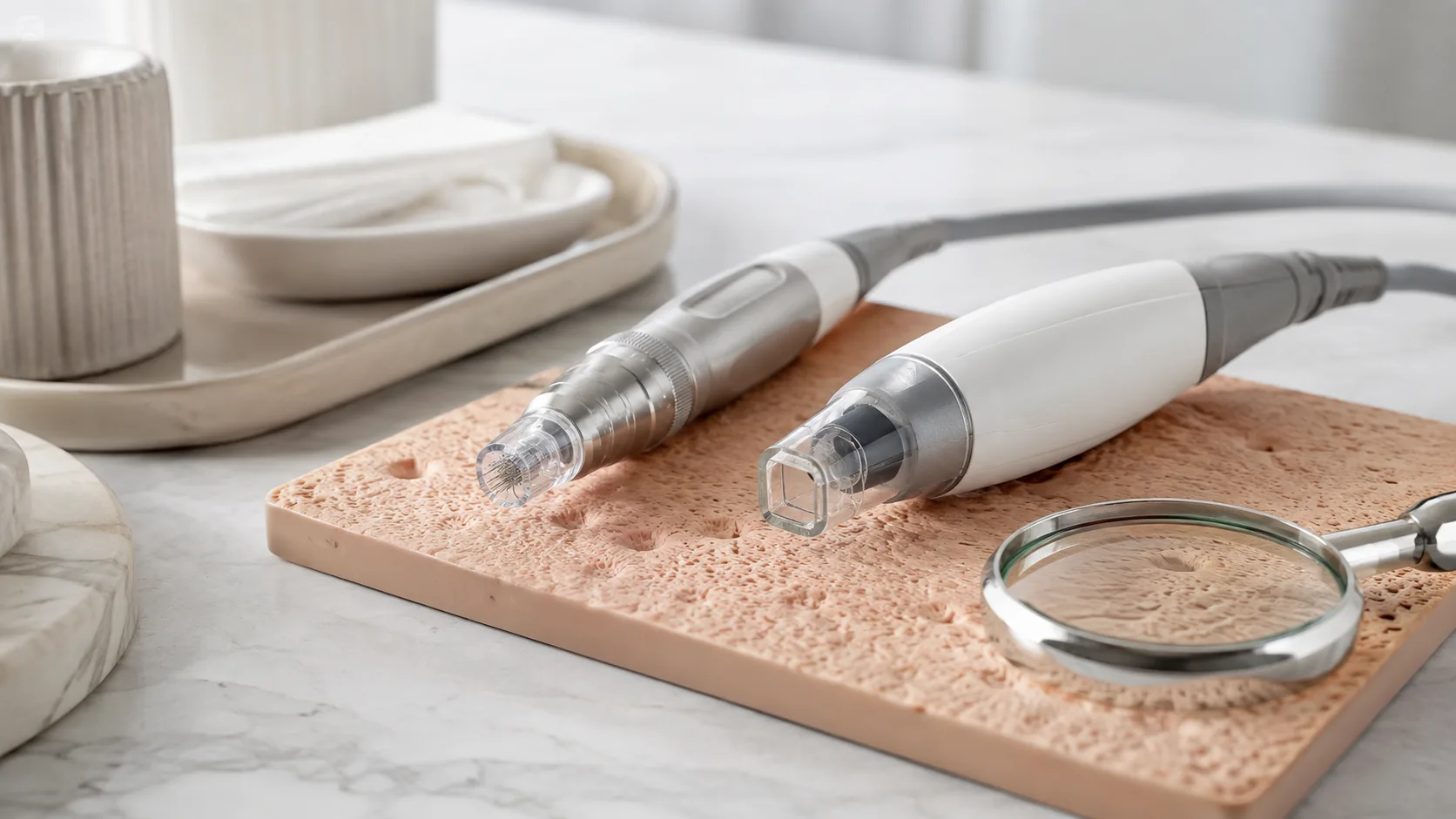
Golden Needle or Fractional Laser? Choosing for Acne Scars and Pores
golden needle or fractional laser is a question about two methods that work through different energy types and mechanisms of action: golden needle delivers radiofrequency energy to the dermis through microneedles, while fractional laser uses light energy to create microscopic columns in the epidermis. Both aim to renew collagen, but the pathway the energy takes into the skin, and the layer it affects, differ. The right choice depends on the type of acne scar, skin tone, pore appearance and how much recovery time you can accept; both methods are equally valid options, and neither automatically outweighs the other. This article is for general information only; your personal plan is set at examination.
How do the mechanisms differ?
The mechanism in golden needle
In golden needle treatment, fine microneedles are inserted into the skin to a controlled depth, and radiofrequency energy is delivered directly to the dermis from their tips, largely sparing the epidermis. This aims to trigger collagen production while keeping surface damage limited. Because needle depth can be adjusted in millimetre increments, energy can be directed to the intended tissue layer. This precise control allows golden needle to be used for different purposes at different tissue depths.
The mechanism in fractional laser
Fractional laser, on the other hand, applies light energy split into thousands of microscopic columns across the skin; controlled tissue damage occurs within these columns, and the intact tissue around them speeds up healing. Energy can progress from the epidermis down to the dermis, so there is also a direct effect on surface tissue. The bridges of intact tissue left between the columns act as a resource that accelerates the healing process. This “fractional” approach aims to speed healing by targeting only part of the surface, not the whole surface.
Both methods target collagen renewal, but the pathway energy takes into the skin differs: with golden needle, energy goes directly to the deeper tissue, while with fractional laser it moves first to the surface and then downward. This difference influences which method is preferred, depending on which tissue layer is being targeted. An approach that prioritises deep tissue damage and one that also acts directly on surface tissue can each stand out in different clinical scenarios. For this reason, the two methods should be seen not as alternatives to each other but as two separate tools that answer different needs.
Collagen renewal does not happen instantly; fibroblast cells become active in the damaged or stimulated tissue, and new collagen production starts to increase over the following weeks and matures over months. This is why, with either method, the visible result appears gradually over the following weeks rather than right after treatment. This process follows a biological timeline that cannot be sped up. For this reason, judging the result too early does not reflect the real effect.
Which method might be considered for which type of acne scar?
Acne scars are clinically classified into three main groups, and each group forms through a different tissue mechanism. This classification provides a basic framework for understanding which method might stand out for which scar type. Each scar type is covered below in its own paragraph, at equal depth. In people with a mixed scarring profile, all three groups can appear together on the same face.
Ice-pick scars
Ice-pick scars take the shape of a narrow, deep channel; in these scars, tissue loss runs from the surface downward like a narrow funnel. Delivering energy deeper can be an advantage for this scar type; golden needle’s adjustable depth may be preferred in some cases because energy can be directed straight to the base of the scar. Fractional laser can also be used on these scars, but if the scar is deep, a purely surface effect may not be enough on its own. This is why depth assessment directly affects the treatment decision for ice-pick scars.
Boxcar scars
Boxcar scars have sharp edges and a flat base; tissue loss is spread over a wider area than with ice-pick scars, but it is shallower. Fractional laser’s broad-area effect may be considered for these scars, since the laser’s ability to create many small columns can help soften the sharpness of the edges. Because the sharpness of the edges is the main visual issue, the gradual smoothing effect fractional laser produces in the surrounding tissue can stand out for this group. Golden needle can also be considered as a complementary option for deep boxcar scars.
Rolling scars
With rolling scars, the wavy appearance of the tissue usually comes from fibrous bands under the skin pulling the surface downward. These bands may be addressed not only with surface energy but also with an effect that reaches deeper, which is why some cases are assessed with both methods in sequence. Golden needle’s effect on the dermis can help release these bands, while fractional laser can help soften the wavy surface appearance. In people with a mixed scarring profile — ice-pick, boxcar and rolling scars all present on the same face — different approaches can be applied region by region rather than relying on a single method throughout.
How is the situation assessed when acne is still active?
When acne is still active, both methods are assessed carefully; aggressive energy delivery is usually postponed while inflammation continues, since both microneedle and laser energy can increase the existing inflammation. This postponement does not mean the treatment is being refused, only that the right timing is being waited for. Applying energy directly over active lesions can both increase irritation and raise the risk of infection. This is why, during an active flare, the priority is bringing the acne under control.
Once active acne is under control, scars can be assessed more reliably; scar depth measured while inflammation is ongoing can look different from how it appears once the acne has settled. Swelling and redness can make the true scar depth look different from what it actually is. This is why clinicians usually recommend a definite treatment plan only after the active phase has calmed down. This waiting period varies from person to person and depends on how severe the acne is.
Even with mild, isolated active lesions, a regional approach can be adopted; treatment can continue in other areas while skipping the spots with active lesions. This flexibility means treatment does not always have to be postponed entirely. With widespread or moderate-to-severe active acne, however, postponing the whole area is usually preferred. This decision is made at examination based on how widespread the active lesions are.
Treating active acne and treating scars are usually separate processes handled at different times. Starting scar treatment too early while acne treatment is still ongoing can negatively affect the outcome of both processes. This is why the sequence goes: first control the inflammation, then assess the scars. This order is recommended for both safety and the quality of the result.
Who is a candidate, and who is not?
Temporary restrictions
Both methods are considered for people whose active acne inflammation has settled and whose skin is relatively stable. Treatment is usually postponed in areas with active pimples, open wounds, active eczema or an uncontrolled skin infection, since applying energy can increase existing irritation. These are temporary restrictions; treatment can be reconsidered once the condition has resolved. This is why a “not suitable” decision is, in most cases, not permanent but time-dependent.
During pregnancy and breastfeeding, the decision for this kind of energy-based treatment is left to clinical judgement; the individual situation is taken as the basis rather than a standard recommendation. In people with a history of keloids (excessive tissue growth), the response to microneedle- or laser-induced tissue trauma can differ, so this information must always be shared. This history does not necessarily rule the treatment out entirely, but it may call for a more cautious approach. This is why it is important to share your history of tissue healing in detail.
Medical history and medication use
In people currently on isotretinoin, or who have recently finished a course, the skin can be thinner and more sensitive, so treatment timing is planned together with the clinician. Anyone with an electronic implant such as a pacemaker must always mention this before golden needle, which uses radiofrequency energy. This information directly affects which technology can be used safely. This is why sharing your full medical history is a precondition for a safe treatment plan.
Fractional laser is usually postponed on skin that has been recently sun-exposed or tanned, because increased melanin raises the risk of PIH; with golden needle, this restriction can be somewhat more flexible but is still assessed. This difference stems from how the two methods affect the epidermis differently. Sun exposure history is therefore asked as a standard question for both methods. Sharing this information accurately determines the safe timing of the treatment.
What is assessed at examination?
At the first examination, the overall condition of the skin, the type and distribution of the scars, Fitzpatrick skin type, sun exposure history, and any medications or supplements being used are assessed together. This assessment directly affects which method, or which combination, will be recommended. The assessment is usually done through a visual examination and a brief tactile check. This first step forms the foundation of the treatment plan.
The skin’s moisture balance, barrier function, and any history of irritation are also recorded; this information determines how cautiously the energy settings are chosen. The person’s expectations and how much recovery time they can accept are also factored into the plan. In people with limited recovery time due to work or social life, this can also influence the choice of method. This is why the examination takes into account not only the skin but also the person’s lifestyle.
The examination does not end with a fixed diagnosis; the findings are used to build a general treatment framework, and the final decision is settled through discussion between clinician and patient. This discussion is an opportunity to ask questions and share any concerns. This is why coming prepared to the examination — with previous treatments, a medication list, and expectations — makes the process more efficient. This preparation helps the first session be planned more accurately.
At some clinics, close-up photographs are taken during the examination to document scar depth and distribution; this makes it easier to compare at follow-up visits. These photographs also show how the treatment plan is updated over time. This documentation step is optional and is never done without the person’s consent. You can state your preference on this at the examination.
How does the risk of PIH in darker skin differ between the two methods?
Post-inflammatory hyperpigmentation (PIH) is when the skin overproduces pigment after treatment, forming temporary or long-lasting dark patches, and this risk varies with skin tone, the energy applied and aftercare. In darker skin types (Fitzpatrick IV-VI), this risk is generally higher than in lighter skin types. This difference shows up to different degrees with the two methods. Each method is discussed below separately, in terms of its own PIH mechanism.
PIH risk with fractional laser
Because fractional laser involves epidermal ablation — surface damage — the risk of PIH after treatment on darker skin types calls for relatively more caution. This is because damaged surface cells can trigger excess pigment production during healing. This risk is also linked to the energy intensity applied and how frequently sessions are done; aggressive settings applied in close succession on darker skin can raise the likelihood of PIH. Lower-intensity settings with sessions spaced further apart can help limit this risk.
PIH risk with golden needle
Because golden needle directs energy to the dermis with less effect on the epidermis, its PIH risk may be assessed as lower in some cases; preserving surface integrity can reduce this likelihood. However, applying energy too deep or too frequently does not eliminate this risk entirely; the risk is lower, but not zero. This is why, for darker skin types, a test application and a gradual increase in energy may be preferred with golden needle as well. This difference is not an absolute rule; sun protection, skin type and treatment settings together determine PIH risk.
How does recovery time and return to daily life compare?
Recovery time is one of the most concrete differences between the two methods, and this difference directly affects planning your return to daily life. The typical recovery course for each method is covered separately below. These timeframes offer a general reference; individual healing speed can vary. Timing before an important social event should be planned with these differences in mind.
Recovery after golden needle
After golden needle, redness and mild sensitivity lasting a few days are usually seen; the needle marks, appearing as tiny dots, can fade within a few days. During this period, makeup is usually postponed until 24-48 hours after treatment. Most people can return to work or their daily schedule the day after golden needle; once the mild redness can be covered with makeup, concerns about social visibility also ease. This relatively short recovery time can be a practical advantage for people with a busy work schedule.
Recovery after fractional laser
After fractional laser, depending on the intensity used, redness, micro-crusting and peeling can last up to about a week; with more intensive settings, noticeable redness and sensitivity on the skin surface can be expected for several days. During this period, makeup is usually postponed until peeling is complete. Some people manage this time by working from home or postponing social events. Rather than fixing on an exact number of days, it is best to go by the range the clinic recommends.
Is there a difference in pore appearance?
For enlarged pore appearance, both methods aim to tighten the tissue through collagen support. Fractional laser’s surface effect can produce a visible change in the tissue around the pores, while golden needle’s deeper effect targets overall tissue quality and elasticity more. These two different approaches contribute to pore appearance from different angles. The result depends less on which method is used and more on the skin’s starting condition.
The underlying cause of pore enlargement is usually weakened collagen and elastin support around the pore; as this support decreases, the pore wall becomes more visible. Because both methods aim to rebuild this support, a gradual improvement in pore appearance can be expected, though the result varies with the skin’s starting condition. In skin with high sebaceous gland activity, pore appearance can remain somewhat visible even after treatment. This is why the expectation should be set as a visible tightening, not complete closure.
In some cases, using both methods at different times may aim to provide both surface and deep tissue support together; this decision rests entirely on examination findings. This combination comes up more often when pore appearance occurs alongside acne scars. Not every patient needs a combination, though. A single method can also achieve a meaningful improvement.
How is the number and spacing of sessions determined?
The number of sessions varies with scar type, skin response and the goal being targeted; fixed numbers found online are not a personal prescription. An interval is left between sessions to let the skin heal, and this can vary with the method and energy intensity used. This interval is needed to give the collagen renewal process time to complete. Shortening the interval can re-irritate tissue that is still healing.
Session interval
In general, golden needle sessions may be a few weeks apart, while fractional laser may call for a slightly longer interval depending on skin response; the exact number and spacing are determined at examination based on scar severity and healing speed. This difference comes from the additional effect fractional laser has on the epidermis. This is why this mechanism difference should be kept in mind when comparing session intervals between the two methods.
Session frequency depends not only on recovery time but also on how much redness a person can tolerate in daily life; for people with frequent social events, the intervals can be planned a bit longer. This flexibility aims to increase comfort without compromising treatment effectiveness. Some people prefer to pause treatment after a busy period. This pause does not mean the plan starts over, only that it needs rescheduling.
What does preparation and the first 24-72 hours involve?
Before either method, the skin should be clean, and any active acne, sunburn or open wound should be reported to the practitioner. Anyone on a skin-thinning treatment such as isotretinoin must always mention this, as it can affect the treatment decision. These preparation steps are standard practices that directly affect the safety of the treatment. Missing preparation information can lead to a session being postponed.
In the first 24-72 hours after golden needle, mild redness and tiny dot-like needle marks are usually visible, and these gradually fade. After fractional laser, redness can be more pronounced, and with certain settings a mild warming sensation may last a few hours. In both cases, sun protection and moisturising are the recommended basic aftercare steps. These findings follow an expected, predictable course with either method.
In people taking blood thinners or high-dose supplements such as fish oil, bruising and redness can be somewhat more noticeable; this information should be shared with the practitioner before treatment. Treatment on an area with active sunburn is postponed until the skin has healed. This kind of temporary restriction is there to protect the safety of the treatment. For this reason, it is recommended not to hesitate about sharing this information.
What should you pay attention to in daily life and aftercare?
For the first few days after treatment, it is recommended to avoid active-ingredient products — retinol, high-concentration acid products — other than a gentle, fragrance-free cleanser and the recommended moisturiser, as these can irritate skin that is still healing. Using sunscreen is especially important during this post-treatment period, since skin can become temporarily more sensitive to sun after both golden needle and fractional laser. This sensitivity is directly linked to PIH risk. Regularly reapplying a high-SPF product is recommended for both methods.
Intense sweat-inducing sports are usually postponed for the first few days, since sweating and friction can increase irritation. High-heat environments such as saunas or steam baths are also not recommended in the first few days for a similar reason. These restrictions are usually limited to a few days and are not permanent. As the skin returns to its normal appearance, these activities can be resumed gradually.
Following the time frame the clinic gives for resuming makeup reduces the risk of infection and prevents products from getting into micro-channels that have not yet fully closed. If travel is planned, this should be shared in advance, and factors such as flights or a change of climate should be taken into account. If travel to a sunny destination is planned in particular, treatment timing can be adjusted accordingly. This kind of planning helps protect both safety and the result.
When to return to your regular skincare routine varies with the method used and the energy intensity applied; the clinic’s written instructions should be taken as the guide here. Returning to your routine too early can irritate skin that is still healing. This is why not rushing contributes to a better result in the long run. If the instructions are unclear, checking with the clinic is the safest approach.
When might a combination be considered?
In some cases, a clinician may plan both methods together at different times, targeting different scar types or tissue layers. This decision should be based on examination findings, not a ready-made package. A combination is not needed for every patient; a single method provides a sufficient result for some people. This is why recommending a combination is an exceptional decision based on individual findings.
When deciding on a combination, the dominant scar type and tissue depth, the skin’s tendency toward pigmentation and its Fitzpatrick type, response to previous treatments, and an acceptable recovery time are all weighed together. These four factors determine whether a combination will be safe and worthwhile. When a combination is used, the two treatments are usually done in separate sessions rather than on the same day. This separation allows the skin to heal from each treatment individually.
A combination plan usually calls for a longer treatment timeline than a single-method plan. This is why, when a combination is recommended, time expectations should be adjusted accordingly. The result can be thought of as the sum of the two methods’ individual effects, but no exact ratio can be given. This uncertainty explains why a combination is recommended only with care.
- The dominant scar type and tissue depth
- The skin’s tendency to pigmentation and its Fitzpatrick type
- Response to previous treatments
- An acceptable recovery time
What are common misconceptions?
The claim that “fractional laser is equally safe on every skin type” is incomplete. In darker skin types, the risk of pigmentation calls for more careful planning, and energy settings are chosen more cautiously for these groups. This does not mean fractional laser cannot be used on darker skin, only that it requires a more careful approach. With the right settings, a safe result can also be achieved on darker skin.
The statement that “golden needle is painless” is also misleading. Even though local anaesthesia is used during the procedure, a completely pain-free experience is not guaranteed. Anaesthetic cream greatly reduces the sensation of the needles, but mild discomfort can still be felt in some areas. This is why it is healthier to come to the session with realistic expectations.
The expectation that “scars disappear completely in one session” does not reflect reality either. The result develops gradually, depending on the number of sessions, scar depth and skin response. For deep scars, aiming for a noticeable improvement is more realistic than expecting complete flattening. This is why the expected outcome should be clarified at examination, based on scar depth.
The belief that “more intense energy always gives a better result” is also wrong. Increasing intensity can also raise the risk of PIH and irritation, which can make the outcome worse rather than better. The right energy level is balanced according to skin type and scar depth. Striking this balance requires the judgement of an experienced practitioner.
What are the warning signs?
After either treatment, some findings fall outside the usual healing course and should be reported to the clinic. These include pain that is more severe than expected and keeps increasing, widespread redness lasting more than a few days, or fluid-filled blisters in the area. These signs are rare, but they should be taken seriously if noticed. Ignoring this kind of finding can negatively affect the healing process.
Signs of infection such as fever, chills or a marked increase in warmth in the area also require urgent assessment. Such signs are rare, but the clinic should be contacted without delay if they are noticed. Signs of infection should always be taken seriously, regardless of which treatment was used. Early intervention helps the healing process complete without complications.
Skin changes that appear as unexpected darkening or light-coloured patches should also always be shown at the follow-up visit; changes noticed early are generally easier to manage. This kind of colour change can be an early sign of PIH. Noticing it early can help limit the change with appropriate care recommendations. This is why it is helpful to photograph such a change as soon as you notice it and share it with the clinic.
Why is the follow-up visit important?
The follow-up visit allows the skin’s response to be assessed at the recommended interval rather than in the early days; redness or crusting seen early on does not reflect the final result. At this visit, the energy setting or interval for the next session can be reviewed based on how the tissue has responded. This assessment is an ongoing process that keeps the treatment tailored to the individual. Skipping the follow-up means missing this chance to adjust the plan.
Photographs taken at regular intervals, under the same lighting and from a similar angle, help track change objectively; a decision should not be made based on how things look on a single day. For both patient and practitioner, these photographs are the most reliable way to show progress concretely. Taking the photographs under the same light and at the same distance improves the accuracy of the comparison. This consistency prevents progress from being over- or under-interpreted.
An unexpected finding should not wait until the follow-up visit; it should be shared with the clinic as soon as it is noticed, since the follow-up visit is for routine tracking and does not replace urgent care. This distinction matters because some findings require rapid attention. Routine follow-up, on the other hand, is more about assessing the long-term course of the plan. Keeping these two purposes separate makes it easier to take the right step at the right time.
Decision and follow-up
The answer to golden needle or fractional laser is personal, shaped by your scar type, skin tone, pore appearance and preference for recovery time. This information offers a general framework; the final decision is made by the examination findings. Since result expectations can vary from person to person, setting a realistic timeline brings comfort at every stage of the process. This is why, rather than rushing the decision, it is recommended to give the examination process the time it needs.
Both methods are considered safe and effective when applied correctly; which one suits you better is assessed together with your scar type, your skin’s tolerance and your time constraints. This assessment is not a one-off; the plan can be updated as treatment progresses. Your personal preferences and feedback play an important role in this update.
This information does not replace personal medical advice; you are advised to consult the clinic whenever anything is unclear. The more complete the details you share at the examination, the more accurate the recommended plan will be. In the end, the most suitable method is a personal decision, shaped by your own scar profile and expectations.
learn more about golden needle treatment. book an appointment for an acne scar assessment.
Frequently Asked Questions (FAQ)
Do golden needle and fractional laser use the same type of energy?
No. Golden needle delivers radiofrequency energy to the dermis through microneedles, while fractional laser uses light energy to create microscopic columns in the epidermis. The two methods differ in how the energy enters the skin and which tissue layer it affects; with golden needle the epidermis is largely spared, while with fractional laser the surface is also directly affected. This difference is a deciding factor in treatment choice, and which method is preferred depends on which tissue layer is being targeted. Both aim at collagen renewal, but this renewal is a biological process that starts over weeks and matures over months. This is why judging the result right after treatment is not accurate with either method.
Which method might be more suitable for deep ice-pick scars?
For narrow, deep ice-pick scars, golden needle’s adjustable depth may be preferred in some cases, since energy can be directed to the base of the scar. This does not mean the same choice applies to every patient, though; in people with a mixed scarring profile — more than one scar type on the same face — different approaches can also be applied region by region. The decision becomes clear once the scar’s depth and shape are assessed at examination. If the scar is deep, fractional laser’s surface effect alone may not be enough, in which case delivering energy deeper can stand out. Fractional laser can still be considered as a complementary option for these scars.
Which method carries a higher risk of pigmentation on darker skin?
Because fractional laser has an epidermal effect, the risk of post-inflammatory hyperpigmentation (PIH) on darker skin types may call for more careful planning. With golden needle, since energy is directed more toward the dermis, this risk may be lower in some cases, though not zero. Energy intensity and how often sessions are done also affect this risk; it is not an absolute rule, and sun protection matters with either method. For darker skin types, a test application and a gradual increase in energy may be preferred with either method.
Can either of these treatments be done while I still have active pimples?
Aggressive energy delivery is usually postponed during active inflammation, since both microneedle and laser energy can increase existing irritation and raise the risk of infection. At examination, the skin’s current condition is assessed, and scars are evaluated more reliably once the acne is under control, since swelling and redness can make the true scar depth look different than it is. Proper timing also has a positive effect on healing. With mild, isolated lesions, treatment can continue regionally in other areas, but with widespread or moderate-to-severe active acne, postponing the whole area is usually preferred. This postponement does not mean refusing treatment, only waiting for the right timing.
How long does peeling last after fractional laser?
This depends on the intensity used; it can last a few days with lighter settings and up to about a week with more intensive settings, and noticeable redness and sensitivity on the skin surface can be expected during this time. Rather than fixing on an exact number of days, the range the clinic recommends should be taken as the guide, since individual healing speed can vary. Timing before an important event should be planned with this in mind, and sunscreen use should not be skipped during this period. Makeup is usually postponed during this time until peeling is complete. Some people choose to manage this period by working from home or postponing social events.
Will golden needle leave marks on my face afterward?
The needle-entry points can appear as small red marks and usually fade within a few days; these are a temporary sign of healing, not a permanent mark. Expecting a permanent mark is not accurate, though individual healing can vary, and this period can be somewhat longer for people taking blood thinners. This is why it is important to share any medication and supplements you use with the practitioner before treatment. If an unexpected finding occurs — such as prolonged redness or firmness — it should be shared with the clinic. Most people can return to their daily schedule without any issue the next day.
Which method is more effective for pore appearance?
Both methods aim to tighten the tissue through collagen support; fractional laser contributes through its surface effect, while golden needle contributes more through deeper tissue quality. Because pore appearance depends on the collagen and elastin support around it, the result develops gradually, and a marked difference should not be expected after a single session. Which approach suits your pore appearance is determined at examination by assessing the skin’s starting condition and the underlying cause of pore enlargement. In skin with high sebaceous gland activity, pore appearance can remain somewhat visible even after treatment; in that case, the expectation should be a visible tightening rather than complete closure. In some cases, using both methods together at different times can also be considered.
Can the two methods be used together?
In some cases, a clinician may plan both methods together at different times; this decision is based on examination findings related to scar type, tissue layer and the skin’s tendency toward pigmentation. It should not be decided from a ready-made package; an acceptable recovery time and response to previous treatments are also factored into this planning. When a combination is used, the two treatments are usually done in separate sessions, since this separation lets the skin heal from each treatment individually. A combination plan usually requires a longer treatment timeline than a single-method plan. Not every patient needs a combination; a single method can also achieve a meaningful improvement for some people.