Stages of Male Hair Loss (The Norwood Scale)
The stages of male hair loss form a classification that defines which phase androgenetic alopecia, that is male pattern hair loss, is at and that directly determines the treatment decision. A hairline receding at the temples, thinning at the crown (vertex), hair strands becoming thinner and losing colour, and open areas merging over time are the typical findings of this process. Hair loss progresses not suddenly but over years and in a specific pattern; the Norwood scale is used precisely to read this pattern. So what exactly is male pattern hair loss, how many stages does the Norwood scale consist of, which treatment suits which stage, when should a hair transplant be done and can hair loss be stopped? In this comprehensive guide, we address all these questions in detail.
What Is Male Hair Loss?
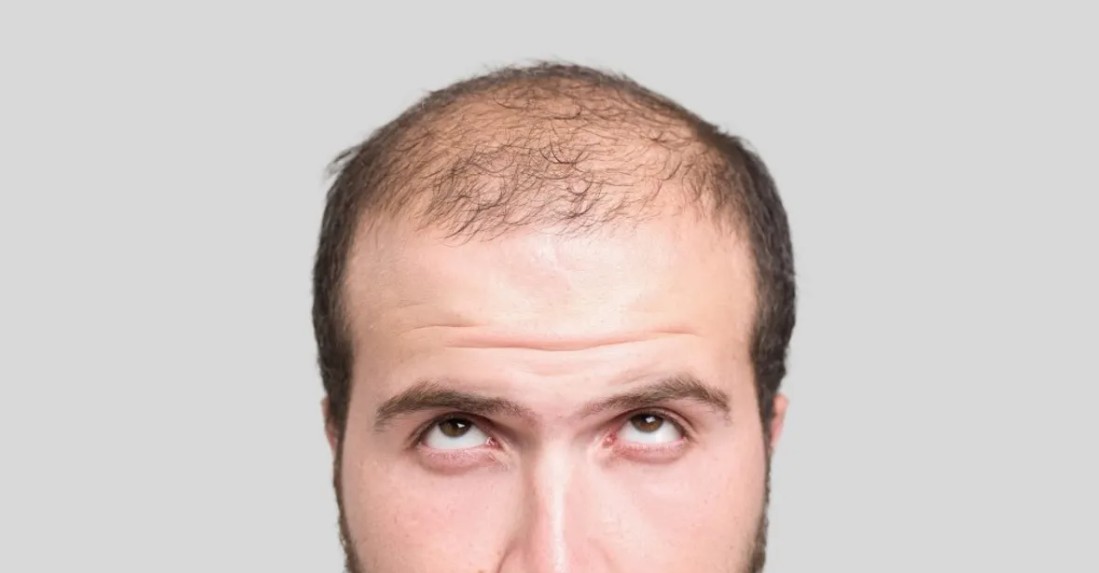
Male pattern hair loss, called androgenetic alopecia in medical language, is a progressive picture of hair loss caused by genetic predisposition and hormonal influence together. It is the most common cause of hair loss in men and constitutes the great majority of all hair loss. Its characteristic feature is that hair is lost not randomly but in a predictable pattern: first the temples recede, then the crown thins. The hair at the nape and above the ears is generally preserved; this is a critical detail in terms of treatment. The process progresses over years and does not stop by itself. At Zen Polyclinic this picture is assessed through the stage and the donor capacity.
Why Does Androgenetic Alopecia Occur?
At the basis of this picture lies a hormone called DHT (dihydrotestosterone). Testosterone is converted to DHT via the enzyme 5-alpha reductase. In genetically sensitive hair follicles, DHT causes the follicle to shrink, that is miniaturisation. With each hair cycle the strand becomes a little thinner, shorter and loses colour; eventually the follicle stops production completely. The important point is this: the problem is not a high DHT level but the follicle’s genetic sensitivity to DHT. This sensitivity can be inherited from both the mother’s and the father’s side. Because the follicles in the nape area do not carry this sensitivity, they are preserved for life and used as donors in hair transplantation.
What Is the Norwood Scale?
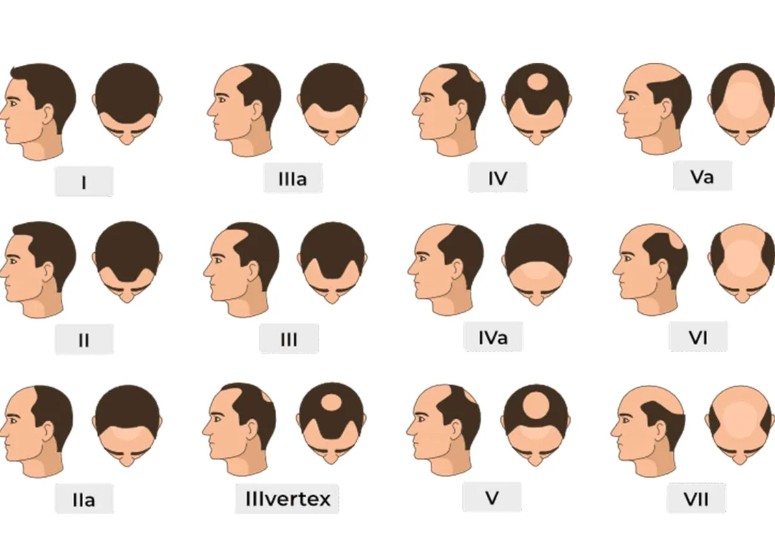
The Norwood scale (Hamilton-Norwood scale) is a standard, globally accepted measure that classifies male pattern hair loss into seven stages according to its severity and pattern. It was first defined by Hamilton in the 1950s and took its present form after being developed by Norwood in the 1970s. The scale defines the degree of recession of the hairline and the opening at the crown with visual diagrams. In this way the physician and the patient speak the same language; instead of vague expressions such as “it’s shedding a bit”, a clear definition such as “Norwood 3 vertex” is used. This standardisation is indispensable for treatment planning and for following progress.
Why Is the Norwood Scale Important?
The Norwood stage is not merely an academic label; it is the data at the centre of the treatment decision. While medical treatment and support treatments come to the fore in early stages, hair transplantation comes onto the agenda in advanced stages. The stage also determines how many grafts will be needed, whether the donor area is sufficient and what density can realistically be achieved. It also serves to follow change over time: photographs taken a year apart and a record of the stage objectively show whether the hair loss has stopped. For this reason, determining the stage at the first examination forms the basis of the whole process. Planning without knowing the stage is like setting off without knowing the direction.
What Is Norwood Stage 1?
Stage 1 is the stage in which the hairline is close to its childhood state and there is no marked recession or thinning. The forehead line is straight and full; there is no opening at the temples. This stage clinically expresses the absence of hair loss. However, this does not mean there will be no hair loss in the future; in people with a genetic predisposition the process may simply not have started yet. The most valuable thing to do at this stage is to know the family history and to protect hair health. In young men with a family history of early and advanced hair loss, being aware of the first signs of thinning preserves the chance of early intervention and can delay the process.
What Is Norwood Stage 2?
Stage 2 is the stage in which the hairline begins to recede slightly at the temples and inconspicuous triangular openings form at the corners of the forehead. This change is accepted in most men as part of natural maturation and is called a “mature hairline”. In other words, stage 2 is not always a sign of pathological hair loss; many men remain at this stage throughout their lives. The distinguishing point is the speed of progression: if the line continues to recede rapidly and the hair strands have begun to thin, the androgenetic process is active. Starting medical treatment at this stage is the most efficient period in terms of slowing progression.
What Is Norwood Stage 3?
Stage 3 is the first stage clinically accepted as the beginning of hair loss. The openings at the temples have deepened and become marked and symmetrical; the forehead line has clearly taken the form of the letter M. In these areas the hair has either been lost completely or has thinned greatly. Stage 3 is the point at which many men begin to worry seriously for the first time and start looking for treatment. At this stage the process is actively progressing and will not stop if there is no intervention. Medical treatment is still quite effective at this phase; preserving existing hair is far easier than bringing back what has been lost. Acting early is decisive.
What Is Norwood Stage 3 Vertex?
Stage 3 vertex is the sub-stage in which, alongside recession at the temples, a marked opening also begins at the crown (vertex). The person usually does not notice this themselves; they realise it when someone tells them or when they see it in photographs. Thinning at the crown begins with the hair simply looking thinner and sparser there, then becomes an open circle. This stage is important because there is now loss on two separate fronts: the front hairline and the crown. Treatment planning must take both areas into account. Medical treatment responds particularly well at the vertex area; at the front line the response is more limited.
What Is Norwood Stage 4?
At stage 4 the recession of the front hairline has markedly progressed and the opening at the crown has grown. Between these two areas there is still a relatively dense band of hair; this band separates the two open areas from each other and is the defining feature of stage 4. The loss has now become impossible to hide and it becomes difficult to cover with a hairstyle. At this stage medical treatment alone cannot bring back the former appearance; however, it is still necessary to preserve existing hair and slow progression. Hair transplantation becomes a strong option at this stage. The donor area is usually sufficient and a natural, satisfying result can be obtained with a well-planned transplant.
What Is Norwood Stage 5?
At stage 5 the band of hair between the front area and the crown has markedly thinned and narrowed; the two open areas have come closer together but have not yet fully merged. The lost area is wide and the remaining hair may also show signs of thinning. This stage is a threshold at which hair transplant planning must be done carefully; because while the area to be covered is large, the donor capacity is limited. It is usually not possible to cover the whole area with high density; therefore priority is given to the front hairline. Because the front line frames the face and is the area with the highest visual impact. Realistic expectation is critically important at this stage.
What Is Norwood Stage 6?
At stage 6 the band of hair between the front area and the crown has completely disappeared; the two open areas have merged to form a single, wide bald area. Hair remains only at the sides and the nape, in a horseshoe shape. At this stage the lost area is very wide and the donor capacity is most often insufficient to fully meet this area. Hair transplantation is still possible, but the goal is not to bring back the former density; it is to create a framing front hairline and markedly improve the appearance. It is sometimes planned in two sessions. At this stage the physician offering an honest and realistic framework is the most important determinant of satisfaction.
What Is Norwood Stage 7?
Stage 7 is the most advanced phase of the scale. Hair remains only above the ears and at the nape in a narrow strip; this strip may also have thinned. The whole upper area is open. At this stage, because the donor area is both narrow and limited, the result obtainable from hair transplantation is quite restricted. Covering the entire upper area is physically not possible. Even so, creating a limited front hairline can make a meaningful difference in appearance by restoring the frame of the face. Candidate selection must be done very carefully at this stage. Attempts made with unrealistic expectations both exhaust the donor and create disappointment.
What Is the Norwood A Variant?
Alongside the classic stages of the Norwood scale there is an “A” variant that follows a different pattern (Stage 2A, 3A, 4A, 5A). In this type hair loss progresses not from the crown but from the front hairline backwards, on a single front. In other words, an M shape does not form at the temples, the line recedes as a whole and a separate opening does not develop at the vertex. The A variant is seen less often but is important: this pattern usually results in a wider area of loss and the donor area may remain limited. In addition, transplant planning differs; the front line design and graft distribution diverge from the classic pattern. Making this distinction is necessary for correct planning.
Which Stage Is Expected at Which Age?
The age of onset and the speed of progression of androgenetic alopecia are largely genetic. In some men the process begins in the early twenties and progresses rapidly; this group is the most at risk because the likelihood of reaching very advanced stages during their lifetime is high. In others it begins in the forties and progresses slowly, stopping at stage 3. The general tendency is for the stage to rise as age advances; however, this is not linear or predictable. Early onset is considered a harbinger of an advanced stage. Therefore a stage 3 patient aged 25 requires far more careful planning than a stage 3 patient aged 55; because they have many years ahead in which to lose more.
How Do You Determine Your Stage?
The most reliable way to determine the stage is a medical assessment, but it is possible to get a basic idea. In a well-lit environment, with dry hair, photographs should be taken from the front, the side and especially from above; this is essential because the crown cannot be seen in a mirror. These photographs can be compared with the Norwood diagrams. However, this is only a rough estimate. At the medical examination the diameter of the hair strands is additionally measured with trichoscopy; the proportion of miniaturised strands shows how active the hair loss is. This is information that cannot be seen with the eye and it changes the treatment decision. A pull test and assessment of donor area density are also part of this examination.
What Are the Limitations of the Norwood Scale?
The Norwood scale is a valuable tool but it is not perfect. Its greatest limitation is that it defines only the pattern and area of loss; it does not take hair quality and donor capacity into account. Two different stage 4 patients obtain completely different results if their donor densities differ. The scale also does not assess the thickness of the strand, the hair-skin colour contrast or curliness; yet these factors markedly affect visual density. It may not fully cover intermediate stages (for example between 3 and 4). It also does not predict future progression. For this reason the stage is not a decision-making tool on its own; it is an important but not the only part of a comprehensive assessment.
Which Treatment Suits Which Stage?
The choice of treatment is shaped according to the stage:
- Stage 1-2: follow-up, preventive approach, early start of medical treatment if needed.
- Stage 2-3: medical treatment takes priority; mesotherapy and PRP are supportive.
- Stage 3 vertex-4: medical treatment + hair transplantation is evaluated.
- Stage 5-6: hair transplantation takes priority; front line focused planning, two sessions if needed.
- Stage 7: limited transplantation or alternative solutions; careful candidate selection.
This table is a general road map; the final decision is made after donor capacity and age are assessed. Our hair transplantation services are planned within this framework.
What Does Medical Treatment Provide in the Early Stage?
In the early stage the most important goal is not hair transplantation but preserving existing hair. Because bringing back lost hair is far harder than preserving what exists. Medical treatments slow miniaturisation by reducing the effect of DHT on the follicle or by increasing blood flow. Used regularly, they can slow hair loss and in some cases provide partial regain. However, their effects continue only while they are used; when stopped, the gain is lost. These treatments must be started with a medical assessment and after discussing the side effect profile. We cover in detail how hair loss can be slowed without a hair transplant in this article.
At Which Stage Do Hair Mesotherapy and PRP Work?
Hair mesotherapy and PRP are treatments that provide direct nutritional and growth factor support to the follicle. The area in which they are most efficient is the early to middle stages, where the follicles have not yet been completely lost and thinning and sparseness are dominant. They do not create new hair in a completely bald area; because there are no follicles left to work with. Hair mesotherapy is usually planned as a series of sessions and its effect is cumulative. PRP works with a similar logic and is applied by concentrating the growth factors in the person’s own blood. These methods are not a solution on their own but supportive parts of a holistic plan.
What Is the Place of Growth Factor and Support Treatments?
Growth factor treatments aim to support follicle activity by enriching the cellular environment around the hair roots. Growth factor treatment is used especially to support the cycle of follicles in the thinning phase. Similarly, hair support treatments can strengthen the result when planned together with medical treatment. These treatments are also valuable after a hair transplant; they support the process of the transplanted grafts taking hold and the preservation of the existing hair around them. However, expectations must be realistic here too: these methods slow progression and improve existing hair, they do not recreate a lost area.
At Which Stage Should a Hair Transplant Be Done?
The ideal range for hair transplantation is generally between stage 3 vertex and stage 6. In this range the loss is marked enough to make a transplant meaningful, while the donor capacity is sufficient to carry the result. Transplanting at a very early stage (stage 2-3) is generally not recommended; because as the hair loss continues, the existing hair behind the transplanted hair falls out and an artificial, inconsistent appearance emerges. This makes second and third transplants necessary and exhausts the donor early. The decision on a hair transplant should be made not only according to today’s appearance but according to where you will be in 10-20 years.
Why Is Donor Area Capacity Critical?
The most fundamental truth of hair transplantation is this: new hair is not created, existing hair is redistributed. Therefore the donor area is the real limit of all planning. Because the follicles at the nape and above the ears are not sensitive to DHT, they are permanent for life and are used as donors. However, this area is finite; in an average person the number of grafts that can be harvested is limited, and excessive harvesting leaves thinning and permanent scarring in the donor. That is why in advanced stages covering the whole area may not be mathematically possible. A good plan sees the donor as a budget and sets aside a share for future hair loss. A plan that does not do this spends the long term for short-term gain.
How Should Expectations Be Established in Advanced Stages?
At stages 5, 6 and 7 the most critical issue is expectation management. At these stages the lost area is wide while the donor is limited; therefore returning to the density of a 20-year-old is physically not possible. However, this does not mean a transplant is meaningless. A well-designed front hairline makes a marked difference in appearance and self-confidence by reframing the face; even if the crown is not fully covered. The strategy here is to invest the donor in the area that creates the highest visual impact. Approaches promising you “full density” should be treated with caution. At Zen Polyclinic these limits are shared openly; because an honest framework is the precondition of satisfaction.
DHI or FUE?
The Norwood stage can also affect the choice of technique. DHI hair transplantation is a technique in which grafts are placed directly with special pens and the channel-opening step is not separate; it provides an advantage in situations requiring densification, that is transplanting between existing hair, and in front line design. Diamond-Tip FUE, on the other hand, makes it possible to work efficiently over wider areas with a high number of grafts thanks to micro channels opened with diamond tips. In situations requiring a wide area such as stage 5-6, FUE generally comes to the fore. The choice of technique is made according to the person, the area and the graft need; both give excellent results in the right hands.
Does Hair Loss Continue After a Hair Transplant?
This is one of the most frequently overlooked and most important truths: a hair transplant does not treat androgenetic alopecia. Because the transplanted grafts are taken from the donor, they are resistant to DHT and permanent. However, your existing hair in the non-transplanted areas is genetically sensitive and continues to fall out. Therefore preserving existing hair with medical treatment after a transplant is essential for the long-term consistency of the result. Otherwise, after a few years the transplanted area stays while its surroundings open up and an artificial appearance emerges. A good hair transplant plan is considered successful not on the day of the transplant but in how it looks ten years later.
What Are the Common Misconceptions?
The most widespread misconception is the belief that hair loss is inherited only from the mother’s side; yet the predisposition can be inherited from both parents. The second is the idea that wearing a hat or washing frequently causes hair loss; neither is associated with androgenetic alopecia. The third is the belief that baldness is related to high testosterone; what is decisive is not the hormone level but the genetic sensitivity of the follicle. The fourth is the notion that shampoos and serums can reverse an advanced stage. Another is the thought “if I have a hair transplant I don’t need to do anything anymore”; existing hair continues to fall out. Finally, the belief that stress alone causes permanent baldness is also not correct.
When Should You See a Physician?
The right time is the moment you begin to worry; not waiting for it to progress. An assessment is recommended especially in these situations: the hairline receding visibly over the last year or two, noticing thinning at the crown, hair strands markedly thinning, or increased shedding on the pillow and in the shower. In young men with a family history of early and advanced hair loss, being assessed once even before there are findings is valuable. In addition, sudden, widespread and patternless hair loss does not fit androgenetic alopecia; thyroid problems, iron deficiency or another cause should be investigated. Early consultation widens the treatment options available to you.
How Are Realistic Expectations Established?
The strongest determinant of satisfaction in hair loss is a correctly established expectation. Androgenetic alopecia is a chronic and progressive process; it is not a condition to be “treated and finished” but a picture to be managed. What should be expected from medical treatment is to slow hair loss and preserve existing hair; not to return to the hair of one’s youth. What should be expected from a hair transplant is to gain a natural and balanced appearance to the extent the donor allows; not for the lost area to be completely filled. Results appear gradually over months. Promises such as “guaranteed”, “permanent solution” or “full density in a single session” should be treated with caution. Those who set realistic goals are far more satisfied.
How Is Hair Loss Assessed at Zen Polyclinic?
At Zen Polyclinic the process begins with a detailed examination and history. The Norwood stage is determined; the diameter of the hair strands and the rate of miniaturisation are measured with trichoscopy. The density and capacity of the donor area are calculated; a prediction of future progression is made based on age and family history. If necessary, other causes such as thyroid problems and iron deficiency are excluded. As a result of this holistic assessment a personalised plan is established: medical treatment, support treatments and, if needed, hair transplantation are planned in the correct order. The option unsuitable for you is clearly stated. The same standard applies at our Istanbul Ataşehir clinics. For an appointment you can reach us through our appointment page.
Conclusion
The stages of male hair loss are defined in a standard language thanks to the Norwood scale and form the basis of the treatment decision. Stage 1-2 is follow-up and protection; stage 3 is the most efficient period for medical treatment; stage 3 vertex-6 is the range in which hair transplantation comes onto the agenda; and stage 7 is the advanced phase with limited options. However, the stage alone is not sufficient; donor capacity, age, speed of progression and hair quality determine the decision together. A hair transplant does not treat androgenetic alopecia; therefore preserving existing hair is essential for long-term consistency. Early assessment widens the options; realistic expectation determines satisfaction.
Frequently Asked Questions (FAQ)
What is the Norwood scale?
The Norwood scale (Hamilton-Norwood scale) is a standard, globally accepted measure that classifies male pattern hair loss into seven stages according to its severity and pattern. It defines the degree of recession of the hairline and the opening at the crown with visual diagrams. In this way the physician and the patient speak the same language; treatment planning and objective follow-up of progress become possible.
In how many stages is male hair loss examined?
It is examined in seven stages according to the Norwood scale. At stage 1 there is no hair loss. Stage 2 is the mature hairline. Stage 3 is the first stage at which clinical hair loss begins. At stage 3 vertex the crown also opens. At stages 4-5 the areas grow and the band between them thins. At stage 6 the band disappears. Stage 7 is the most advanced phase. There is also an A variant following a different pattern.
At which Norwood stage is a hair transplant done?
The ideal range is generally between stage 3 vertex and stage 6. In this range the loss is marked enough to make a transplant meaningful, while the donor capacity is sufficient to carry the result. Transplanting at a very early stage (2-3) is not recommended; because hair loss continues, an artificial appearance emerges and the donor is exhausted early. At stage 7 the result is quite limited and candidate selection must be careful.
Does hair loss continue after a hair transplant?
Because the transplanted grafts are taken from the donor area, they are resistant to DHT and permanent. However, a hair transplant does not treat androgenetic alopecia; your existing hair in the non-transplanted areas is genetically sensitive and continues to fall out. Therefore preserving existing hair with medical treatment after the transplant is essential for the long-term consistency of the result.
Why does male pattern hair loss occur?
At its basis lie the hormone DHT (dihydrotestosterone) and genetic predisposition. Testosterone is converted to DHT via the enzyme 5-alpha reductase and causes miniaturisation, that is shrinking, in genetically sensitive follicles. What is decisive is not a high DHT level but the follicle’s sensitivity to DHT. This sensitivity can be inherited from both the mother’s and the father’s side.
Can I determine my Norwood stage myself?
You can get a rough idea. In a well-lit environment, with dry hair, you can take photographs from the front, the side and especially from above and compare them with the Norwood diagrams; this is essential because the crown cannot be seen in a mirror. However, this is only an estimate. At a medical examination the strand diameter and rate of miniaturisation are measured with trichoscopy; this information, invisible to the eye, changes the treatment decision.
Can hair loss be stopped in the early stage?
It cannot be stopped completely but it can be markedly slowed. In the early stage the goal is not to bring back what is lost but to preserve existing hair; this is much easier. Medical treatments slow miniaturisation by reducing the effect of DHT on the follicle. Mesotherapy, PRP and growth factor play a supportive role. However, the effects continue only while they are used; when stopped, the gain is lost.
When should I see a physician?
The moment you begin to worry; without waiting for it to progress. An assessment is recommended especially if the hairline has receded visibly over the last year or two, if there is thinning at the crown, if strands have markedly thinned or if shedding has increased. Sudden, widespread and patternless hair loss does not fit androgenetic alopecia; causes such as thyroid problems or iron deficiency should be investigated. Early consultation widens the treatment options.