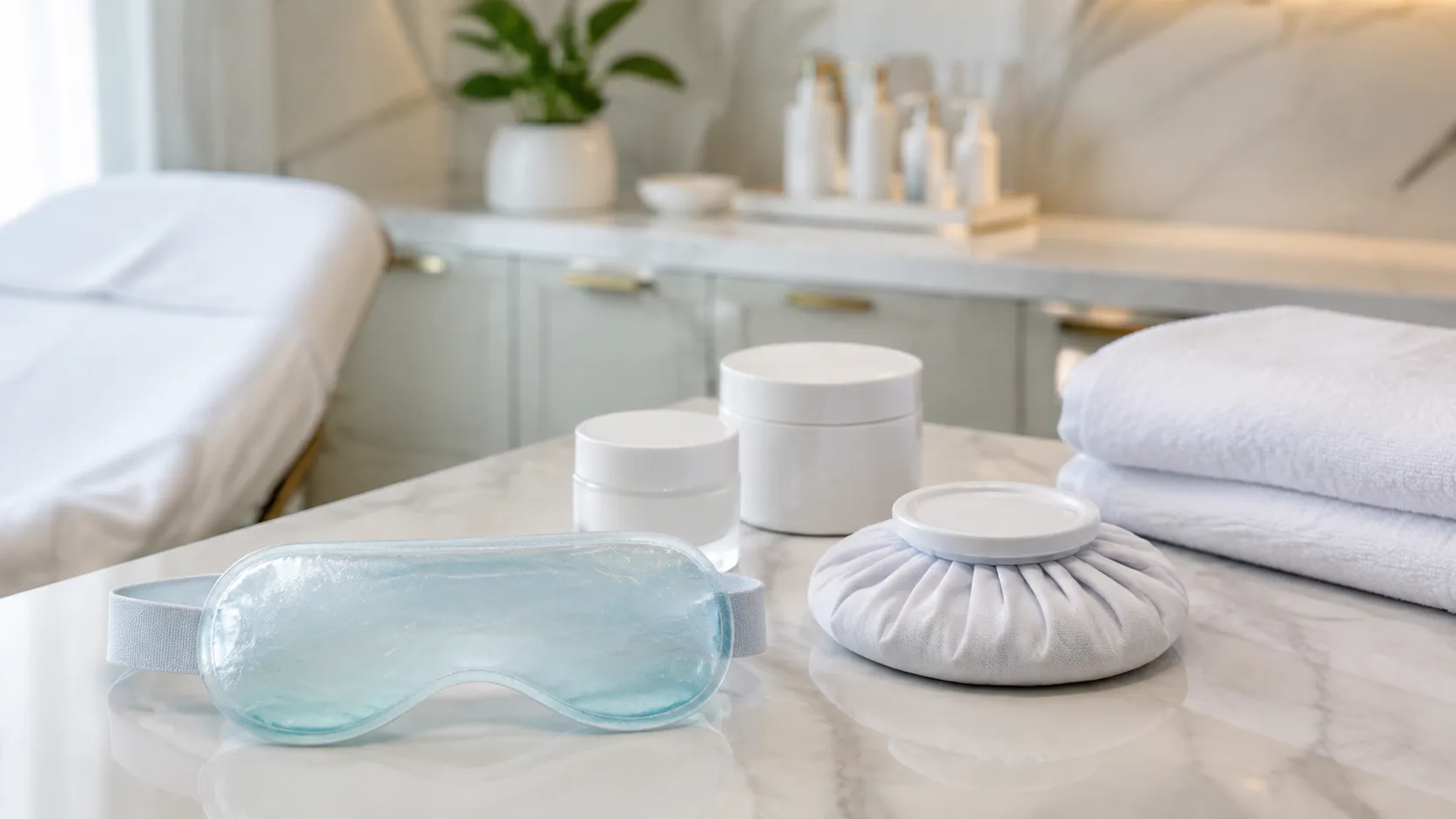
When Does Swelling Settle After Under-Eye Light Filler?
swelling after under-eye light filler becomes noticeably milder within a few days for most people, but because of the delicate structure of the under-eye area, the exact timeline varies from person to person. It is important to tell apart expected healing from swelling that needs to be assessed. This article is for general information; your own course is assessed at examination.
Why does the under-eye area behave differently from other areas?
The skin under the eyes is one of the thinnest areas of skin on the body, with very little fat tissue beneath it; this means even small amounts of fluid build-up become visible to the eye. The lymphatic drainage in this area also works more slowly than in other parts of the face, meaning it can take longer for accumulated fluid to be cleared. The loose connective tissue beneath the skin also sets the stage for swelling to spread downward under gravity and gather along the edge of the lower eyelid.
When these three features come together, an amount of oedema that would go unnoticed on the cheek or the jaw can remain visible under the eyes for several days. This does not mean the treatment has failed; it is an anatomical feature of the area.
How visible these three features become also varies from person to person; factors such as skin thickness, pre-existing under-eye bags, or a chronic tendency toward allergies can make the same amount of oedema barely noticeable in one person and clearly visible in another. This variability is one of the reasons personal history is asked about at examination.
Muscle movement in the under-eye area also contributes to this different behaviour; blinking is repeated thousands of times a day, and this constant movement affects fluid circulation in the area differently than in more static parts of the face. In some people this movement has a healing effect that speeds things up, while in others it can cause a slight extra sensitivity in the first days.
The thinning of the fat and muscle support tissue under the skin with age can also increase this area’s sensitivity to swelling; in younger skin, the tighter tissue structure helps fluid disperse more quickly, while in skin with reduced support tissue, oedema can remain visible for longer. This difference is one of the factors that explains why the same treatment can follow a different course in different age groups.
What is the typical course of swelling?
Within the first 24 to 72 hours, swelling often increases; this is the tissue’s natural response to the injection and the product used. It then gradually decreases, and for most people it has noticeably subsided within 5 to 7 days. Reaching the final, settled appearance may require a window of 2 to 4 weeks; this depends on the product used and the person’s tissue response.
Drawing a permanent conclusion from the fullness or asymmetric appearance seen in the first days can be misleading. Taking photos in the same light and at the same time of day makes it easier to track the change.
A difference between the swelling seen in the morning and in the evening is also a normal part of this process; the hours spent lying down overnight can increase morning swelling, while time spent upright and moving during the day can lead to some reduction by evening. This daily fluctuation does not mean healing has stopped or reversed.
Feeling a mild tightness or fullness in the area during the first week after treatment is also a common experience; this sensation usually eases as the swelling subsides and should not be confused with pain. If this sensation intensifies or turns into clear pain, it may be a sign that the course is moving outside what is expected.
This course can be summarised as follows:
- 0-72 hours: swelling may increase as a natural response.
- 5-7 days: most people see a clear reduction.
- 2-4 weeks: the final, settled appearance is reached.
How can swelling be told apart from bruising?
Swelling is tissue gaining volume as it fills with fluid, and it usually does not cause a marked change in skin colour. Bruising, on the other hand, is a colour change that progresses through purple, green and yellow tones, caused by small vessels being affected during injection. The two can be seen at the same time but follow different timelines; bruising typically changes colour and fades within 7 to 10 days, while swelling can subside earlier.
Reporting the use of any medication or supplement that increases bleeding before treatment can help reduce the risk of bruising.
Another factor that affects how long bruising lasts is the injection technique used, needle or cannula; treatments done with a cannula are sometimes considered to carry a lower risk of vessel injury, though this is not a guarantee in every case. The skin thickness in the area can also affect how visible a bruise becomes.
The colour of a bruise changes progressively over time; the dark purple-blue tone of the first days turns greenish within a few days, then yellowish, before disappearing completely. This colour-change process is a sign that the bruise is healing as expected; a sudden darkening in colour or hardening of the area, however, is a finding that should be assessed separately.
In some people, a bruise can feel larger than it looks; this is because the visible edges of the colour change can appear somewhat wider than the actual area of bleeding underneath. This usually does not extend how long the bruise takes to resolve on its own; it simply creates a more noticeable first impression.
How do salt and water intake affect swelling?
Salt intake
High salt intake can increase general fluid retention in the body, and this can make oedema under the eyes more noticeable as well. Being mindful of salt intake for a few days after treatment is therefore commonly recommended, especially given that processed and ready-made foods can carry hidden amounts of salt.
Water and caffeine intake
Adequate water intake can also indirectly affect how swelling progresses; when the body does not get enough fluid, it can tend to retain water, which can paradoxically increase oedema. Drinking water at regular intervals throughout the day, without overdoing it, is a simple habit that supports general circulation and tissue healing.
The effect of caffeinated drinks on swelling can vary from person to person; in some people, a mild diuretic effect can create a temporary feeling of relief, while excessive consumption can disrupt overall fluid balance and indirectly affect oedema. Continuing your usual amounts without overdoing it in the first days after treatment is a reasonable approach for most people.
Why are sleep habits and keeping the head elevated recommended?
Fluid tends to pool in the facial area while lying down overnight; raising the head slightly with one or two pillows can help reduce morning swelling in some people. Adequate, regular sleep also supports the general healing process.
For people who habitually sleep face-down, pressing the face into the pillow can increase local pressure, so it can be worth temporarily trying to get used to sleeping on your back in the first days. It is normal for this change to feel uncomfortable on the first few nights, and it can be adjusted to over time.
Alcohol consumption and long periods spent in front of a screen can also indirectly affect fluid retention around the eyes; staying moderate in the first days, alongside these other measures, makes it easier to track the swelling accurately.
Why does the tear trough area need different attention?
Anatomical features of the tear trough area
The under-eye hollow, also known in medical language as the tear trough, sits at the transition point between the eyelid and the cheek, where the relationship between bone structure, muscle and skin is more complex than in other parts of the face. Filler applied in this area aims both to fill the hollow and to keep the thin skin above it looking smooth; the balance between these two goals is an important factor that determines the amount and technique used in treatment.
Amount applied and bone support
Applying too much product in the tear trough area can create a puffiness or shadowing that is more noticeably visible here than in other areas, because of the thin structure of this region. For this reason, a gradual approach using a smaller amount of product is generally preferred here, with a small additional treatment considered a few weeks later if needed.
The fact that bone support in this area differs from person to person is also a factor that affects the result; in people with a pronounced cheekbone and eye socket bone structure, filler tends to settle more predictably, while for people with less pronounced bone support, the clinician may adjust the treatment plan accordingly. For this reason, the amount and technique recommended for the tear trough area is not a standard prescription but a plan determined individually at examination.
Why can delayed swelling appear weeks later?
Causes of delayed swelling
Some products, particularly hyaluronic-acid based fillers that tend to hold water, can cause a localised increase in swelling days or even weeks after treatment; this is sometimes called delayed swelling. This is generally linked to the product’s water-attracting property, the amount of salt or fluid taken in that day, or a mild allergic-type reaction.
When assessment is needed
Delayed swelling that is painless and symmetrical is usually just monitored; swelling that starts suddenly, is one-sided and pronounced calls for assessment.
It is also important to tell delayed swelling apart from infection: if only swelling is present and the area is painless without increased warmth, monitoring is usually enough. In contrast, if marked redness, an increasing feeling of warmth and worsening pain are seen together, this should be assessed separately.
A recent upper respiratory infection, a feverish illness or a seasonal allergy flare-up can also trigger a temporary increase in swelling weeks later in some people; this connection may not always be obvious, so it is helpful to mention any recent health issues at your follow-up appointment.
In most people who experience delayed swelling, it subsides on its own within a few days; however, in cases of recurrent or prolonged delayed swelling, the clinician may choose to review all products and dates used up to that point to look for a possible cause. This kind of review is also useful information for future treatments.
What is the Tyndall effect, and when does it come up?
How the Tyndall effect occurs
The Tyndall effect occurs when certain hyaluronic-acid based filler products, placed too close to the skin’s surface or too superficially, reflect light differently at a certain angle, creating a bluish-grey colour appearance in the area. In areas where the skin is thin, such as under the eyes, this appearance is more noticeable than in other areas.
This is generally related to the depth of the product and can lessen on its own over time, but in cases that appear pronounced and persistent, the clinician may recommend a targeted solution. The difference between the Tyndall effect and swelling or bruising is that the colour change has a bluish-grey tone and generally varies depending on the light.
How to tell it apart from a bruise
When this appearance is noticed, the safest approach is to consult the clinic that performed the treatment rather than looking for a solution on your own; in some cases, a specific method can be applied to reduce this appearance.
Telling the Tyndall effect apart from a simple bruise is not always easy on your own; both cause a colour change in the area. As a general clue, a bruise changes colour over time and disappears completely within a few weeks, while the Tyndall effect tends to stay as a more constant bluish-grey tone; examination is needed for a definite distinction.
Is asymmetry normal, and when does it need assessment?
Differences considered normal
A slight difference between the two under-eye areas in the first days after treatment is commonly seen; this is generally because swelling does not subside at the same rate on both sides, and it usually balances out on its own over time. It should also be kept in mind that the body is not naturally perfectly symmetrical, and small differences between the under-eye areas can exist even before treatment.
Asymmetry that needs assessment
In contrast, an asymmetry that lasts longer than two weeks, becomes increasingly pronounced or appears suddenly calls for clinical assessment. Comparing with earlier photos is a more reliable way to make this distinction than relying on a subjective impression.
The level of asymmetry present before treatment should also be part of this assessment; many people’s natural facial structure has small differences between the two sides, and filler aims to balance this difference rather than eliminate it completely. For this reason, before-treatment photos are an important reference point for distinguishing whether a difference seen afterward is new or a continuation of a pre-existing feature.
How should a cold compress be applied correctly to the under-eye area?
A brief, indirect cold application, for example ice wrapped in a cloth, can bring relief in the first 24 to 48 hours. No pressure should be applied directly to the eyeball, and ice should never touch the skin directly; this can be both uncomfortable and irritating to delicate tissue.
The duration and frequency of the compress should follow the instructions given by your practitioner; there is no single protocol that suits everyone.
Some clinics recommend short applications every few hours on the first day, then reducing the frequency from the second day onward. This detail, too, varies with the person and the product used.
Instead of a cold compress, some people prefer to use frozen gel packs; if this kind of product is used, wrapping it in a thin cloth or towel before it touches the skin matters both for delivering the cold in a controlled way and for preventing a possible cold burn. Some temporary redness in the area after a compress is normal and usually fades within a few minutes.
When can you go back to makeup and sun exposure?
Makeup
Applying makeup over small needle marks at the injection site while they are not yet healed can increase the risk of irritation or infection at the mark; for this reason, postponing makeup directly on this area for the first twenty-four to forty-eight hours is recommended. Applying light makeup to other parts of the eye area is generally fine sooner.
Sun protection
Long sun exposure is a factor that can both increase swelling through a heat effect and make colour change in a bruised area more noticeable. Wearing sunglasses and avoiding direct sun in the first days is a beneficial choice for both comfort and healing; when sunscreen use can begin should be asked of your practitioner.
When choosing sunglasses, making sure the frame does not press on the under-eye area can reduce sensitivity in the first days. On days spent for a long time by the sea or a pool, avoiding both sun and direct contact with chlorinated or salt water is a simple way to support the healing process.
Which findings are expected healing, and which need assessment?
Mild, symmetrical swelling that is gradually decreasing is generally part of the expected healing process. In contrast, marked asymmetry lasting more than two weeks, a bluish-grey discolouration under the skin, sometimes called the Tyndall effect, or increasing pain or firmness are findings that call for clinical assessment.
These kinds of findings should not be waited on with the assumption they will resolve on their own; they should be reported to the clinic, since earlier assessment can make any necessary correction simpler.
In summary, the following points can help distinguish expected healing from a situation that needs assessment:
- Expected: mild, symmetrical swelling that decreases day by day.
- Needs assessment: marked asymmetry lasting more than two weeks.
- Needs assessment: a bluish-grey discolouration under the skin, or increasing pain.
What are the most common misconceptions?
The idea that “the more swelling there is, the better the result will be” is not correct; early swelling has more to do with the tissue’s natural response to injection than with the amount of product, and it is not directly proportional to the final appearance. Similarly, the idea that “if the swelling doesn’t fully go away in a week, the treatment has failed” is also misleading; a 2-4 week window for the final result to settle is normal.
The idea that “bruising under the eyes always means the filler was done wrong” is also incomplete; because of the fine vessel structure in this area, bruising is a known side effect that can occur with a certain likelihood even when the technique was applied correctly. Knowing this can help you follow the expected healing process rather than panicking when you see a bruise.
The idea that “under-eye filler gives the same result at every age” is also incomplete; because skin quality, bone structure and existing tissue volume change with age, the same amount of product can create a different appearance in different people. For this reason, expectations about how the result will look should be based on your own examination findings rather than general examples.
Why is any complaint related to vision treated as an emergency?
Blurred vision, sudden vision loss, double vision or pain that worsens with eye movement are extremely rare after under-eye filler treatments, but they are findings that require urgent assessment. These symptoms can signal a vascular complication, and time can be critical.
If such a complaint is noticed, it should not be waited on; contact your clinic directly, or the nearest emergency department if needed.
Although these kinds of urgent symptoms are extremely rare, the fact that the under-eye area contains a dense network of blood vessels is one of the main reasons why treatment by an experienced practitioner, using a technique appropriate to the anatomy, helps reduce this risk. Discussing this topic openly with your clinic before treatment gives you confidence both in preparation and in knowing what to do in an emergency.
What is assessed at the follow-up appointment?
A follow-up appointment is usually planned a few weeks after treatment; by this time, the swelling is expected to have settled and the final appearance to have emerged. At this appointment, the clinician assesses fullness, symmetry, skin colour and any ongoing complaints together.
Comparing with earlier photos helps show the real change over time rather than relying on a subjective impression. This appointment is also when any need for an additional correction, and its timing if needed, can be discussed.
Making a note of, or photographing, any change you notice during healing before your follow-up appointment makes the clinician’s assessment easier. In particular, the difference between the day swelling is at its most and the day it has subsided the most gives your clinician valuable information about how the process is progressing.
If a further session is being planned, seeing how the previous treatment has settled usually requires waiting at least a few weeks; not leaving enough time between consecutive treatments can make it harder to assess both the oedema and the natural appearance. For this reason, it is recommended not to rush and to let the process follow its own timeline.
A safe assessment for swelling after under-eye light filler is possible when the course of the swelling, any accompanying findings and personal medical history are discussed together. What is described here is a general framework and does not replace a personal diagnosis or a guaranteed timeline for any individual. Do not hesitate to contact your clinic if you notice any change that concerns you.
learn more about under-eye restoration treatment. request an appointment for a personal assessment.
Frequently Asked Questions (FAQ)
How long does swelling last after under-eye light filler?
In the first 24-72 hours, swelling may increase as a natural response, since this is how the tissue reacts to the injection. It then gradually decreases, and for most people it has noticeably subsided within 5-7 days. Reaching the final, settled appearance may take a further window of 2-4 weeks, depending on the product used and the person’s tissue response. Drawing a permanent conclusion from the fullness seen in the first days can be misleading; taking photos in the same light and at the same time of day makes it easier to track the change.
Why does my under-eye area look more swollen in the morning?
The hours spent lying down overnight increase the tendency for fluid to pool in the facial area, which can make morning swelling more noticeable. Raising the head slightly with one or two pillows can help reduce this effect in some people. This effect can be more noticeable in people who habitually sleep face-down, since pressure from the pillow against the area can increase fluid build-up. Time spent upright and moving during the day contributes to some reduction of this swelling by evening.
Can I apply ice to my under-eye area?
A brief, indirect cold application, such as ice wrapped in a cloth, can bring relief in the first 24-48 hours. No pressure should be applied directly to the eyeball, and ice should never touch the skin directly, since this can be both uncomfortable and irritating to delicate tissue. The duration and frequency of the compress should follow the instructions given by your practitioner, since there is no single protocol that suits everyone. If frozen gel packs are preferred, they should also be wrapped in a thin cloth before use.
Are swelling and bruising the same thing?
No, swelling is tissue gaining volume as it fills with fluid and usually does not cause a marked change in skin colour. Bruising, on the other hand, is a colour change that progresses through purple, green and yellow tones, caused by small vessels being affected during injection. The two can appear at the same time but follow different timelines; bruising typically fades within 7-10 days, while swelling can subside earlier. Reporting the use of any medication or supplement that increases bleeding before treatment can help reduce the risk of bruising.
Why did swelling appear weeks after my treatment?
Some products, particularly hyaluronic-acid based fillers that tend to hold water, can cause a localised increase in swelling days or even weeks after treatment; this is sometimes called delayed swelling. This is generally linked to the product’s water-attracting property, the amount of salt or fluid taken in that day, or a mild allergic-type reaction. A recent upper respiratory infection or seasonal allergy flare-up can also trigger this pattern in some people. If it is painless and symmetrical it is usually just monitored, but swelling that starts suddenly and is one-sided calls for assessment.
In which situation should I go to the clinic immediately?
Blurred vision, sudden vision loss, double vision or pain that worsens with eye movement are extremely rare after under-eye filler treatments, but they are findings that require urgent assessment. These symptoms can signal a vascular complication, and time can be critical. Marked asymmetry lasting more than two weeks, a bluish-grey discolouration under the skin, or increasing pain are also situations that call for clinical assessment. Such findings should not be waited on with the assumption they will resolve on their own; contact your clinic directly, or the emergency department if needed.
Does eating salty food increase swelling?
Yes, high salt intake can increase general fluid retention in the body, and this can make oedema under the eyes more noticeable as well. Being mindful of salt intake for a few days after treatment is recommended, especially given the hidden amount of salt in processed and ready-made foods. Adequate water intake can also indirectly affect how swelling progresses; when the body does not get enough fluid, it can tend to retain water, paradoxically increasing oedema. Alcohol consumption and long periods spent in front of a screen can create a similar effect, so staying moderate in the first days is recommended.
When should the follow-up appointment be scheduled?
A follow-up appointment is generally recommended a few weeks after treatment, since this is when the swelling is expected to have settled and the real result to have emerged. At this appointment, the clinician assesses fullness, symmetry, skin colour and any ongoing complaints together. Comparing with earlier photos helps show the real change over time rather than relying on a subjective impression. This appointment is also when any need for an additional correction, and its timing if needed, can be discussed.