
Laser Hair Removal
A light-based method that targets the pigment in the hair follicle to reduce hair growth over a planned course of sessions. At Zen Polyclinic it is carried out with two different laser platforms, matched to your skin and hair type.

What is laser hair removal and how does it work?
Laser hair removal uses a beam of light at a specific wavelength that is absorbed by melanin, the pigment that gives hair its colour. The light travels down the hair shaft to the root, where the absorbed energy turns into heat and damages the follicle’s ability to produce new hair. The surrounding skin is left comparatively unaffected, and modern devices cool the skin surface throughout to protect it further.
This selective effect is also why the method works in courses rather than in a single visit. Hair grows in three phases — anagen (active growth), catagen (transition) and telogen (resting). Only follicles in the anagen phase hold enough pigment at the root to absorb the light effectively. Because the hairs in any given area are never all in the same phase at the same time, sessions are spaced several weeks apart so that each visit catches a new group of follicles in their active phase.
Hair colour and skin tone both influence how the settings are chosen. Dark, coarse hair contains the most melanin and therefore responds most predictably. Very light, grey or white hair holds little pigment and does not respond in the same way. Skin tone matters as well: darker or recently tanned skin absorbs more of the light at the surface, so wavelength, pulse duration and energy have to be adjusted accordingly.
Which devices are used at Zen Polyclinic?
No single laser suits every skin and hair combination, so two platforms are kept in use and the choice is made during the assessment.
 Soprano Ice PlatinumThree wavelengths in one handpiece, applied in continuous motion with contact cooling — a gradual heating technique that suits large areas and a wide range of skin types.How it works →
 Duetto MT EvoAlexandrite 755 nm and Nd:YAG 1064 nm in one system, used separately or in sequence so the setting can be matched to skin tone and hair depth.See the wavelengths →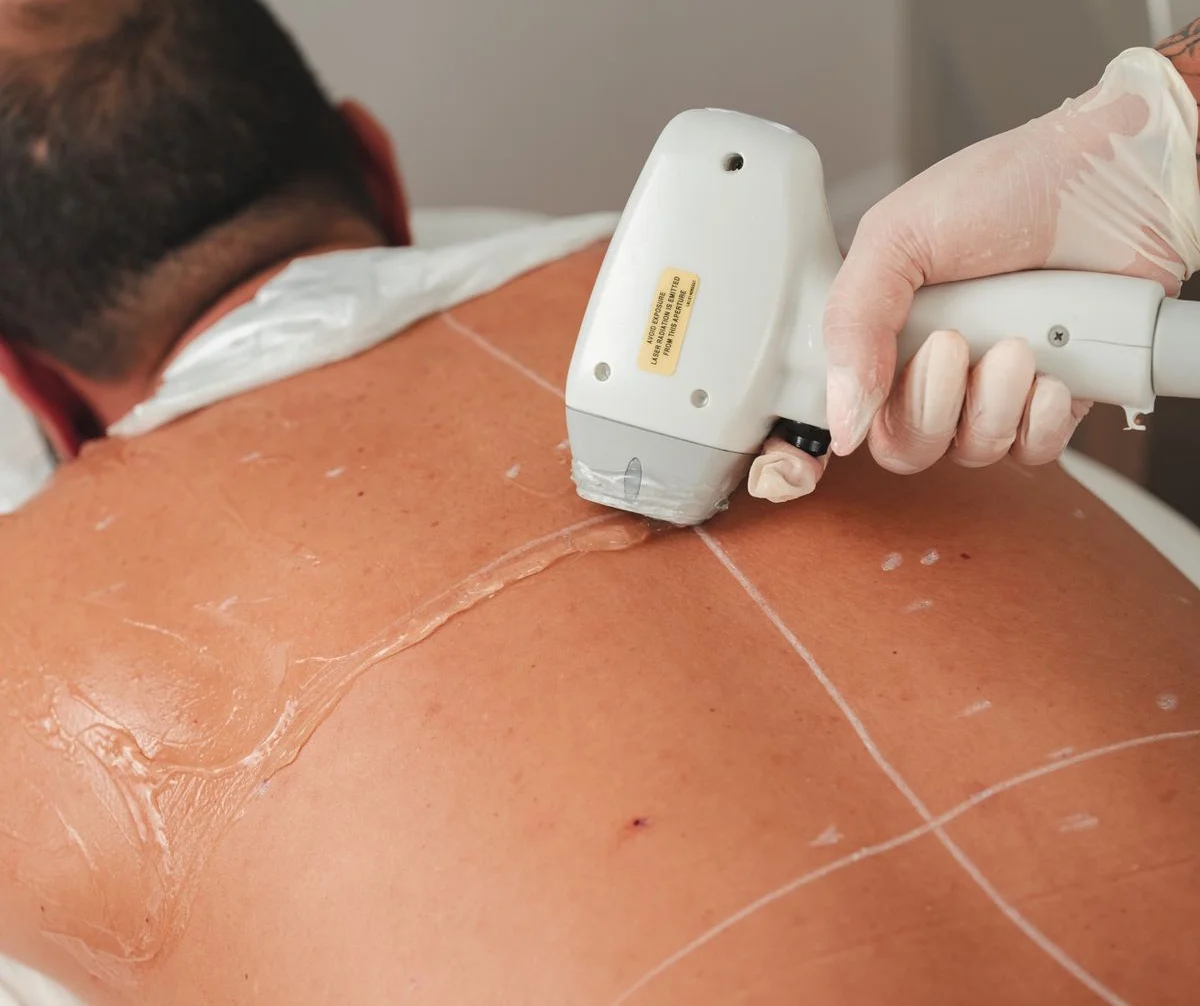
Which areas can be treated?
Almost any area where unwanted hair grows can be treated, for both women and men. The most frequently requested regions are:
- Face — upper lip, chin, jawline, cheeks and the area between the eyebrows
- Neck and nape
- Underarms, full or half arms, hands and fingers
- Chest, abdomen, midline and back — commonly requested by men
- Bikini line and intimate area
- Full or half legs, feet and toes
The area around the eyes is not treated. For any region close to the eyes, protective eyewear is worn throughout the session by both the patient and the practitioner.
How does a session proceed?
Assessment. Skin type, hair colour and thickness, the treatment area, any medication being used and previous hair removal habits are reviewed. The device, wavelength and energy settings are decided at this stage, and a test spot may be applied first.
Preparation. The area is shaved shortly before the session so that the energy travels to the root rather than burning surface hair. Waxing, epilating or plucking must be stopped several weeks beforehand, since these remove the root the laser needs to reach. The skin is cleansed of creams, deodorant and sun protection.
Application. A cooling gel may be used depending on the device. Most people describe the feeling as a warm snap or a rubber-band flick; the cooling systems on both platforms make it considerably easier to tolerate. An underarm takes only a few minutes, while full legs may take closer to an hour.
Afterwards. Mild redness and slight swelling around the follicle openings are normal and usually settle within a few hours. A soothing product and sun protection are applied, and you can return to daily activities immediately. Hot showers, saunas, pools, the gym and direct sun are avoided for a couple of days.
Who is it not suitable for?
Laser hair removal is a well-established procedure, but it is not appropriate for everyone:
- People under 18, unless assessed and referred by a physician
- Pregnant and breastfeeding women
- White, grey or very light blond hair, which lacks the pigment the laser targets
- Freshly tanned or sunburnt skin, including recent solarium or self-tanning use
- Active skin infection, open wounds, eczema or psoriasis in the treatment area
- Isotretinoin use for acne within the previous six months
- Photosensitising medication, including certain antibiotics and herbal preparations
- Epilepsy, uncontrolled diabetes or a history of keloid scarring — these require clearance from the treating physician first
Tell us about any medication you take, recent sun exposure, tattoos or permanent make-up in the area and any previous laser sessions before treatment begins. This information directly affects the settings that are chosen.
When do results become visible?
Treated hairs are not removed instantly. Over the one to three weeks following a session, the damaged hairs work their way out of the skin — a shedding process that can look like regrowth but is not. After the first two or three sessions, most people notice that regrowth comes back finer, slower and patchier.
A course typically runs to six to eight sessions, spaced roughly four to six weeks apart on the face and six to eight weeks apart on the body, because growth cycles differ from region to region. The exact number varies with hormonal factors, hair thickness and the area treated: coarse hair on the underarms or bikini line often responds sooner than fine facial hair. Occasional maintenance sessions may be recommended once the main course is complete.
Combining with other treatments
Laser hair removal is often planned alongside other applications, with appropriate intervals between them. Sessions are usually kept apart from chemical peels, dermapen and other resurfacing procedures in the same area so that the skin is not treated twice while it is still recovering. Where the concern involves ingrown hairs and the marks they leave behind, a skin care plan may be added between laser sessions. Our other light-based applications are listed under laser treatments.
Planning Sessions Around a Trip to Istanbul
Because a full course spans months, most international patients cannot complete it in a single visit — and that’s expected. Two approaches are common: patients living in Istanbul or visiting frequently space sessions across regular return trips; patients on a single longer stay (several weeks) may be able to fit two sessions into one visit, with the remainder of the course completed on a follow-up trip or transitioned to a clinic closer to home with guidance on the protocol used. Sun exposure, not season, is the main scheduling factor — tanned skin postpones a session, and sun protection is required afterward, which is worth factoring into a trip built around beach time or outdoor travel.
Frequently asked questions
Is laser hair removal painful?
How many sessions will I need?
Can I be treated in summer?
Should I shave before my appointment?
Does it work on blond or white hair?
Is it safe on darker skin tones?
What about tattoos or permanent make-up?
Can I complete a full course in one trip to Istanbul?
Usually not in a single short visit, since a full course spans months. Most international patients space sessions across return trips or complete an initial one to two sessions and continue elsewhere with guidance on the protocol used.